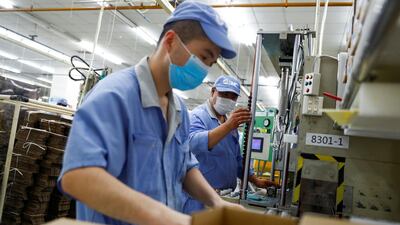
The world's second largest economy continued to recover from the impact of the coronavirus as Chinese factories expanded at the fastest pace in nearly a decade in July, on the back of higher domestic demand.
The Caixin/Markit Manufacturing Purchasing Managers' Index(PMI), a composite indicator designed to provide a single-figure snapshot of operating conditions in the manufacturing economy rose to 52.8 last month from June's 51.2, marking the sector's third consecutive month of growth and the biggest jump since January 2011.
A reading above 50 indicates expansion, while one below, points to a contraction.
"Overall, flare-ups of the epidemic in some regions did not hurt the improving trend of the manufacturing economy, which continued to recover as more epidemic control measures were lifted,” Dr. Wang Zhe, senior economist at Caixin Insight Group said.
“The supply and demand sides both improved, with relevant indicators maintaining strong momentum. However, we still need to pay attention to the weakness in both employment and overseas demand.”
China was the first country to report coronavirus cases in December last year. However, strict lockdown measures introduced by Beijing helped limit the spread of the disease inside the country. As of Monday, the number of infections in China reached 84,428 with 4,634 deaths, according to Worldometer. Total recoveries stand at 79,013. There are more than 18 million infections globally and over 693,000 deaths.
“Output expanded for the fifth month in a row, and at the fastest rate for nine-and-a-half years, with many companies citing greater client demand amid a further recovery in market conditions following the Covid-19 outbreak”, the Caixin report said.
The recovery however appear uneven as hiring remained weak with the subindex for employment staying in negative territory for the seventh consecutive month. The survey, which is based on the responses of purchasing managers in a panel of around 500 private and state-owned manufacturers, found that some companies increased recruitment to meet production needs, while others remained cautious and laid off workers to reduce costs.
New export orders also remained in contraction territory for the seventh consecutive month, as coronavirus continues to spread across the globe with countries reporting second waves of the pandemic, according to the report.
The world economy is set to slide into its deepest recession since the Great Depression, with the International Monetary Fund projecting a 4.9 per cent contraction this year and a sluggish recovery in 2021.
Growth in China will decelerate to 1 per cent, compared to a previous 1.2 per cent growth estimate, after expanding 6.1 per cent in 2019, its slowest pace in about three decades, according to the fund.
“Traders are somewhat optimistic about the economic recovery in China. The Chinese July manufacturing activity printed a better number than the forecast,” Naeem Aslam, chief market analyst at Ava Trade said.
Beijing has rolled out a number of measures to boost growth, including cuts in key lending rates as well as allowing local governments to sell far more bonds to fund infrastructure projects.
China's rebound was also complemented with a revival across eurozone factories which registered a strong return to growth in July — the region's first manufacturing expansion in one-and-a-half years — as demand continued to recover in line with the further easing of restrictions on activity related to the coronavirus outbreak.
IHS Markit Eurozone Manufacturing PMI registered 51.8, up from 47.4 in the previous month.
Spain was the strongest-performing nation overall, with a 53.5 PMI, the highest reading for over two years. France and Austria had slower but solid gains as well, registering PMIs of 52.4 and 52.8 respectively. Germany and Italy had modest growth at 51 and 51.9 respectively.
Only Greece and the Netherlands registered PMI readings below 50.0 in July.
“Eurozone factories reported a very positive start to the third quarter, with production growing at the fastest rate for over two years, fuelled by an encouraging surge in demand," said Chris Williamson, chief business economist at IHS Markit.
"Growth of new orders in fact outpaced production, hinting strongly that August should see further output gains," he added. "The order book improvement has also helped restore business confidence about the outlook in July to January’s pre-pandemic peak."
Job numbers remain a "major concern" as the labour market is likely to be key to determining the path of economic recovery, Mr Williamson said.
Though the pace of job losses slowed to the lowest since March, it remains greater than at any time since 2009, due to widespread cost-cutting at many companies hit hard by the pandemic.
"Increased unemployment, job insecurity, second waves of virus infections and ongoing social distancing measures will inevitably
restrain the recovery," Mr Williamson said.
“The next few months numbers will therefore be all important in assessing whether the recent uplift in demand can be sustained, helping firms recover lost production and alleviating some of the need for further cost cutting going forward.”

