
Resilience will be the buzz word when policymakers, senior government officials and business leaders gather in Abu Dhabi this week for the Make it in the Emirates summit.
Initiatives and strategies to expand and protect the UAE’s industrial base will also be in sharp focus, as well as investments into the country’s critical supply chains amid geopolitical upheaval.
The event, which will run from May 4 to May 7, is expected to generate more than Dh168 billion ($45.7 billion) in offtake agreements.
The fifth iteration of the summit at Adnec is expected to be the largest yet, with more than 1,000 companies taking part from across the Emirates.
The number of participants has risen by 42 per cent this year, and 60 per cent of the companies taking part are small and medium enterprises operating in the UAE.
The summit will open with a keynote address by Dr Sultan Al Jaber, Minister of Industry and Advanced Technology and managing director and group chief executive of Adnoc.
Panel discussions will focus on strengthening industrial resilience, technology, youth innovation, and ways in which the UAE’s In-Country Value programme will create long-term opportunities.
The list of speakers appearing at the event includes UAE ministers, government officials and industry leaders from sectors including manufacturing, robotics, AI, banking and property.
Setting the tone
The launch this week of a Dh1 billion fund to support the industrial sector, and the announcement of a national strategy to secure supply chains and boost local food, medicine and industrial production, have set the tone for the event.
The National Industrial Resilience Fund is part of a broader package of initiatives the UAE government has announced before the summit. It is aimed at boosting the industrial sector, one of the foundations of the country's economic diversification agenda.
“The new UAE government initiatives offer a qualitative boost to the nation’s industrial development trajectory … to accelerate economic growth and enhance the competitiveness of the industrial sector,” Dr Al Jaber said.
“The UAE’s industrial sector provides an integrated ecosystem that combines demand stimulation, access to financing, enhanced decision readiness, and the expansion of national products across markets.”
The new package approved by the UAE cabinet underpins the government’s efforts to “strengthen resilience, expand local production, [and] secure supply chains”.
The resilience fund will support priority industries including primary metals, mechanical, electrical and chemical units, as well as pharmaceuticals and active medicine ingredients, medical supplies, advanced technology and construction.
“The national fund for the industrial sector … is timely and the opportunity aligns with what businesses are telling us,” said Mohamed Al Marzooqi, chief executive of HSBC in the UAE.
The bank, which has operated in the UAE for eight decades, is also part of the country’s industrial sector growth story, he added, as it “continues to invest in connecting local manufacturers to international supply chains and in providing the trade and financing solutions that help them scale”.
-
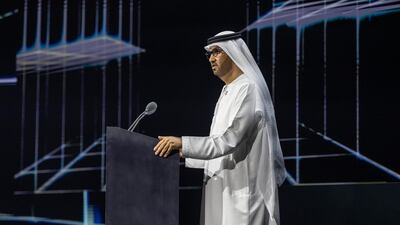
Dr Sultan Al Jaber, Minister of Industry and Advanced Technology, gives an opening speech on the first day of Make it in the Emirates 2025 at Adnec. All photos: Antonie Robertson / The National -

The ROX automotive stand is pictured at the fourth Make it in the Emirates event, now under way at Adnec for four days -

The Arbus flight stand attracts interest. This year's event is five times larger than in 2024 and features more than 700 exhibitors -

Calidus Industries exhibits its wares as the spotlight shines on domestic manufacturing at Adnec -
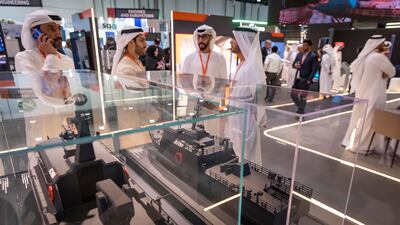
The Edge exhibition. The UAE has been focusing on industrial growth as it diversifies its economy from oil -

More from the Calidus Industries stand -
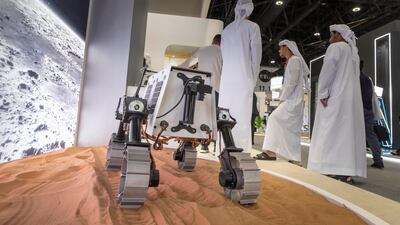
A display by Khalifa University, as the nation taps into modern and forward-looking sectors -
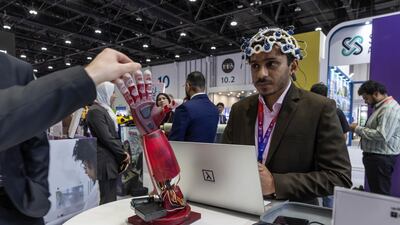
A cognitively controlled robotic hand on display at the NYUAD stand -

Make it in The Emirates 2025 runs until Thursday, May 22


Industrial push
As part of its economic diversification efforts, the UAE is aggressively pursuing industrial growth, as well as the expansion of sectors such as tourism and technology.
In 2021, the UAE launched its Operation 300bn strategy, which is aimed at positioning the country as an attractive industrial centre by 2031. The government has identified chemicals, electrical, construction, machinery and equipment, food, transport, metals, pharmaceuticals, rubber, plastic and fibreglass, and wood and paper among its priority industries.
Last year, the government launched Emirates Growth Fund, a Dh1 billion investment platform under the Emirates Development Bank, to support small and medium businesses.
The bank hopes to approve up to Dh9 billion in funding this year, its chief executive, Ahmed Al Naqbi, told The National.
The ICV programme is intended to grow the industrial sector by redirecting half of government spending on procurement and tender contracts to the national economy by 2031.
The incentives introduced this month also include amendments to the ICV programme, which is no longer only an incentive-based framework. The scheme is now mandatory across certain sectors, including federal entities and companies in which the government holds at least a 25 per cent stake.

