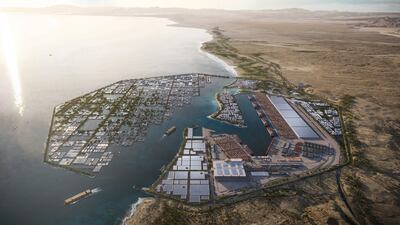
Officials in Saudi Arabia are seeking to position Neom as a logistics hub with the development of a new trade corridor connecting European and Gulf markets.
The Port of Neom, part of the $500 billion mega project, is intended to bypass the Strait of Hormuz to access global export markets and continue trade activity.
The strait – through which about a fifth of the world's oil normally passes – was effectively shut during the Iran war, but was declared “completely open” by Tehran on Friday.
The Port of Neom is a strategic gateway on the Red Sea, connecting the UAE, Kuwait and Iraq to markets in Europe through lorries and ships. Egypt, the Arab world’s most populous country, is also part of the corridor.

It forms part of Oxagon, an industrial city within the futuristic Neom that the kingdom is developing as it focuses on diversifying its economy from oil. Neom has invested more than 7.5 billion Saudi riyals ($2 billion) for development of the sustainable port.
“Neom is being pulled into a more grounded phase … the focus now is on what can be built, financed and sustained within clearer limits,” Irina Tsukerman, a geopolitical analyst in New York, told The National.
“Attention is moving towards areas that can show measurable progress and clearer economic use, especially in logistics, industry and energy … oversight is more direct and each part is expected to demonstrate relevance, attract partners and fit into a broader economic framework.”
Wider focus
Saudi Arabia is also investing heavily in sectors such as infrastructure, tourism and real estate to spur growth in its non-oil sector.
Goods are transported from European countries by lorries to Italy's Port of Trieste, which is then shipped to Egypt, via vessels to Damietta Port and lorries to the Port of Safaga, and finally to the Port of Neom through ships. From there, cargo is carried to destinations in the Gulf region and Iraq overland.
The route is already actively used by importers from several European countries including Italy, the UK, Germany and Poland, Neom said this week. Its importance was rising when the Strait of Hormuz remained closed to shipping traffic, leaving Gulf countries and Iraq looking for alternative routes for transporting general cargo and crude.
“There is a clear recalibration under way,” Oliver Cornock, global editor-in-chief of Oxford Business Group, told The National.
“While early narratives centred on flagship developments such as The Line, the strategic emphasis is now shifting towards industrial and logistics functionality, particularly around Oxagon and the Port of Neom.”
Route diversifications are now as important as headline mega projects, especially when the Strait of Hormuz was closed, he added.
Saudi ports such as Yanbu and Jeddah are already offering alternatives for the kingdom and Gulf countries, and Neom is strengthening alternative routes further.
“In this context, Neom is evolving into a practical node within Saudi Arabia’s wider Red Sea logistics corridor, complementing established hubs such as Yanbu,” said Mr Cornock.
The Port of Neom handles a variety of cargo including container, bulk and wheeled freight, to help the kingdom play a critical role in overcoming supply chain challenges.
“We're building an all-electric port where equipment and vehicles run on power from solar panels, battery storage and recovered energy fed back into the system, creating a circular energy economy,” Melissa Blake, operations director at the Port of Neom, said in an article on its website.

Its new container terminal, T1, which is nearing completion, is designed for scale with a 550‑metre access channel, 18.5‑metre draft and 900‑metre quay wall to accommodate the world’s largest vessels, its website says.
Fully automated cranes are set to be operational this year, with autonomous vehicles and integrated warehouses to follow.
“Neom is taking shape as a collection of projects with varying timelines and roles. Industrial, logistics and energy components are advancing with clearer alignment to national priorities,” Ms Tsukerman said.
New trade corridors emerge
New trade corridors are emerging as the US-Iran war disrupted old routes and demonstrated how even a relatively tiny waterway like the Strait of Hormuz can has vast implications on global trade.
Saudi Arabia and the UAE, the Arab world’s two biggest economies, have already used pipelines to export crude when the waterway was shut.
The kingdom has been exporting oil through the East-West crude pipeline connecting Abqaiq in the east to Yanbu on the Red Sea, while the Emirates is relying on a pipeline running from Habshan in Abu Dhabi to Fujairah. Iraq is exporting through a pipeline and using lorries to export to Syria’s terminals for global markets.
Meanwhile, the Saudi Ports Authority and Sharjah logistics firm Gulftainer are also teaming up on a new trade corridor project.
Under the partnership, there will be direct connectivity between Sharjah and Dammam in eastern Saudi Arabia involving sea and land transport to reduce transit times and improve cargo flow efficiency.
It also involves the integration of ports from the two countries, including the Khorfakkan Commercial Terminal on the east coast of the UAE, which bypasses the Strait of Hormuz, as well as inland logistics hubs such as the Sajaa dry port in Sharjah.
Fujairah, as well as ports in Oman such as Sohar and Duqm, are also providing alternative trade routes.
“Across both energy and manufacturing supply chains, we are seeing greater investment in bypass infrastructure, including pipelines and Red Sea and Arabian Sea ports, and increased use of multimodal logistics, such as sea, air and overland corridors via Central Asia,” Mr Cornock said.
Yanbu is already a critical Red Sea export hub, strengthened by pipeline connectivity and industrial expansion, while Jeddah remains a major commercial gateway, with established shipping links and growing logistics capacity, he added.
Fujairah is strategically positioned outside the Strait of Hormuz, with strong pipeline access and bunkering capabilities. Duqm is emerging as a key Arabian Sea hub, with refining and industrial ambitions.

