
The threat of US sanctions on Iran’s trading partners has intensified in recent days, but any potential impact is expected to be felt most by Tehran and energy-dependant Iraq, analysts have said.
US President Donald Trump signed an executive order on Friday imposing sanctions on Iran’s key trading partners. Mr Trump had first announced the tariff threat last month at a rate of 25 per cent. However, the order did not specify a rate but said an “additional ad valorem rate of duty – for example, 25 per cent – may be imposed on goods imported into the United States that are products of any country that directly or indirectly purchases, imports, or otherwise acquires any goods or services from Iran”.
Iran’s main trading partners between January and October last year were China, with trade of $14.5 billion, Iraq ($10.5 billion), the UAE ($7.5 billion) and Turkey ($7.3 billion), according to Trade Data Monitor.

“While the US tariff threat introduces uncertainty, Iran’s major diversified export partners (China, UAE, Turkey) are likely more well-positioned to absorb the shock by switching suppliers,” said Nasser Saidi, president of Nasser Saidi and Associates and former economy minister of Lebanon.
“The pain will be felt primarily by Iran (revenue loss, isolation, inflationary impact) and Iraq (energy security crisis),” Mr Saidi, who also served as the vice-governor of the Central Bank of Lebanon, told The National.
China alone accounted for more than 90 per cent of Iran’s oil exports in October last year, primarily through independent Chinese refineries.
“Should additional tariffs be imposed, it would be relatively simple for China to source it from other trade partners, including from the GCC (given current production levels). The primary risk here is geopolitical: any such move could reignite the US-China trade war,” Mr Saidi said.
Turkey, which relies on Iranian natural gas, could also diversify its sources and hence any long-term disruption would be minimal.
Following the initial announcement of the tariff, the UAE’s Minister of Foreign Trade Dr Thani Al Zeyoudi said last month that the country was still exploring the details.
“We are the second-largest trading partner with Iran, and it is one of the main providers and suppliers of many of our commodities, especially food products,” he said at an event.
“We have to see, is this going to affect the supply of the food products, or some of the products that come from Iran? Is this going to affect the prices on the consumer and how much they're paying to have the alternative?”
For countries like the UAE, Iran is a primary supplier of fresh fruits, vegetables, and livestock due to proximity – short shipping times allow for fresh produce, Mr Saidi said.
“However, if the UAE is forced to halt Iranian food imports to avoid US tariffs, it can switch to alternative suppliers (likely Pakistan, India or Europe). While this involves a logistical shift, the availability of alternate suppliers suggests that inflationary pressure on food would be contained.”
Impact on Iran and Iraq
Iran’s economy has already been suffering under sanctions reimposed by Washington in 2018, after Mr Trump during his first term withdrew the US from the nuclear deal Tehran signed with world powers, known as the Joint Comprehensive Plan of Action. Those sanctions have yet to be lifted. The economy received another hit when snapback sanctions were imposed by Britain, France and Germany at the UN General Assembly in September last year.
If Iran’s top trading partners substantially cut trade to protect their US market access, Tehran will shift to land-based trade and through the Caspian – which is “more difficult for the US to monitor and enforce trade restrictions”, Mr Saidi said.
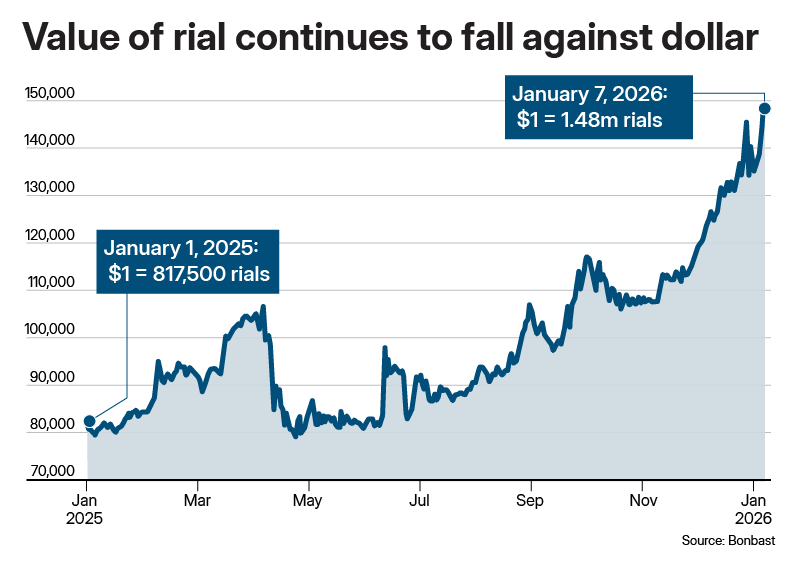
But it is possible that informal trade will increase with small vessels moving food and consumer goods off the books and crossings by land. “Iran could end up offering even steeper discounts on its oil and commodities to keep partners hooked on – leading to loss of revenue. Plus, the decline in Iran’s imports would lead to goods shortages, an uptick in inflation, alongside a fall in rial and raising poverty rates,” he added.
Meanwhile, Iraq is heavily dependent on Iran not just for food, but also for electricity and gas.
“If Iraq is forced to cut these ties to avoid US tariffs, the result wouldn't just be food inflation: it would be energy inflation and potential blackouts, which drives up the cost of everything locally,” Mr Saidi said.
A lot of cross-border Iran-Iraq trade also goes unreported, making it more difficult to monitor, he added.
Negotiation tactic
However, the move by the US appears to be part of the negotiation with Iran, with a “low probability” of strict enforcement, Hasnain Malik, head of emerging and frontier market investment strategy at Tellimer, told The National.
“The difference with the punitive US tariff on India for purchases of Russian oil and this potential punitive threat on importers of Iranian goods is that the US was, at the time, in the midst of an unresolved tariff deal,” he said.
If the tariff is applied, “it would obviously hit [Iran’s] largest trading partners, some of whom, such as Turkey and the UAE, are important US allies”.
Global policy changes
Overall, the impact of constant policy changes globally has made markets more cautious in their reactions, Andrew Bailey, governor of the Central Bank of England, said on Sunday.
“It is, of course, the case that not all of the initial announcements of policy shifts have been followed through to the word and on occasions, the impact of those announcements on economies and financial markets has not been quite as initially predicted,” he said at the Alula Emerging Markets Economies event.
“The good news is that the world economy has been remarkably resilient in the face of much higher policy uncertainty. Although this uncertainty, including the impact of tariffs, has weighed on the level of activity, and accepting that there is varying momentum of economic activity across countries and sectors, the world economy has shown an impressive ability to adapt to the shifting landscape,” he added.

