

The protests in Iran calling for regime change, which have reportedly been quelled after continuing for several weeks since December, were sparked in large part by economic factors.
The country's currency, the rial, fell sharply against the US dollar in December, igniting the protests within the narrow isles of Tehran's Grand Bazaar.
More than 2,600 people have been killed in the protests and subsequent government crackdown, according to rights groups.
-

Anti-government demonstrators and supporters of exiled Iranian crown prince Reza Pahlavi outside the Houses of Parliament in London. EPA -

Iranians during a protest in Tehran on January 9. AFP -
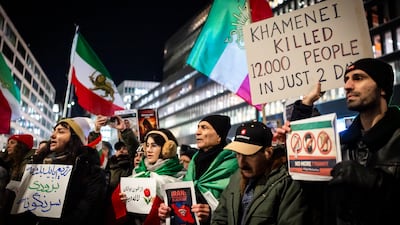
Protesters attend a rally in Zurich on January 13 in support of the nationwide mass demonstrations in Iran. EPA -

A screengrab shows body bags lying outside Kahrizak Forensic Medical Centre in Tehran, after deadly protests across Iran. Reuters -

Activists attend a rally in support of the protesters, in Los Angeles, California. AFP -

Protesters burn a picture of Iran's supreme leader Ayatollah Ali Khamenei outside Downing Street, in London. AFP -

Demonstrators gather in Paris to support the Iranian people amid the anti-government protests in Iran. AFP -
Smoke rises from a mosque as protesters gather amid evolving anti-government unrest in Tehran, Iran, on Friday. Reuters -
Protesters gather amid evolving anti-government unrest in Tehran, Tehran Province, Iran, on Friday. Reuters -
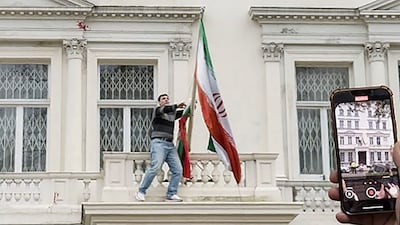
A protester pulls down the Iranian flag from the balcony of Iran's embassy in central London on Saturday. AFP -
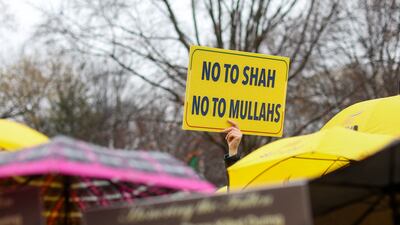
A person holds a placard, as demonstrators and activists rally in support of nationwide protests in Iran, outside the White House in Washington. Reuters -
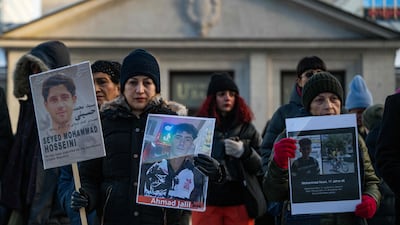
Protesters display placards featuring portraits of Iranians executed by the Iranian regime, during a rally in Berlin on Saturday. AFP -
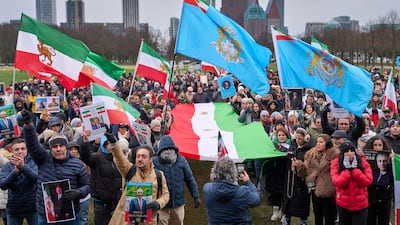
People protest in solidarity with demonstrations in Iran at Malieveld Square, Netherlands on Saturday. AFP


Currency crisis
The Iranian rial declined significantly over the past few months and was trading at more than 1.42 million to the US dollar on the parallel market on Friday, compared to around 807,000 a year ago, according to Bonbast.com, which monitors unofficial exchange rates.
"The rial’s record lows reflect deep structural problems — chronic foreign exchange scarcity, loss of confidence in policy, sanctions, and political uncertainty," said Alex Vatanka, senior fellow at the Middle East Institute.
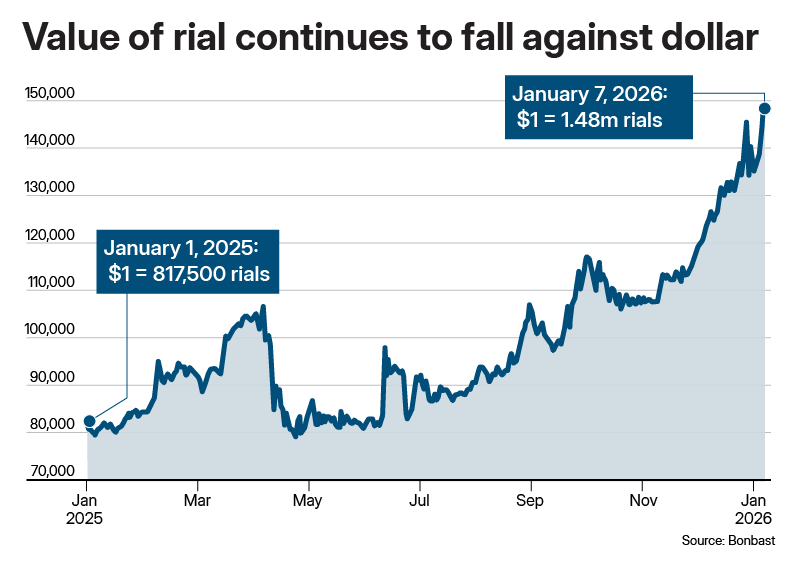
The rial is currently a barometer of political fear, said Mohammad Farzanegan, professor of Middle East economics at the Centre for Near and Middle Eastern Studies in Germany.
"As long as the geopolitical pincer - the combination of external economic warfare led by the US and internal institutional rot remains, the currency has no floor."
According to Mr Vatanka, without restoring access to foreign currency, as well as "meaningful fiscal reform, or a credible stabilisation strategy", continued depreciation is probable.
"There’s no clear floor: markets will price in risk and uncertainty — and if confidence collapses further, new lows will follow. That sharp devaluation was already a central driver of unrest."
Impact of sanctions
Iran's economy has suffered under sanctions reimposed by Washington in 2018, after US President Donald Trump during his first term withdrew the US from the nuclear deal Tehran signed with world powers, known as the Joint Comprehensive Plan of Action. Those sanctions have yet to be lifted.
The economy received another hit when snapback sanctions were imposed by Britain, France and Germany at the UN General Assembly last September.
"The snapback has been the decisive psychological and legal 'trigger' for the current crisis," Mr Farzanegan said.
"It destroyed the remaining legal shield of the JCPOA, signaling a permanent state of siege. The snapback didn't just add more sanctions; it broke the last bit of social trust in the currency."
Mr Vatanka agreed that renewed UN and US sanctions — including snapback measures — have compounded Iran’s chronic economic weaknesses.
They have "heightened currency scarcity, amplified inflationary pressures and robbed the central bank of reliable tools to stabilise the rial", he said.
"Sanctions aren’t the only driver – domestic mismanagement matters, too – but they have materially worsened economic conditions.”
Meanwhile, the US this week announced a series of new sanctions on Iran in response to its crackdown on protests. Treasury Secretary Scott Bessent said the sanctions were focused on "key Iranian leaders" involved in the suppression.
Soaring inflation
Inflation has soared, with the rate hitting 52.6 per cent in December, official data showed.
"Inflation isn’t just cyclical — it is structural. It stems from the currency collapse, supply bottlenecks, subsidy reforms, subsidies being cut, and weak confidence that prices will be stable," Mr Vatanka said.
Symbolic controls will not change the situation, he said. "It demands restoration of monetary credibility, predictable exchange-rate management, prudent fiscal policy, and credible institutional authority — all of which hinge on political reform and confidence building, not just technical tweaks."
Looking ahead, consumer prices are set to rise higher because the government is caught in an inflationary trap, Mr Farzanegan said.
"Stabilisation is only possible through a dual breakthrough: a diplomatic de-escalation to end the economic siege and a genuine internal campaign against the systemic corruption that my studies show is the primary driver of sanction-induced instability."

