


The Black Friday shopping bonanza has become an annual tradition for bargain hunters, with millions of people around the world seeking deals.
In the UAE, the event is also referred to as “White Friday”. This is in recognition of the region revering Fridays as a day of worship and a time for gatherings of friends and family.
Global Black Friday sales hit about $74.4 billion in 2024, a nearly 5 per cent annual rise, data from Resourcera shows. Analysts expect a similar upward trend this year.

On Friday, November 28, this year, shoppers in the US alone spent $8.6 billion online, up 9.4 per cent year-on-year, an Adobe Analytics report found - showing how consumers are increasingly favouring shopping on the web compared to visiting physical stores, owing to the latter's overall convenience further sweetened by extra discounts and deals offered exclusively online.
But spending aside, there's more to this in the UAE: the big shopping day's relationship with consumers has continued to evolve, analysts say, with the growth in online shopping and introduction of buy-now-pay-later programmes fuelling new trends.
Reflection in the UAE
Consumers in the Emirates are increasingly using the opportunity to make over their lifestyles, analysts say.
People are updating their wardrobes and homes, and increasing omnichannel - the mix of physical and digital ways to buy - is helping them, according to Redseer Strategy Consultants.
"What was once a purely deal-driven shopping moment has evolved into a reflection of changing consumer aspirations," said Akshay Jayaprakasan, an associate partner at Bengaluru-based Redseer.
And while online shopping is a favoured tool, the in-store experience is regaining some ground in the Emirates, as retailers add more in-store deals and mirror what are being offered online, enticing consumers to consider both experiences.
That, in tandem with flexible financing methods such as buy-now-pay-later programmes and split-up payments, is giving consumers more confidence with their purchases, Redseer said. More than 85 per cent of shoppers are expected to increase their use of BNPL this season, it added.
"The result is a more concentrated and evenly distributed purchase landscape, suggesting that consumers are now planning to shop across a wider mix of categories, rather than focusing on just a few," Mr Jayaprakasan said.
-

Shoppers outside Selfridge's in London. The UK is losing ground to France, Italy and Spain when it comes to non-EU visitor spending because of the scrapping of VAT-free shopping, business fear. Derrick Hardman, chairman of the Association of International Retail, said: 'A big gap has opened up between the UK and its EU rivals when it comes to spending by visitors from around the world. The cause of this is no mystery – the removal of tax-free shopping by the last government is putting people off coming and spending here.' Getty Images -
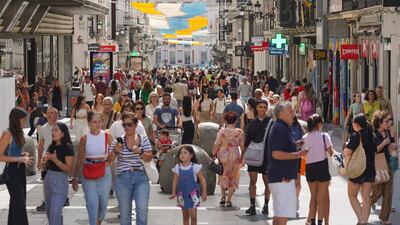
Shoppers on a busy retail street in Madrid, Spain. Spending by non-EU visitors in the UK has stagnated at just 75 per cent of pre-Covid levels in the UK, while soaring to 166 per cent of 2019 levels in Spain, 159 per cent in France and 137 per cent in Italy, according to tax-free shopping specialist Global Blue’s data for September. Non-EU visitor spending is growing year-on-year in the EU, but has plateaued in the UK. Spending by visitors from Gulf states is worst affected, down 27 per cent on 2019 levels in the UK, but up 169 per cent in France, 154 per cent in Spain and 153 per cent in Italy. Getty Images -

Almost 96 per cent of businesses in the West End, pictured above, believe international customers have moved their spending to cities such as Paris and Milan, with 81 per cent seeing fewer international visitors, according to a survey in August by the New West End Company. Getty Images -
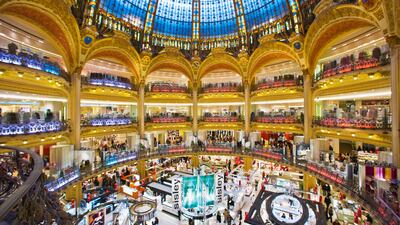
Galeries Lafayettes’s flagship store in Paris, above, achieved double-digit sales growth in the first half of 2025, as the city enjoyed a flood of tourists. International visitors to the French capital rose 9 per cent for the period, with almost 22 million non-French customers visiting the store. It is expected to exceed €2 billion in turnover this year. Getty Images -

In Italy, Rinascente stores, which has its flagship in Milan, reported a net profit of 12 per cent year-on-year for the first six months of 2025. Alamy -
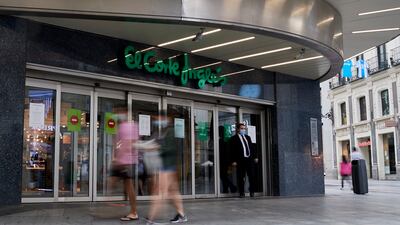
In Spain, luxury department store El Corte Ingles promotes its shops in Madrid, Barcelona, Marbella and Lisbon as key destinations for luxury shoppers, offering an instant 15 per cent tax refund with no minimum spend. The business grew 3.9 per cent in the last financial year. Getty Images -
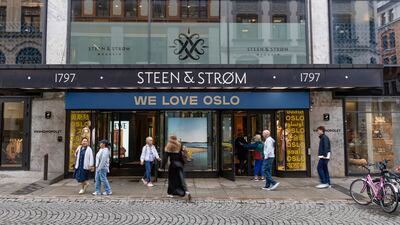
It’s not just those traditional shopping destinations. Norway’s Steen & Strom, which claims to be the oldest department store in the world, reported a 27 per cent rise in tax-free sales to tourists in the first eight months of this year. It said its customers told them they were choosing to make luxury purchases abroad rather than in London. Getty Images


'Trendy' shopping
Colour-themed days have flourished in the UAE. Amazon, the world's largest e-commerce marketplace, has its White Friday, while homegrown Noon has Yellow Friday.
But other promotions throughout the year attract similar consumer interest. Among the most notable would be the Dubai Shopping Festival, which spans from December to January.
During the Dubai Summer Surprises, merchandise revenue grew 15 per cent, with 40 per cent coming from mobile orders, according to a report from UAE-based gifting platform Flowwow and marketing firm Admitad. The study analysed more than two million orders across the UAE, Middle East and North Africa.
The figures were enough for Flowwow to declare DSS as the "new Black Friday of the season", and the UAE as a central hub for online shopping activity.
“The growth in cross-border orders shows just how open and globally connected the UAE market is," Flowwow chief executive Slava Bogdan said.
A 'stress test'
Black Friday - and, by extension, Cyber Monday and other colourful offshoots - has long been viewed as a gauge for the health of retail and consumer sentiment.
It remains "one of the biggest stress tests for the modern retail landscape", said Trevor Jordaan, a senior director at US software firm Blue Yonder.
He said soaring e-commerce demand, fast delivery expectations and intense cross-border shopping put strain on platforms, logistics and inventory systems.
And "with high competition and highly price-sensitive shoppers, even small operational weaknesses quickly become visible", Mr Jordaan added.
That, however, means retailers have to ramp up their online game, ensuring that their systems are ready to keep pace with that growing number of digital patrons.
"In this environment, even a small disconnect between forecasting, fulfilment, or returns can quickly erode margins and undermine customer experience," Mr Jordaan said.

