


Live updates: Follow the latest on Israel-Gaza
The cost of damages to the Lebanese economy due to the Israel-Gaza war, which has spilt over into southern parts of Lebanon, is soaring and an escalation in conflict would be "disastrous", analysts say.
Fighters of the militant group Hezbollah have exchanged fire with Israeli forces along Lebanon's border with Israel almost daily since the Gaza war erupted on October 7.
Hezbollah leader Hassan Nasrallah also warned on Tuesday that there would be no peace on the Israel-Lebanon border without a ceasefire in Gaza.
Nasser Saidi, a former economy minister and deputy governor of Lebanon's central bank, told The National that the violence has caused extensive damage to buildings, infrastructure and private property, adding up to huge losses for Lebanon's already struggling economy,
More than 65,000 people have been displaced in Lebanon because of the war.
Trade, tourism, hospitality as well as agriculture and aviation are some of the sectors that have been hit hard.
“The direct attacks in the south of Lebanon heighten uncertainty, inflict damage and destruction to an already impoverished region of the country and inevitably augment the country's burdens,” Mr Saidi, who is also head of consultancy Nasser Saidi and Associates, said.
“Already, Lebanon’s four main economic pillars, trade and tourism, health, education, banking and finance have been decimated by the ongoing crisis and lack of reforms. Not to mention the long-term scarring effects from the mass migration of Lebanon's human capital which will accelerate if there is an escalation or war in Lebanon."
-
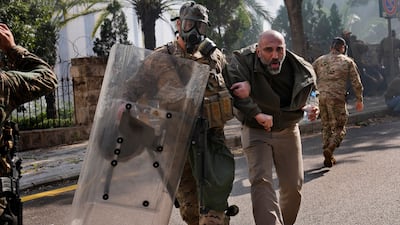
A Lebanese soldier, left, helps a retired comrade who inhaled tear gas during a protest in Beirut to demand better pay. AP -

Lebanese soldiers push back retired comrades trying to reach government buildings in Beirut during a protest to demand better pay. AP -
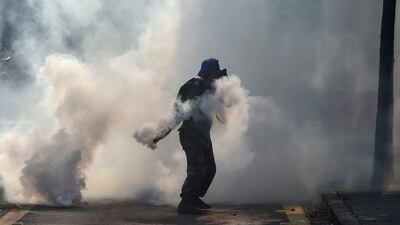
A retired member of the Lebanese security forces returns a tear gas canister towards riot police during a protest in downtown Beirut. EPA -
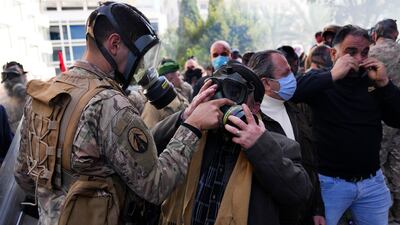
A Lebanese soldier gives a gas mask to a retired comrade who inhaled tear gas during the protest. AP -

A Lebanese soldier fires tear gas during a protest by retired members of Lebanon's security forces outside the government palace in Beirut. EPA -
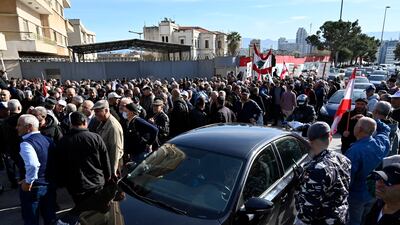
Retired Lebanese security force members block an entrance of the government palace to prevent ministers from attending a cabinet meeting. EPA -
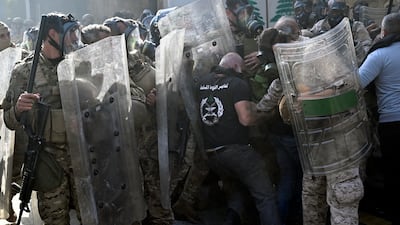
Retired members of the Lebanese security forces clash with soldiers during the protest. EPA -
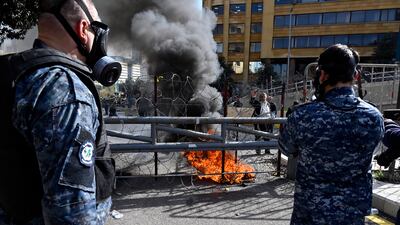
Protesters burn tires during the protest. EPA -
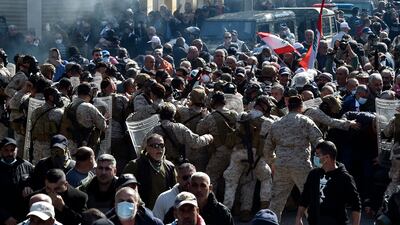
Protesters and soldiers clash outside the government palace in downtown Beirut. EPA -
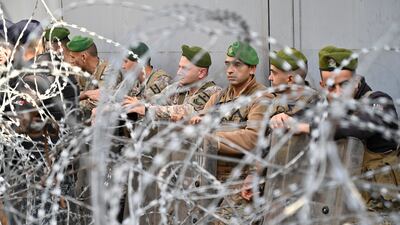
Lebanese soldiers on guard during the protest by retired members of Lebanon's security forces. EPA


Last week, an Israeli air strike hit a car in the southern Lebanon city of Nabatieh, marking the first time the regional centre has been hit since the Gaza war erupted.
“The tensions on the border and the fears of the conflict spreading have made the already bad situation worse and will remain a major headwind to any significant improvement in the economy,” Maya Senussi, lead economist for Middle East at Oxford Economics, said.
The country's economy is estimated to have suffered damages worth $1.5 billion due to the war, according to local media reports.
The agriculture sector has been particularly affected by the fighting.
“South Lebanon and Nabatieh are major agricultural hubs accounting for 21.5 per cent of Lebanon's cultivated areas and damage to the sector will result in loss of the means of livelihood and income,” Mr Saidi said.
Last year, farmers in south Lebanon told The National that their crops had been contaminated with white phosphorus after Israel used the highly toxic and flammable substance during its cross-border clashes with Hezbollah and other allies of Hamas.
Meanwhile, the banking sector is facing more than $70 billion in losses and the currency has lost more than 90 per cent of its value since 2019 when Lebanon defaulted on its debt for the first time in its history.
The country is grappling with what the World Bank has called one of the worst global financial crises since the middle of the 19th century.
It has yet to enforce critical structural and financial reforms required to unlock $3 billion of assistance from the International Monetary Fund, as well as billions in aid from other international donors, due to a lack of consensus among the political ruling class.
It has a caretaker cabinet led by Prime Minister Najib Mikati, but with limited powers. It also needs to elect a president after the six-year term of Michel Aoun finished at the end of October, but this requires the agreement of the political elite.

“Any escalation [in the conflict] to the wider nation would be disastrous for a country already reeling from political, economic, and social woes - rebuilding would likely take decades rather than years,” Mr Saidi said.
The country was previously projected to post 0.2 per cent growth in its gross domestic product in 2023, after five years of being in the red, but expected to turn into a contraction of between 0.6 per cent and 0.9 per cent following the war, according to a World Bank report in December.
Against a fragile economic, financial and external backdrop and falling reserves, the country’s debt-to-GDP will rise to 232 per cent this year from 151 per cent in 2020 when Lebanon defaulted, Standard Chartered Bank economist Carla Slim said.

The economic outlook for Lebanon for 2024 is “cloudy given that it is unclear when and how the war on Gaza will end and, therefore, when will the confrontations along the Blue Line cease”, said Nassib Ghobril, chief economist and head of the Economic Research and Analysis Department at Beirut-based Byblos Bank.
The Blue Line is the frontier set out by the UN, which marks the line to which Israeli forces withdrew when they left South Lebanon in 2000.
“The cumulative impact of the war is being increasingly felt on the economy and, particularly on the private sector as it has become more challenging to plan for the medium to long terms,” he said.
However, he said the private sector will rebound quickly if the conflict ends, despite Lebanon's economy facing headwinds due to delays in reforms.
“The private sector has accumulated enough experience during shocks and conflicts, and has demonstrated its ability to adjust to such circumstances. So when this cloud of uncertainty is removed, it will pick up its activity,” Mr Ghobril added.
Lebanese expatriates, who accounted for 62 per cent of visitors from abroad in 2022 and the first 11 months of last year, are also expected to continue visiting the country more than other tourist segments, supporting the growth of the economy.
“A permanent ceasefire as part of regional accord will have a positive impact on investor and consumer confidence,” Mr Ghobril said.

