

Saudi Arabia, the Arab world’s largest economy, has revised its growth forecast for 2023 and expects to record a budget deficit this year as it boosts spending to achieve its diversification ambitions.
The kingdom expects real gross domestic product to grow by 0.03 per cent this year, “due to a voluntary reduction in oil production”, compared with a previous growth estimate of 3.1 per cent, a preliminary budget statement from the Ministry of Finance showed on Saturday.
Non-oil growth this year is projected to reach 5.9 per cent, led by the trade, hospitality and tourism sectors, it said.
Saudi Arabia is now forecasting a deficit of 82 billion Saudi riyals ($21.86 billion) this year, compared with its previous estimate of a surplus of 16 billion riyals.
For this year, the country is now projecting revenue of 1.180 trillion riyals and spending of 1.262 trillion riyals.
Earlier estimates put revenue at 1.130 trillion riyals and spending at 1.114 trillion riyals.
In 2024, the kingdom expects a total revenue of 1.172 trillion riyals and a total expenditure of 1.251 trillion riyals.
It also aims to boost spending to 1.3 trillion riyals in 2025 and 1.368 trillion riyals in 2026.
At the domestic level, the Saudi government “seeks to support economic growth by implementing a group of developmental projects and regional and sectoral strategies” as part of its Vision 2030 agenda, the Ministry said.
“Thus the government is working to expand government spending that has a transformative effect while maintaining fiscal sustainability in the medium and long term.”
Saudi Arabia has sharply reduced its oil production to stabilise the market amid sluggish growth in China, the world’s second-largest economy, and recession concerns in developed economies.
Brent crude, the benchmark for two thirds of the world’s oil, closed at $92.20 a barrel on Friday after trading above $95 in the previous few sessions.
The Ministry also said that the kingdom would post a budget deficit of 1.9 per cent of GDP next year, 1.6 per cent of GDP in 2025, and 2.3 per cent of GDP in 2026.
Real GDP has been projected to grow by 4.4 per cent in 2024, 5.7 per cent in 2025 and 5.1 per cent in 2026.
The government expects “limited budget deficits” to continue in the medium term as a result of “expansionary” spending policies that support economic growth, the Ministry said.
The government will meet financing needs by borrowing and will seek to diversify its funding sources, it added.
“We are expecting revenue to be slightly higher than the government's budgeted revenue owing to the additional performance-linked dividend by [Saudi Aramco], which implies the deficit could be slightly lower than 82 billion riyals,” said Mazen Al Sudairi, an analyst at Al Rajhi Capital.
“At the same time, this leaves room for higher spending than government projections as well as our estimates,” he said.
Saudi Arabia’s economy grew 8.7 per cent last year, the highest annual growth rate among the world's 20 biggest economies, driven by a rise in oil prices and strong performance of its non-oil private sector.
The International Monetary Fund has said it expects the kingdom’s economy to grow by 1.9 per cent this year, instead of 3.1 per cent as previously projected, mainly due to production cuts and lower oil prices.
Growth in the kingdom is projected to pick up to 2.8 per cent in 2024, the Washington-based fund said in its latest World Economic Outlook update.
-
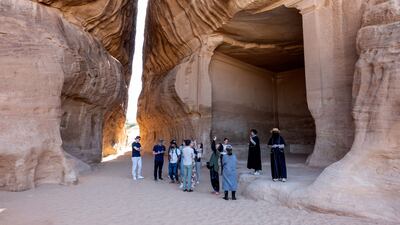
Tourists take a tour of the ancient Nabataean site of Hegra in AlUla, Saudi Arabia. Bloomberg -
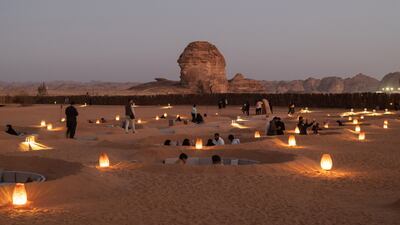
Outdoor seating at the Harrat Viewpoint in AlUla. Bloomberg -
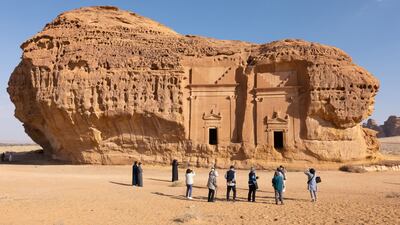
Hegra’s Tomb of Lihyan in AlUla. Bloomberg -
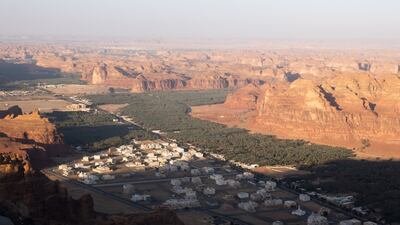
The ancient archeological site of AlUla is seen from the Harrat Viewpoint. Bloomberg -
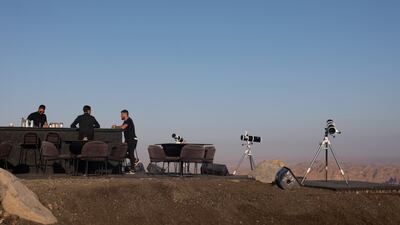
Staff of the Okto restaurant at the Harrat Viewpoint observation site. Bloomberg -
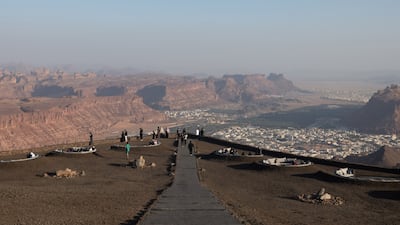
Tourists at the Harrat Viewpoint. Bloomberg -
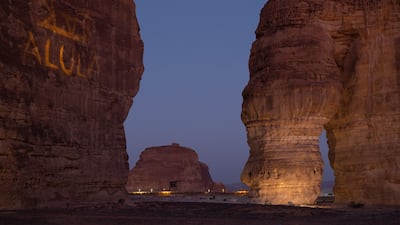
Evening illuminations at the Elephant Rock site, also known as Jabal Alfil. Bloomberg -
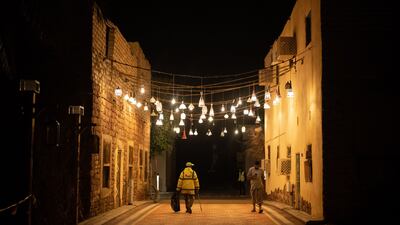
The restored Old Town of AlUla. Bloomberg -
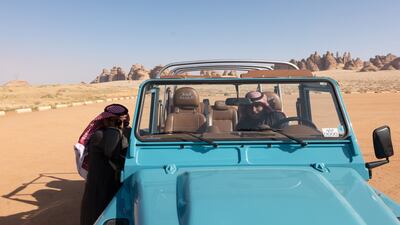
Private drivers wait for tourists. Bloomberg -

An ice cream van parked at the ancient archeological site. AFP


Last month, S&P Global Ratings affirmed Saudi Arabia’s rating at “A-/A-1” with a stable outlook and said the kingdom will benefit from higher crude production as well as growth in its non-oil economy next year.
“Reforms in the past few years, including measures to drive non-oil economic growth and widen the non-oil tax base, alongside significant social liberalisation, should continue to improve Saudi Arabia's economic and fiscal profile,” the rating agency said.
Inflation in the kingdom is expected at 2.6 per cent for this year and will “remain at acceptable levels in the medium term” due to measures taken by the government to contain price increases, set a ceiling on gasoline prices, ensure an abundance of food stocks and social support programmes, the ministry said.

