

America's employers added a solid 223,000 jobs in December, evidence that the economy remains healthy even as the Federal Reserve is rapidly raising interest rates to try to slow economic growth and the pace of hiring.
With companies continuing to add jobs across the economy, the unemployment rate fell from 3.6 per cent to 3.5 per cent, matching a 53-year low, the Labour Department said on Friday.
All told, the December jobs report suggested that the labour market may be cooling in a way that could aid the Fed's fight against high inflation. Last month's gain was the smallest in two years, and it extended a hiring slowdown that began last year.
And average hourly pay growth eased to its slowest pace in 16 months. That slowdown could reduce pressure on employers to raise prices to offset their higher labour costs.
Average wage growth was up 4.6 per cent in December from 12 months earlier, compared with a recent peak of 5.6 per cent in March. And in the past three months, job gains have averaged 247,000 — a decent pace but well below 2022's monthly average of 375,000.
“If these trends continue, we can feel more and more confident that the strength of this labour market is sustainable,” said Nick Bunker, head of economic research at the online job site Indeed’s Hiring Lab.
“The outlook for next year is uncertain, but many signs point toward a soft landing,” rather than a feared recession.
Traders on Wall Street appeared encouraged by the jobs report's suggestion of milder pay growth. Stock prices rose sharply.
At the same time, December's hiring figures don not necessarily make the Fed's path forward any clearer. The pace of job gains is still strong enough to keep lowering the unemployment rate, which, in turn, could keep pay growth high.
Lisa Cook, a member of the Fed's board of governors, said in a speech on Friday that “inflation is far too high” and “of great concern,” though she also noted that wage growth “has indeed started to decelerate".
Other recent data also point to a cooling economy: a measure of business activity in services, including finance, restaurants and transportation, contracted in December for the first time since 2020. A similar measure for manufacturing also shrank last month.
And a near-doubling of mortgage rates this year has sent home sales tumbling for 10 straight months.
Last month's job gains capped a second straight year of robust hiring during which the nation regained all 22 million jobs it lost to the Covid-19 pandemic. Yet the rapid hiring and the hefty pay raises that accompanied it likely contributed to a spike in prices that catapulted inflation to its highest level in 40 years.
-

Twitter has cut more than 3,000 jobs since Elon Musk purchased the social media company, with some of the firings happening in the eye of the public. 'Regarding Twitter’s reduction in force, unfortunately there is no choice when the company is losing over $4M/day,' Mr Musk tweeted. AFP -
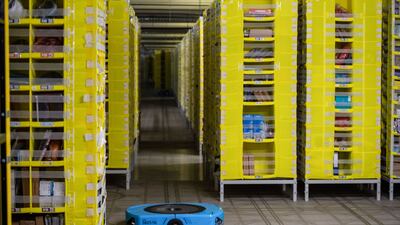
A robot retrieves a pallet of items for employees to sort at an Amazon warehouse. The e-commerce company plans to cut about 10,000 jobs and the lay-offs have started, chief executive Andy Jassy said. Bloomberg -

Facebook parent Meta is cutting 11,000 jobs, the first major round of layoffs in the social-media company’s history. 'I want to take accountability for these decisions and for how we got here,' said Meta chief Mark Zuckerberg, pictured. AP -

Hewlett-Packard expects to cut up to 6,000 jobs by the end of the 2025 fiscal year, or about 12 per cent of its global workforce, as computer sales slide amid consumer budget constraints. AFP -

Apple, the iPhone maker, has paused hiring for many jobs outside of research and development, an escalation of its plan to reduce budgets heading into next year. AFP -

Digital banking start-up Chime Financial is cutting 12 per cent of its staff, or 160 people. A representative of the company said Chime remains well-capitalised and the move will position it for 'sustained success'. Reuters -

Cisco Systems is beginning a restructuring plan that will affect about 5 per cent of employees. The company says it will incur pretax charges of about $600 million for severance, termination and other costs. The employees will be given a chance to move to other jobs within the company, chief financial officer Scott Herren said. AFP -

Dapper Labs founder and chief executive Roham Gharegozlou said in a letter to employees that the company had laid off 22 per cent of its staff. He cited macroeconomic conditions and operational challenges stemming from the company’s rapid growth. Dapper Labs created the NBA Top Shot marketplace for nonfungible tokens, a digital asset class that has suffered a steep drop in demand since the cryptocurrency market downturn. Reuters -

Intel is cutting jobs and slowing spending on new plants to save $3 billion next year, the chip maker said. The hope is to save as much as $10 billion by 2025. The headcount reduction could be in the thousands. Reuters -

Lyft's cost-saving efforts include divesting its vehicle service business. It is eliminating 13 per cent of staff, or about 683 people. The company had already said it would freeze hiring in the US until at least next year. Reuters -

Peloton laid off 500 employees globally, or about 12 per cent of the workforce, in October. It was the fourth time this year the company has cut staff. Along with other expense reduction measures, Peloton said the move will help it reach the break-even point on cash flow by the end of the 2023 fiscal year. Reuters -

Qualcomm has frozen hiring in response to a faster-than-feared decline in demand for phones, which use its chips. It now expects smartphone shipments to decline in the double-digit per cent range this year, worse than the outlook it gave earlier. Reuters -

Salesforce is focusing on margins as demand for its software products slows. The company has cut hundreds of workers from sales teams as it looks to improve profitability. Since 2017, Salesforce had almost tripled its workforce. AP -

Payments company Stripe, one of the world’s most valuable start-ups, is cutting more than 1,000 jobs. The 14 per cent staff reduction will return its headcount to about 7,000. Co-founders Patrick, pictured, and John Collison told staff that they needed to trim expenses more broadly to prepare for 'leaner times'. Bloomberg


The picture for 2023 is much cloudier. Many economists foresee a recession in the second half of the year, a consequence of the Fed’s succession of sharp rate hikes. The central bank’s officials have projected that those increases will cause the unemployment rate to reach 4.6 per cent by year’s end.
Though the Fed's higher rates have begun to cool inflation from its summertime peak, they've also made mortgages, auto loans and other consumer and business borrowing more expensive.
For now at least, the pace of hiring is showing surprising resilience in the face of higher interest rates across the economy. One recent beneficiary is Ethan Edwards of Oklahoma City, who accepted a job offer last month after having looked around for nearly a year.
Mr Edwards, 41, had taken his time because he was picky. He already had a job in local broadcasting, where he worked in marketing. But he wanted to find a position in a new industry in which he could work from home while avoiding a pay cut.
The strong job market eventually delivered. A recruiting firm, Aquent, connected Mr Edwards to a digital marketing company, where he now leads strategic planning.
“So far," he said, “every step of the way has been awesome.”
Among industries, the largest job gains last month were in health care, which added 74,000. Leisure and hospitality, a category includes restaurants, hotels, and entertainment, gained nearly as much: 67,000.
Retailers added 9,000, transportation and warehousing companies nearly 5,000. Construction companies added 28,000 — a surprisingly large gain considering that higher borrowing rates are dragging down residential and commercial real estate.
Many of those jobs were part-time positions. That trend suggests that as inflation began to accelerate, some people took on second jobs to help keep up with rising costs.
Bill Adams, chief economist at Comerica Bank, noted that the December jobs report showed that roughly 80 per cent of people who found jobs last month took part-time work, which typically pays less than full-time jobs. That is likely one reason why wage growth has been slowing.
senior economic adviser to US President Joe Biden
US President Joe Biden suggested on Friday that the continuing job gains were, in part, a reflection of his policies, in which the government supplied vast aid during the pandemic to boost hiring and then added spending on infrastructure, computer chips, manufacturing and other areas to support business investment.
“It’s a good time to be a worker in America,” Mr Biden said. “We still have work to do to bring down inflation.”
Jared Bernstein, a senior economic adviser to Mr Biden, said the administration is still hoping for growth in inflation-adjusted wages.
“What’s important to us is that families have the buying power through their paycheques to get ahead,” Mr Bernstein said
Some businesses, notably restaurants and hotels, are still scrambling to regain jobs lost to the pandemic. Among them is HMSHost, which operates 990 airport restaurants in North America under 350 different brands. The company is looking to hire 100 workers to help staff new restaurants that will open in the coming weeks.
Laura FitzRandolph, its chief human resources officer, said the company expects demand for travel to remain strong in 2023.
“We’re not slowing down in our hiring efforts or our business at all,” she said.
HMSHost hired roughly 23,000 people last year as the company desperately tried to staff up after laying off 90 per cent of their workers during Covid-19 shutdowns.
Mr FitzRandolph said many job applicants had failed to show up for interviews. But in recent months, the company is seeing more people apply for openings, and those applicants are more likely to appear for interviews.
“It's becoming somewhat easier to find people to work in the restaurant industry," she said.
In June, year-over-year inflation had reached 9.1 per cent, the highest level in 40 years, before slowing to 7.1 per cent in November. Last year, in an aggressive drive to reduce inflation back toward its 2 per cent goal, the Fed raised its benchmark rate seven times.
Fed chairman Jerome Powell has emphasised in recent remarks that consistently strong job growth, which can force employers to raise pay to find and keep workers, can perpetuate inflation: companies often raise prices to pass on their higher labour costs to their customers. And higher pay typically fuels more consumer spending, which can keep inflation elevated.
For that reason, Mr Powell and other Fed officials have laboured their belief that to tame inflation, unemployment will have to rise from its current low level.
Technology companies have been laying off workers for months, with some, including Amazon, saying that they had hired too many people during the pandemic. Amazon has boosted its layoffs to 18,000 from an earlier announcement of 10,000. Cloud software provider Salesforce says it will cut 10 per cent of its workers, and Facebook's parent company Meta says it will shed 11,000.
Yet outside of high tech, smaller companies, in particular, are still hiring. According to the payroll processor ADP, companies with more than 500 employees cut jobs in December, while businesses below that threshold added many more workers.
And an analysis by investment bank Jefferies showed that small companies were posting a historically high proportion of job openings.

