
The UAE-India Comprehensive Economic Partnership Agreement (CEPA) can play an important role in boosting India's economy and create much-needed jobs as the country tries to revive growth and come out of the post-pandemic lull, business leaders say.
The two countries have deep historic and cultural ties and the pact could further bolster trade and business relations.
“The sky is the limit for our trade and economic ties as we commit to building a shared future and enhancing the prosperity of our people,” said Piyush Goyal, India's minister of commerce and industry, in a tweet announcing the deal.
The UAE is already India's third-biggest trading partner, while India is the second-largest trading partner of the UAE, with trade volumes amounting to $60 billion in 2019, a report by KPMG showed.
-
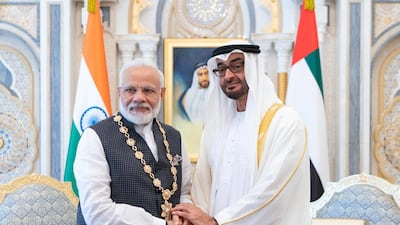
Sheikh Mohamed bin Zayed, Crown Prince of Abu Dhabi and Deputy Supreme Commander of the Armed Forces, with Indian Prime Minister Narendra Modi. Photo: Ministry of Presidential Affairs -
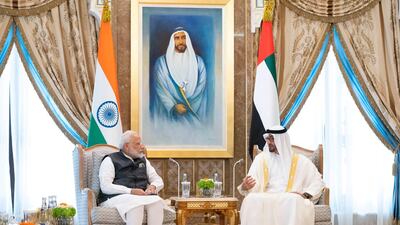
Sheikh Mohamed and Mr Modi during talks at Qasr Al Watan in Abu Dhabi. Photo: Ministry of Presidential Affairs -
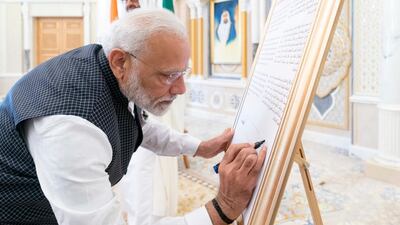
Mr Modi signs a board announcing the introduction of a postage stamp celebrating 150 years since the birth of Mahatma Gandhi, during a reception at Qasr Al Watan. Photo: Ministry of Presidential Affairs -

Sheikh Mohamed signs the same board announcing the introduction of the stamp. Photo: Ministry of Presidential Affairs -
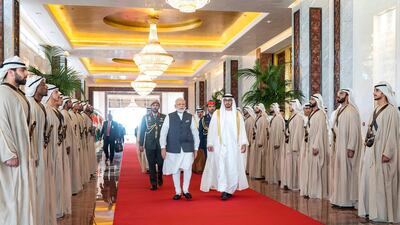
Sheikh Mohamed and Mr Modi inspect a guard of honour in the UAE capital. Wam -
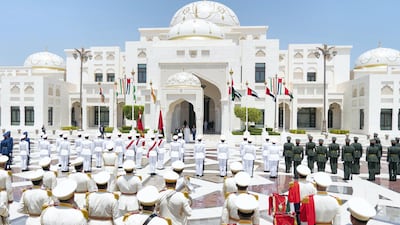
Security forces stand at attention as the national anthem is sung at Qasr Al Watan. Photo: Ministry of Presidential Affairs -
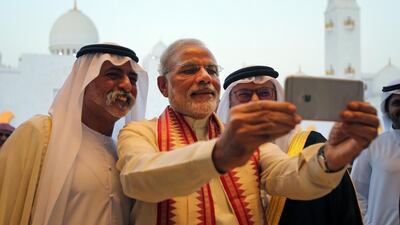
Mr Modi takes a selfie with Sheikh Nahyan bin Mubarak, Minister of Tolerance and Coexistence, left, as they tour the Sheikh Zayed Grand Mosque in Abu Dhabi. AP -
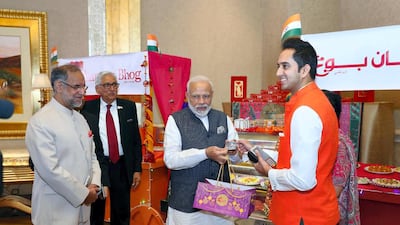
Mr Modi pays for sweets with the new RuPay card during a visit to Emirates Palace. -

Indians queue to hear Mr Modi speak at the Dubai International Cricket Stadium. Pawan Singh / The National -

The Dubai International Cricket Stadium fills up before the Indian prime minister's arrival. Pawan Singh / The National -

Mr Modi speaking at the Dubai International Cricket Stadium. Pawan Singh / The National -
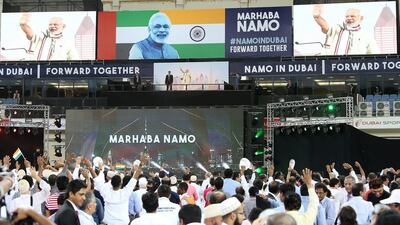
The Indian prime minister waves goodbye to the audience after his speech. Pawan Singh / The National -

Consul General Dr Aman Puri (centre) and guests take part in India’s 73rd Republic Day celebrations at the country's pavilion at Expo 2020 Dubai. Pawan Singh / The National -

Artists perform cultural dances during the Republic Day celebrations at the Expo site in Dubai. Pawan Singh / The National -
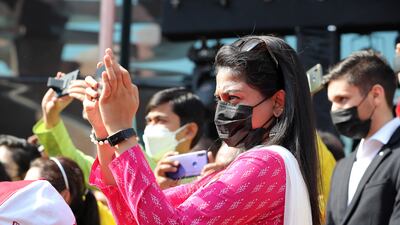
Guests take pictures during the Republic Day celebrations at the Expo site. Pawan Singh / The National


Exports of refined petroleum and jewellery, including pieces made from gold and diamonds, stand to benefit enormously from the pact.
“It's extremely significant,” says Colin Shah, chairman of the Gem and Jewellery Export Promotion Council in India, explaining that the deal was mutually beneficial for the jewellery industry in both countries.
New Delhi has been executing a series of reforms to create employment and support industries in a bid to reinvigorate the economy, which was battered by the impact of the Covid-19 pandemic and lockdowns.
Unemployment levels have been uncomfortably high, hitting 6.6 per cent in January, in a country with a population of about 1.4 billion, data from Centre for Monitoring Indian Economy show.
As part of its strategy to bolster its economy, India is striving to boost exports by developing trade relationships with several nations.
Last month, India and the UK launched negotiations on an ambitious free trade agreement. And Mr Goyal hinted at similar deals with Australia and Canada as he addressed the media on Friday.
The announcement of the pact with the UAE is a significant step in India's plans to grow its global trade and attract investment, business leaders say.
“This agreement was long awaited as India-UAE trade relations have huge potential to grow,” says M C Garg, chairman of Goodluck India, a company which manufactures and exports materials including pipes and galvanised sheets to the UAE.
The CEPA comes amid deepening collaboration between India and the UAE in the energy sector. The South Asian country has become the UAE’s top liquefied natural gas customer and Indian companies have secured exploration rights in Abu Dhabi.
In addition to the potential benefits for the oil and gas sector and India's energy security, analysts see scope for growth in foreign direct investment (FDI) between the two countries.
Bilateral FDI flows between the two countries between 2003 and 2021 reached more than $57bn, figures from fDi Markets show.
“India and the UAE’s long-standing economic relationship and mutually attractive investment opportunities have led to substantial bilateral FDI flow over the past decade,” KPMG reported.
“The majority of India’s FDI has been in the coal, oil and gas and real estate sectors, while the UAE’s FDI has primarily flowed into real estate and ceramics and glass.”
With more than 3.4 million Indians living in the UAE, this also drives a substantial flow of funds into India, the report said.
“Aside from FDI, there has also been considerable investment by companies owned or operated by Indians based in the UAE.”
In India, Mr Garg expects that the agreement will increase opportunities for companies like his.
“We are of the firm opinion that this is going to be highly synergistic and mutually beneficial as significant investment would flow into India,” he said.
“Companies like Goodluck stand to benefit out of this as we have a strong presence in the areas of infrastructure, renewables and specialised engineering products which are key areas of interest of the UAE government.”
Mr Shah said that ultimately, a free trade agreement between the UAE and India could increase exports of jewellery from India to the UAE by $5-$6bn annually.
“The 5 per cent duty, which used to be there, [and] made India uncompetitive [when] compared to the imports the UAE was making from countries like Singapore, Malaysia, China … this will give the Indian manufacturers a level playing field now, which will help improve India's exports to the UAE.”
Sectors including health care and technology in India also stand to benefit from the agreement.
Some business heads in India say the CEPA gives them confidence to expand in the Middle East and the wider region.
“This bilateral trade agreement between the UAE and India will open new doors for many ventures across both the nations,” says Sanjay Borkar, chief executive and co-founder of FarmERP, an agriculture management software platform.
“It’s a proud moment and every enterprise will reap the benefits in some way or another. We have already started scaling up in the Mena region aggressively and this agreement is another motivation for us to continue doing what we have been so far.”

