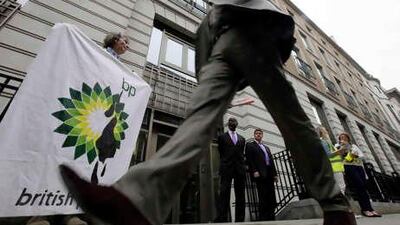
BP's latest energy outlook shows the potential for an imminent peak in oil demand. AP

Is BP a bellwether of the oil industry’s future?


Robin Mills
  • English
  • Arabic

Ever since the days of former chief executive John Browne, BP has had a talent for making headlines and leading the industry, if not always in the right direction. Its latest energy outlook, the first major long-term view that takes coronavirus into account, shows the potential for an imminent peak in oil demand.

Rather than some abstract exercise, such a near-term peak has big implications for the choices of companies and of Opec.

BP presents three scenarios for global energy and climate: one assuming “business as usual” gradual evolution of policies, and two consistent with the Paris Agreement targets of limiting global warming to 1.5-2 degrees Celsius. In every one though, 2019 appears the all-time peak of oil demand.

Even with business-as-usual, demand recovers only slightly to 2025 before falling gradually. In the other two cases, oil demand drops precipitously to 30-50 million bpd by 2050. That may seem a long way off, but is well within the active life of oil-fields developed today, and even more so of Opec’s remaining reserves.

The scenarios are given more credibility by being in line with BP’s own new corporate strategy. This sees its oil and gas output falling about 40 per cent by 2030, not entering any new countries for hydrocarbon exploration, while building up its portfolio of solar, wind and electric vehicle charging stations.

Despite claims by some media, BP is not the first major oil company to predict an imminent peak in oil demand. Statoil (now Equinor) has for some years had scenarios that peaked between 2025-30. Even BP last year provided a scenario with a peak around 2024. It is only natural that the severe demand destruction of Covid-19 would bring that date forward.

Moreover, all the major European oil firms have targets for net zero carbon emissions by 2050; BP’s is not the most aggressive.

Such scenarios depend on the post-Covid change in habits such as more home working, and the dismal effect of climate change in damaging economies in Africa and Latin America.

Non-oil technologies may be boosted by a rapid environmental conversion by the governments of leading countries, and the removal of policy barriers. Apart from renewables and electric cars, now quite mainstream, sectors such as plastics, shipping and aviation will have to find and deploy non-oil alternatives quickly.

European petroleum demand is certainly under strong pressure. The European Green Deal, part of post-pandemic recovery, will strongly emphasise electric vehicles. Refining and margins in shrinking markets, such as Europe and Japan now, would also fall. In 1967, there were 40 000 petrol stations in the UK; today, there are about 8000 for a car fleet three times larger. Charging points at home and work could eliminate many remaining forecourts.

The US’s near-term path depends on the results of November’s election. But in the longer term, public opinion in the more economically dynamic parts of the country, and the requirements of sustainability-minded investors, will drive companies to turn to zero-carbon options.

The big question mark is in developing Asian economies. India, China, Indonesia and others have not weaned themselves off coal, which is dirty but cheap and secure. Even the growing competitiveness of renewables has not yet made much impact on the portfolio of planned new coal power stations, despite analyses showing solar and wind would be cheaper.

This story may well be repeated for familiar and convenient oil-fuelled vehicles. Outside China, where the government has strongly backed them, electric vehicles will need to be clearly superior in cost and performance, and appeal to consumer tastes.

Since the global financial crisis, oil demand has grown on average almost 1.4 million barrels per day each year, ranging from 0.8-1 million bpd when oil prices were high to 1.8 million bpd when they had just fallen sharply (in 2015-16). Opec sees demand at about 90.2 million bpd this year and 96.9 million bpd next year, recovering to 2019 levels by 2022.

This depends, of course, on a rapid easing of the Covid-19 pandemic and the associated economic fallout. After the 2008-9 global financial crisis, in retrospect a less severe shock, demand rose 3 million bpd in 2010. A resumption of the last decade’s average growth from 2022 onwards would get us past the 2019 level by about 2024. So even BP’s business-as-usual scenario requires a sharp break with past trends.

For oil companies and oil-exporting countries, the exact timing of the peak may have attracted much debate. But it is less important than the level of demand at peak, the speed of the decline afterwards, and the price path. It would be easier to adjust to a long, bumpy plateau of demand than a rapid decline.

Prices will probably be lower on average as demand drops. But there will still be cycles of underinvestment and inadequate capacity when the market tightens.

Geopolitical events, perhaps the failure of the industry in collapsing states such as Venezuela and Libya today, could also interrupt supply. Investment in some non-Opec producers may be constrained by a loss of investor appetite along with growing government restrictions.

Because of these factors, BP sees Opec gaining market share. But its overall production is set to drop in the decade to 2030, then rise only gradually to 2050 even in the business-as-usual case.

National oil companies and ministries, who have planned for major production increases and for vast new refineries to meet Asian appetites, will hope that BP is mistaken.

Robin M. Mills is CEO of Qamar Energy, and author of The Myth of the Oil Crisis

Central%20Bank's%20push%20for%20a%20robust%20financial%20infrastructure
%3Cul%3E%0A%3Cli%3ECBDC%20real-value%20pilot%20held%20with%20three%20partner%20institutions%26nbsp%3B%3C%2Fli%3E%0A%3Cli%3EPreparing%20buy%20now%2C%20pay%20later%20regulations%26nbsp%3B%3C%2Fli%3E%0A%3Cli%3EPreparing%20for%20the%202023%20launch%20of%20the%20domestic%20card%20initiative%26nbsp%3B%3C%2Fli%3E%0A%3Cli%3EPhase%20one%20of%20the%20Financial%20Infrastructure%20Transformation%20(FiT)%20completed%3C%2Fli%3E%0A%3C%2Ful%3E%0A
Herc's Adventures

Developer: Big Ape Productions
Publisher: LucasArts
Console: PlayStation 1 & 5, Sega Saturn
Rating: 4/5

The Birkin bag is made by Hermès. 
It is named after actress and singer Jane Birkin
Noone from Hermès will go on record to say how much a new Birkin costs, how long one would have to wait to get one, and how many bags are actually made each year.

Jawan
%3Cp%3E%3Cstrong%3EDirector%3A%20%3C%2Fstrong%3EAtlee%3C%2Fp%3E%0A%3Cp%3E%3Cstrong%3EStars%3A%3C%2Fstrong%3E%20Shah%20Rukh%20Khan%2C%20Nayanthara%2C%20Vijay%20Sethupathi%26nbsp%3B%3C%2Fp%3E%0A%3Cp%3E%3Cstrong%3ERating%3A%20%3C%2Fstrong%3E4%2F5%3C%2Fp%3E%0A
Company%20Profile
%3Cp%3E%3Cstrong%3ECompany%20name%3A%3C%2Fstrong%3E%20myZoi%3Cbr%3E%3Cstrong%3EStarted%3A%3C%2Fstrong%3E%202021%3Cbr%3E%3Cstrong%3EFounders%3A%3C%2Fstrong%3E%20Syed%20Ali%2C%20Christian%20Buchholz%2C%20Shanawaz%20Rouf%2C%20Arsalan%20Siddiqui%2C%20Nabid%20Hassan%3Cbr%3E%3Cstrong%3EBased%3A%3C%2Fstrong%3E%20UAE%3Cbr%3E%3Cstrong%3ENumber%20of%20staff%3A%3C%2Fstrong%3E%2037%3Cbr%3E%3Cstrong%3EInvestment%3A%3C%2Fstrong%3E%20Initial%20undisclosed%20funding%20from%20SC%20Ventures%3B%20second%20round%20of%20funding%20totalling%20%2414%20million%20from%20a%20consortium%20of%20SBI%2C%20a%20Japanese%20VC%20firm%2C%20and%20SC%20Venture%3C%2Fp%3E%0A
Generation Start-up: Awok company profile

Started: 2013

Founder: Ulugbek Yuldashev

Sector: e-commerce

Size: 600 plus

Stage: still in talks with VCs

Principal Investors: self-financed by founder

Company Profile

Name: Thndr
Started: 2019
Co-founders: Ahmad Hammouda and Seif Amr
Sector: FinTech
Headquarters: Egypt
UAE base: Hub71, Abu Dhabi
Current number of staff: More than 150
Funds raised: $22 million

Dust and sand storms compared

Sand storm

  • Particle size: Larger, heavier sand grains
  • Visibility: Often dramatic with thick "walls" of sand
  • Duration: Short-lived, typically localised
  • Travel distance: Limited 
  • Source: Open desert areas with strong winds

Dust storm

  • Particle size: Much finer, lightweight particles
  • Visibility: Hazy skies but less intense
  • Duration: Can linger for days
  • Travel distance: Long-range, up to thousands of kilometres
  • Source: Can be carried from distant regions
Essentials

The flights
Emirates, Etihad and Malaysia Airlines all fly direct from the UAE to Kuala Lumpur and on to Penang from about Dh2,300 return, including taxes. 
 

Where to stay
In Kuala Lumpur, Element is a recently opened, futuristic hotel high up in a Norman Foster-designed skyscraper. Rooms cost from Dh400 per night, including taxes. Hotel Stripes, also in KL, is a great value design hotel, with an infinity rooftop pool. Rooms cost from Dh310, including taxes. 


In Penang, Ren i Tang is a boutique b&b in what was once an ancient Chinese Medicine Hall in the centre of Little India. Rooms cost from Dh220, including taxes.
23 Love Lane in Penang is a luxury boutique heritage hotel in a converted mansion, with private tropical gardens. Rooms cost from Dh400, including taxes. 
In Langkawi, Temple Tree is a unique architectural villa hotel consisting of antique houses from all across Malaysia. Rooms cost from Dh350, including taxes.

UAE currency: the story behind the money in your pockets
The smuggler

Eldarir had arrived at JFK in January 2020 with three suitcases, containing goods he valued at $300, when he was directed to a search area.
Officers found 41 gold artefacts among the bags, including amulets from a funerary set which prepared the deceased for the afterlife.
Also found was a cartouche of a Ptolemaic king on a relief that was originally part of a royal building or temple. 
The largest single group of items found in Eldarir’s cases were 400 shabtis, or figurines.

Khouli conviction

Khouli smuggled items into the US by making false declarations to customs about the country of origin and value of the items.
According to Immigration and Customs Enforcement, he provided “false provenances which stated that [two] Egyptian antiquities were part of a collection assembled by Khouli's father in Israel in the 1960s” when in fact “Khouli acquired the Egyptian antiquities from other dealers”.
He was sentenced to one year of probation, six months of home confinement and 200 hours of community service in 2012 after admitting buying and smuggling Egyptian antiquities, including coffins, funerary boats and limestone figures.

For sale

A number of other items said to come from the collection of Ezeldeen Taha Eldarir are currently or recently for sale.
Their provenance is described in near identical terms as the British Museum shabti: bought from Salahaddin Sirmali, "authenticated and appraised" by Hossen Rashed, then imported to the US in 1948.

- An Egyptian Mummy mask dating from 700BC-30BC, is on offer for £11,807 ($15,275) online by a seller in Mexico

- A coffin lid dating back to 664BC-332BC was offered for sale by a Colorado-based art dealer, with a starting price of $65,000

- A shabti that was on sale through a Chicago-based coin dealer, dating from 1567BC-1085BC, is up for $1,950

Our family matters legal consultant

Name: Hassan Mohsen Elhais

Position: legal consultant with Al Rowaad Advocates and Legal Consultants.

The burning issue

The internal combustion engine is facing a watershed moment – major manufacturer Volvo is to stop producing petroleum-powered vehicles by 2021 and countries in Europe, including the UK, have vowed to ban their sale before 2040. The National takes a look at the story of one of the most successful technologies of the last 100 years and how it has impacted life in the UAE.

Read part three: the age of the electric vehicle begins

Read part two: how climate change drove the race for an alternative 

Read part one: how cars came to the UAE

Islamophobia definition

A widely accepted definition was made by the All Party Parliamentary Group on British Muslims in 2019: “Islamophobia is rooted in racism and is a type of racism that targets expressions of Muslimness or perceived Muslimness.” It further defines it as “inciting hatred or violence against Muslims”.

Engine: 5.6-litre V8

Transmission: seven-speed automatic

Power: 400hp

Torque: 560Nm

Price: Dh234,000 - Dh329,000

On sale: now

Dubai Bling season three

Cast: Loujain Adada, Zeina Khoury, Farhana Bodi, Ebraheem Al Samadi, Mona Kattan, and couples Safa & Fahad Siddiqui and DJ Bliss & Danya Mohammed 

Rating: 1/5

How to apply for a drone permit
  • Individuals must register on UAE Drone app or website using their UAE Pass
  • Add all their personal details, including name, nationality, passport number, Emiratis ID, email and phone number
  • Upload the training certificate from a centre accredited by the GCAA
  • Submit their request
What are the regulations?
  • Fly it within visual line of sight
  • Never over populated areas
  • Ensure maximum flying height of 400 feet (122 metres) above ground level is not crossed
  • Users must avoid flying over restricted areas listed on the UAE Drone app
  • Only fly the drone during the day, and never at night
  • Should have a live feed of the drone flight
  • Drones must weigh 5 kg or less
THE BIO:

Sabri Razouk, 74

Athlete and fitness trainer 

Married, father of six

Favourite exercise: Bench press

Must-eat weekly meal: Steak with beans, carrots, broccoli, crust and corn

Power drink: A glass of yoghurt

Role model: Any good man

LA LIGA FIXTURES

Friday

Granada v Real Betis (9.30pm)

Valencia v Levante (midnight)

Saturday

Espanyol v Alaves (4pm)

Celta Vigo v Villarreal (7pm)

Leganes v Real Valladolid (9.30pm)

Mallorca v Barcelona (midnight)

Sunday

Atletic Bilbao v Atletico Madrid (4pm)

Real Madrid v Eibar (9.30pm)

Real Sociedad v Osasuna (midnight)

Who's who in Yemen conflict

Houthis: Iran-backed rebels who occupy Sanaa and run unrecognised government

Yemeni government: Exiled government in Aden led by eight-member Presidential Leadership Council

Southern Transitional Council: Faction in Yemeni government that seeks autonomy for the south

Habrish 'rebels': Tribal-backed forces feuding with STC over control of oil in government territory

SPEC SHEET

Display: 10.4-inch IPS LCD, 400 nits, toughened glass

CPU: Unisoc T610; Mali G52 GPU

Memory: 4GB

Storage: 64GB, up to 512GB microSD

Camera: 8MP rear, 5MP front

Connectivity: Wi-Fi, Bluetooth 5.0, USB-C, 3.5mm audio

Battery: 8200mAh, up to 10 hours video

Platform: Android 11

Audio: Stereo speakers, 2 mics

Durability: IP52

Biometrics: Face unlock

Price: Dh849

The specs: 2017 Lotus Evora Sport 410

Price, base / as tested Dh395,000 / Dh420,000

Engine 3.5L V6

Transmission Six-speed manual

Power 410hp @ 7,000rpm

Torque 420Nm @ 3,500rpm

Fuel economy, combined 9.7L / 100km
