


Adipec, the world’s largest energy conference, took place in Abu Dhabi last week – and it was hot. Not just metaphorically, but literally: the event was moved a month earlier to accommodate the Cop28 climate gathering at the end of November, and the October weather was sweaty.
After the world experienced its hottest September on record, eyes were on the energy industry to progress its net-zero carbon promises.
Like Indiana Jones trapped in a room with the walls closing in, the energy sector is under stress from four sides.
Consumers, particularly in developing countries, need access to reliable, reasonably-priced energy. Governments and regulators require the carbon footprint of operations to drop towards zero. Environmentalists and climate activists want oil and gas production to drop off rapidly to nothing and be replaced by renewables. And shareholders demand that whatever the companies do, it should be profitable.
Decarbonisation and the road to net zero were the core theme of this year’s Adipec, and have been prominent for several years.
Low-carbon technologies have increasingly gained ground, but the displays of compressors, valves, drill bits and other oilfield kits were as prominent as ever.
The crucial question: with such conflicting pressures, is the industry doing enough to meet climate imperatives?
Dr Sultan Al Jaber, Minister of Industry and Advanced Technology, managing director and group chief executive of Adnoc, and President-designate of Cop28, told The Guardian: “Not having oil and gas and high-emitting industries on the same table is not the right thing to do.”
At Adipec itself, Dr Al Jaber repeated his exhortation to the petroleum business to “step up, align around net zero by or before 2050, zero-out methane emissions and eliminate routine flaring by 2030”.
The company he heads has made substantial steps in this regard.
Adnoc has reported that it emitted 24 million tonnes from its upstream operations last year. It aims to reduce operational intensity – emissions per barrel of oil or cubic foot of gas – by 25 per cent by 2030, from what is already one of the lowest levels globally.
Since Adnoc’s oil and gas capacity is intended to rise significantly, it will need strong action to stop overall emissions from rising. By 2045, it wants its upstream emissions, those from oil and gas production operations, to reach net zero.
At the start of Adipec, the state oil firm doubled its carbon capture target to 10 million tonnes per year by 2030, having last month made the final commitment to a 1.5 million tonne per year capture project at the Habshan gas processing plant.
On Tuesday, it signed with American oil corporation Occidental to plan a million tonne per year plant to capture carbon dioxide directly from the atmosphere, which would be the first such large site outside the US.
On Thursday, it awarded $17 billion of contracts for the Hail and Ghasha offshore gas development, capturing another 1.5 million tonnes and intended to operate with net-zero emissions. By 2030, it also wants to eliminate releases of methane, the main constituent of natural gas, with a much more powerful global warming effect than carbon dioxide.
But overall, the industry has to do much more.
The lack of trust from wider society in much of the West is not surprising when it has spent decades dragging its feet. Ingenious enough to coax oil and gas out of almost impermeable shale, to find and extract hydrocarbons from under 3,000 metres of water or 10,000 metres of rock, but not to zero-out its own emissions.
Methane is one egregious example. This is a flammable gas, and a valuable one. Yet overall leakage rates range from 1.4 per cent to 3.7 per cent, even higher in some examples. Some centres vent unwanted methane directly into the air. Flares that burn off wasted gas don’t combust it entirely; as much as 10 per cent may escape.
Only in 2019 did the topic really gain prominence, when new measurements and satellites revealed the rates of escape to be much higher than previously estimated. Then the pandemic and the Russia-Ukraine war distracted attention.
Now limiting methane is finally back on the agenda. The US government has introduced a fee for leaks, but the industry has fought it, claiming absurdly that unburnt methane from flares, or leaks from equipment that is technically not “operating”, should be exempt.
The failure to tackle one of the simplest and highest-impact problems is not encouraging for bigger challenges. Carbon capture is an essential technology for cutting emissions from oil and gas operations as well as from industry. Indeed, it is the core method for continuing the use of hydrocarbons in a climate-compatible way.
We could have had large-scale carbon capture for two decades. Governments dragged their feet on paying for it properly. But that in turn represented a failure of the industry to make its case and to bring forward ambitious yet viable projects.
Among several successes, a few underperforming operations have been used by opponents to tar the whole enterprise. If oil companies had perceived carbon capture as critical to their business, they would not tolerate that underperformance. Instead, they have been content to pay minor penalties and take their time to fix the issues.
-

Guyana is net zero thanks to dense rainforest cover, despite being a newly oil-producing nation. AFP -

Bhutan was the first country to report net-zero emissions. Getty -

Niue's emissions are negligible, at less than 0.0001 per cent. Photo: Flickr -
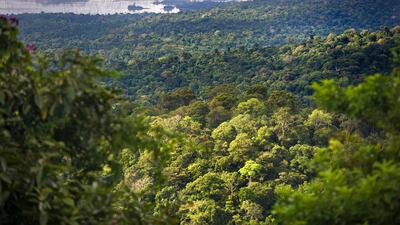
Suriname's forests absorb billions of tonnes of CO2. Getty -
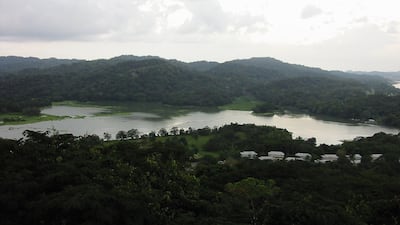
Panama was one of the first three countries to report net-zero emissions. Photo: Flickr -

The Comoros government has reported its carbon emissions have been in the negative since at least 2015. AFP -
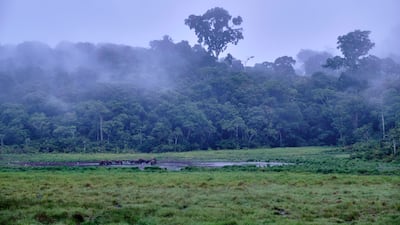
Almost 90 per cent of Gabon's surface is covered by forests, allowing for optimal carbon absorption. Getty -

Madagascar may lose its net-zero status if rampant deforestation continues. Photo: Alexandra Laube / imageBROKER / Shutterstock


Although about 40 million tonnes of capacity is in operation, and 244 million tonnes in development, almost 1,300 million tonnes are needed by 2030 to be on track for the International Energy Agency’s net-zero scenario.
Globally, the oil and gas industry, and its industrial partners, need to put that extra billion tonnes forward – and challenge governments to support it properly.
Indeed, as Dr Al Jaber says, the business needs to step up. At Adipec, and again at Cop28, it will have its seat at the top table. Only if it demonstrates and delivers its commitments on its own emissions, can it have a voice in the much tougher conversations on its long-term future.
Robin M. Mills is chief executive of Qamar Energy and author of 'The Myth of the Oil Crisis'
-
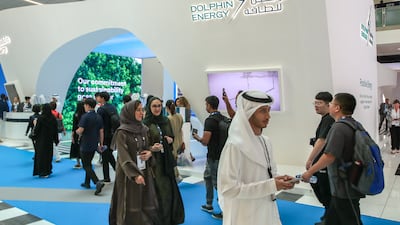
The Dolphin Energy stand at Adipec 2023. All pictures: Victor Besa / The National -
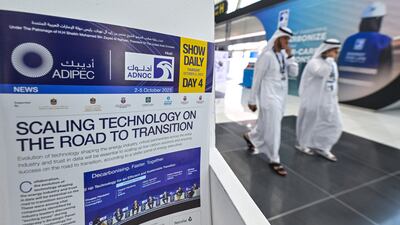
Day four at Adipec -

A visitor to Adipec 2023 on day four -

A panel discussion on 6G connectivity solutions for future power grid architectures -

The Rabdan fully electric vehicle at the Ministry of Industry and Advanced Technology stall, Adipec 2023 -

Visitors admire the Rabdan One, a fully electric vehicle made in the UAE, which is on display at the Ministry of Industry and Advanced Technology stall, Adipec 2023 -

The AD Ports Group stand -
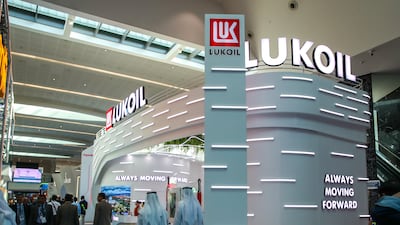
The Lukoil stall at Adipec 2023 -

Visitors on day three at Adipec 2023 -

The NMDC Group stand -

Visitors at the Adnoc stand -
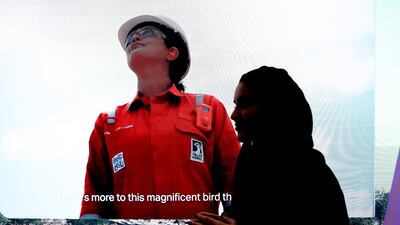
The Adnoc stand -
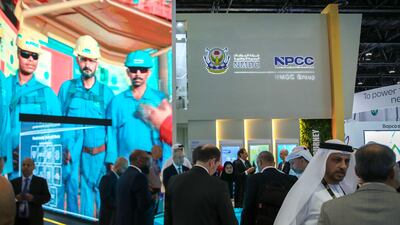
The National Petroleum Construction Company and National Marine Dredging Company stand -

Day three at Adipec 2023 -
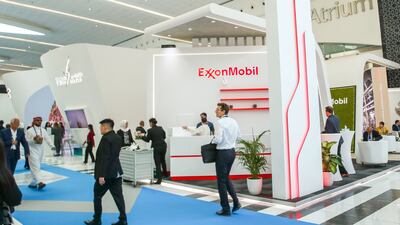
The Exxon Mobil stand -
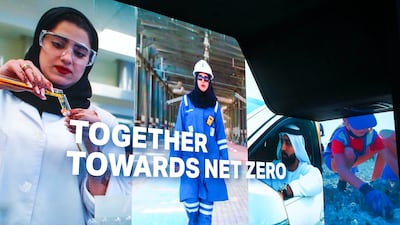
The Adnoc stand -
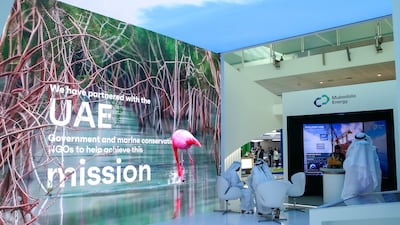
The Mubadala Energy stand at the exhibition -

A model on display at the Adnoc stand -

The Sky News stand -

The Ministry of Industry and Advanced Technology stand -

Day two at Adipec 2023 -

Visitors crowd the aisles on day two at Adipec 2023 -

Adipec 2023 -
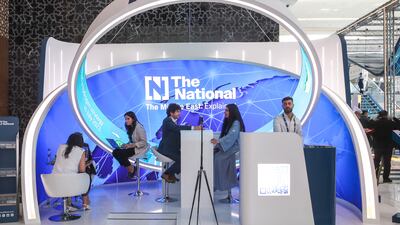
The National stand at Adipec 2023



