

Inflation has undoubtedly been the key economic theme of 2022, with price growth breaching decades-long records in several major economies.
Spurred on by global supply chain disruptions and higher energy prices due to the Ukraine-Russia conflict, annual price growth in the latter part of the year hit rates last recorded in 1981 in both the US and UK.
This runaway price growth in turn caused central banks around the globe to step up the fight against inflation by raising key lending rates.
The US Federal Reserve, the Bank of England and the European Central Bank have raised rates this year by a cumulative 4.25 per cent, 3.25 per cent and 2.5 per cent, respectively.
As a tumultuous 2022 comes to a close and we begin to look forward to 2023, a major question will be: “what next?” for central banks, and what those decisions, in turn, mean for the outlook for global growth.
Although tentative signs are beginning to emerge that inflation may have reached its peak in most developed markets, it appears unlikely that central banks will be in any hurry to undo any of the tightening seen thus far.
Recent statements from the Fed, the BoE and the ECB have all emphasised that policymakers are themselves expecting to have to raise rates further than previously expected, albeit at a slightly slower pace than in 2022.
Clear evidence of this was visible in the Fed’s latest dot plot — a summary of the path committee members expect interest rates to take over the next few years — which showed broad support for further tightening next year.
Fed policymakers now expect interest rates to peak at about 5.25 per cent by the end of 2023, up from 4.75 per cent when the dot plot was last published in September.
The market is more optimistic on the inflation outlook and is pricing in a peak Fed Funds rate of 5 per cent in the first half of next year, and then 50 basis points of cuts in late 2023, taking the Fed Funds rate back to its current level of 4.5 per cent.
-
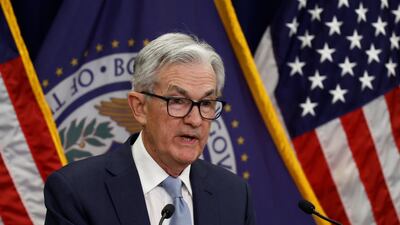
Federal Reserve Chairman Jerome Powell holds a news conference following the announcement that the Fed raised interest rates by half a percentage point, at the Federal Reserve Building in Washington, US. Reuters -

The Central Bank of the UAE also increased its base rate for the overnight deposit facility (ODF) by half a percentage point point. Photo: Central Bank of the UAE -

Residents with variable rate mortgages will feel the change as soon as their next monthly payment is due. Antonie Robertson / The National -

Changes to credit card interest rates are expected within a billing cycle or two. Antonie Robertson / The National -

Monthly instalments on personal loans and car financing are also set to rise. Razan Alzayani / The National


Some of the hawkishness from central banks may, at least, in part, be an attempt to convince consumers and financial markets alike that they intend to remain tough on price growth, to avoid higher inflation expectations becoming entrenched in wage negotiations.
Strong wage growth and a robust labour market have been particular areas of concern for policymakers this year. Central banks will continue to pay close attention to labour markets in 2023, as they have yet to show much response to rising interest rates.
Unemployment rates across major economies have remained at historically low levels. US and UK policymakers will be hoping recent rises in vacancy rates and a small upward shift in unemployment rates in October will mark the start of a cooling off in labour markets.
There are also signs in the UK and US that consumers may be beginning to feel the impact of higher interest rates and inflation, with some measures of retail sales and housing market activity starting to fall.
The impact of large cumulative interest rate rises around much of the globe means that global growth will slow into 2023.
The International Monetary Fund now expects global growth to fall to 2.7 per cent in 2023, from 3.2 per cent in 2022 and 6 per cent in 2021. The fund noted that while gross domestic product growth was expected to remain positive next year, high inflation and rising interest rates would make 2023 “feel like a recession”.
While we think the UK and eurozone economies are probably already in recession, there is a growing expectation that the economic contraction may be less deep than previously feared. This is on the back of a variety of short-term, high-frequency indicators performing better than expected.
An outright recession is harder to call in the case of the US economy, although it is undoubtedly flirting with one. At present, we expect the US economy to grow by less than half a per cent in 2023.
Perhaps the largest question mark for inflation and global growth in 2023 is around the impact of Covid-19 on China and its knock-on impact on the rest of the world.
As China battles large scale outbreaks of Covid-19 into 2023, the short-term impact is expected to be dampened domestic demand curtailing global growth, and further supply chain disruptions.
However, as activity normalises, China’s economic recovery could help to pull the rest of the world out of recession.
Khatija Haque is chief economist and head of research at Emirates NBD

