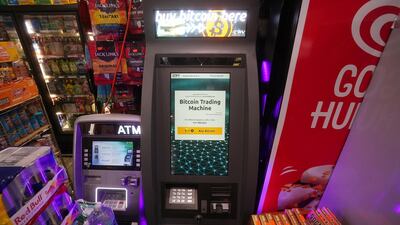
Bitcoin Trading Machine is pictured in a bodega in the Manhattan borough of New York City, February 9, 2021. Reuters

Bitcoin exceeds $50,000 for the first time


  • English
  • Arabic

The seemingly unstoppable rise of Bitcoin continued Tuesday with the cost of a single unit of the digital currency rising above $50,000 for the first time.

The same Bitcoin one year ago would have cost $10,000. The price is up almost 200 per cent in the last three months alone.

Bitcoin is rallying as more companies signal the volatile digital currency could eventually gain widespread acceptance as a means of payment. The vast majority of those who have acquired Bitcoin have treated it as a commodity, like gold, with few places accepting it in exchange for goods or services.

Companies have been wary due to Bitcoin’s volatility and its use by parties who want to avoid the traditional banking system for myriad reasons. On Tuesday, the price crossed and recrossed the $50,000 barrier at least a half dozen times before 10am.

Last Monday, however, the electric car company Tesla sent a tremor through the digital currency markets, saying that it was buying $1.5 billion in Bitcoin as part of a new investment strategy, and that it would soon be accepting Bitcoin in exchange for its cars.

Then Blue Ridge Bank of Charlottesville, Virginia, said that it would become the first commercial bank to provide access to Bitcoin at its branches. The regional bank said Wednesday that cardholders could purchase and redeem Bitcoin at 19 of its ATMs.

BNY Mellon, the oldest bank in the US, followed a day later, saying it would include digital currencies in the services it provides to clients. MasterCard said it would start supporting “select crypto currencies” on its network.

While most expect a slow evolution towards widespread usage of bitcoins as currency, Richard Lyons, a finance professor at the University of California at Berkeley, says it is inevitable. Lyons predicts Bitcoin and other digital currencies “will become transactional currencies increasingly over the next five years. It’s not going to happen overnight,” he said.

Lee Reiners, who teaches fintech and cryptocurrency courses at Duke University School of Law, said BNY Mellon’s move makes sense because “there are now numerous high net-worth individuals and investment funds embracing crypto as an asset class to be added to their portfolio.”

But Mr Reiners believes companies will remain hesitant to accept Bitcoin for payment because of its volatility.

“If you were a merchant, why would you accept payment in an asset that could be worth 20 per cent less a day after you receive it?,” Mr Reiners said in an email.

Investors will have to grapple with that volatility as well. The price of Bitcoin has soared and dipped since its debut on the futures market in 2017. A year ago, Bitcoin sold for below $10,000. Those fluctuations, analysts warn, could wreak havoc on a company’s bottom line and deter investors.

Assuming Tesla bought Bitcoin at the volume-weighted average price of $34,445 in January, the company is sitting on a gain of about 38 per cent with its investment. But in the regulatory announcement unveiling the investment, Tesla warned about the volatility of Bitcoin, its reliance on technology for its use and the lack of a centralised issuer, such as a government.

“While we intend to take all reasonable measures to secure any digital assets, if such threats are realised or the measures or controls we create or implement to secure our digital assets fail, it could result in a partial or total misappropriation or loss of our digital assets, and our financial condition and operating results may be harmed,” Tesla said in the filing.

“Tesla is going to have to be very careful and comprehensive in accounting for its Bitcoin investment on its books,” said Anthony Michael Sabino, a professor of law at St John’s University. “Like any other financial asset other than actual cash, it might fluctuate.”

There appears to be some reluctance among traditional companies regarding Bitcoin, at least as an investment vehicle.

During a recent conference call with investors, General Motors chief executive Mary Barra said her company had no plans to invest in Bitcoin, but would continue to “monitor and evaluate” potential use of digital currency.

“If there’s strong customer demand for it in the future, there’s nothing that precludes us from doing that,” Ms Barra said.


Dubai Bling season three

Cast: Loujain Adada, Zeina Khoury, Farhana Bodi, Ebraheem Al Samadi, Mona Kattan, and couples Safa & Fahad Siddiqui and DJ Bliss & Danya Mohammed 

Rating: 1/5

TV: World Cup Qualifier 2018 matches will be aired on on OSN Sports HD Cricket channel

David Haye record

Total fights: 32
Wins: 28
Wins by KO: 26
Losses: 4

COMPANY PROFILE
Name: Airev
Started: September 2023
Founder: Muhammad Khalid
Based: Abu Dhabi
Sector: Generative AI
Initial investment: Undisclosed
Investment stage: Series A
Investors: Core42
Current number of staff: 47
 
Company%C2%A0profile
%3Cp%3E%3Cstrong%3EDate%20started%3A%20%3C%2Fstrong%3EMay%202022%3Cbr%3E%3Cstrong%3EFounder%3A%20%3C%2Fstrong%3EHusam%20Aboul%20Hosn%3Cbr%3E%3Cstrong%3EBased%3A%20%3C%2Fstrong%3EDIFC%3Cbr%3E%3Cstrong%3ESector%3A%20%3C%2Fstrong%3EFinTech%20%E2%80%94%20Innovation%20Hub%3Cbr%3E%3Cstrong%3EEmployees%3A%20%3C%2Fstrong%3Eeight%3Cbr%3E%3Cstrong%3EStage%3A%20%3C%2Fstrong%3Epre-seed%3Cbr%3E%3Cstrong%3EInvestors%3A%20%3C%2Fstrong%3Epre-seed%20funding%20raised%20from%20family%20and%20friends%20earlier%20this%20year%3C%2Fp%3E%0A

Mercer, the investment consulting arm of US services company Marsh & McLennan, expects its wealth division to at least double its assets under management (AUM) in the Middle East as wealth in the region continues to grow despite economic headwinds, a company official said.

Mercer Wealth, which globally has $160 billion in AUM, plans to boost its AUM in the region to $2-$3bn in the next 2-3 years from the present $1bn, said Yasir AbuShaban, a Dubai-based principal with Mercer Wealth.

Within the next two to three years, we are looking at reaching $2 to $3 billion as a conservative estimate and we do see an opportunity to do so,” said Mr AbuShaban.

Mercer does not directly make investments, but allocates clients’ money they have discretion to, to professional asset managers. They also provide advice to clients.

“We have buying power. We can negotiate on their (client’s) behalf with asset managers to provide them lower fees than they otherwise would have to get on their own,” he added.

Mercer Wealth’s clients include sovereign wealth funds, family offices, and insurance companies among others.

From its office in Dubai, Mercer also looks after Africa, India and Turkey, where they also see opportunity for growth.

Wealth creation in Middle East and Africa (MEA) grew 8.5 per cent to $8.1 trillion last year from $7.5tn in 2015, higher than last year’s global average of 6 per cent and the second-highest growth in a region after Asia-Pacific which grew 9.9 per cent, according to consultancy Boston Consulting Group (BCG). In the region, where wealth grew just 1.9 per cent in 2015 compared with 2014, a pickup in oil prices has helped in wealth generation.

BCG is forecasting MEA wealth will rise to $12tn by 2021, growing at an annual average of 8 per cent.

Drivers of wealth generation in the region will be split evenly between new wealth creation and growth of performance of existing assets, according to BCG.

Another general trend in the region is clients’ looking for a comprehensive approach to investing, according to Mr AbuShaban.

“Institutional investors or some of the families are seeing a slowdown in the available capital they have to invest and in that sense they are looking at optimizing the way they manage their portfolios and making sure they are not investing haphazardly and different parts of their investment are working together,” said Mr AbuShaban.

Some clients also have a higher appetite for risk, given the low interest-rate environment that does not provide enough yield for some institutional investors. These clients are keen to invest in illiquid assets, such as private equity and infrastructure.

“What we have seen is a desire for higher returns in what has been a low-return environment specifically in various fixed income or bonds,” he said.

“In this environment, we have seen a de facto increase in the risk that clients are taking in things like illiquid investments, private equity investments, infrastructure and private debt, those kind of investments were higher illiquidity results in incrementally higher returns.”

The Abu Dhabi Investment Authority, one of the largest sovereign wealth funds, said in its 2016 report that has gradually increased its exposure in direct private equity and private credit transactions, mainly in Asian markets and especially in China and India. The authority’s private equity department focused on structured equities owing to “their defensive characteristics.”

The burning issue

The internal combustion engine is facing a watershed moment – major manufacturer Volvo is to stop producing petroleum-powered vehicles by 2021 and countries in Europe, including the UK, have vowed to ban their sale before 2040. The National takes a look at the story of one of the most successful technologies of the last 100 years and how it has impacted life in the UAE. 

Read part four: an affection for classic cars lives on

Read part three: the age of the electric vehicle begins

Read part two: how climate change drove the race for an alternative 

MATCH RESULT

Al Jazira 3 Persepolis 2
Jazira:
Mabkhout (52'), Romarinho (77'), Al Hammadi (90' 6)
Persepolis: Alipour (42'), Mensha (84')

HIJRA

Starring: Lamar Faden, Khairiah Nathmy, Nawaf Al-Dhufairy

Director: Shahad Ameen

Rating: 3/5

EA Sports FC 24

Company profile

Name: Fruitful Day

Founders: Marie-Christine Luijckx, Lyla Dalal AlRawi, Lindsey Fournie

Based: Dubai, UAE

Founded: 2015

Number of employees: 30

Sector: F&B

Funding so far: Dh3 million

Future funding plans: None at present

Future markets: Saudi Arabia, potentially Kuwait and other GCC countries