


Dubai is well-placed to take the lead on accepting cryptocurrency payments at its hotels and other tourist establishments to help attract more international visitors, its tourism chief said.
The move would be a “great” opportunity for the travel and tourism sector, provided it is well regulated, especially as Dubai's Virtual Assets Regulatory Authority already has frameworks in place for cryptocurrencies, Issam Kazim, chief executive of Dubai Corporation for Tourism and Commerce Marketing, told The National.
“If there is any place that should be taking the lead on this, it should be us,” he said at the Arabian Travel Market event.
“When it comes to being innovative and forward-looking, we don't like to say no to any opportunity that is realistic, we'd like to study it … we have experts in Dubai that we can sit with and understand the pros and cons and how we can launch it and mitigate any potential risks.”
With more travellers and businesses adopting cryptocurrency for travel payments, Dubai is open to facilitate the use of digital currencies.
“If it could be a potential limiting factor to some, then I'd rather remove barriers,” Mr Kazim said. “We'll make sure that we're mitigating all the risk and scrutinising it as much as possible but with an open mind and willingness to adapt and accept it if all the boxes are ticked.”
A handful of hotels in Dubai are already accepting digital currency payments. Palazzo Versace has partnered with Binance to accept payments in cryptocurrencies such as BNB, Bitcoin, and Ethereum for room stays, dining, spa experiences, meetings and events. Similarly, the Manor by JA, located in Al Furjan, has introduced a crypto-to-crypto payment gateway managed by Binance.
-

Changpeng Zhao, the former chief executive of Binance, during a fireside chat -

A dance and light performance during the opening day of the Token2049 Dubai summit on Wednesday. All photos: Antonie Robertson / The National -

Guests at the main stage of Token2049 Dubai -

Star Xu, founder and chief executive of OKX, delivering a keynote at the event -

Bitcoin has been a hot topic at the Token2049 Dubai summit -
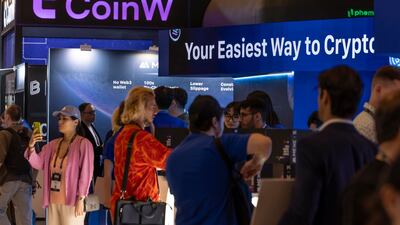
Token2049 is a conference that unites different blockchain and crypto companies under one banner for collaborations and exchanging ideas -

An electronic board displaying current prices of cryptocurrencies -

Crypto companies and enthusiasts flocked to Dubai to participate at Token2049


Growth in international visitors
Dubai expects to exceed last year's annual international visitor numbers by 3 per cent as it intensifies marketing campaigns abroad to promote the emirate, Mr Kazim said. It attracted 18.7 million international tourists in 2024 − up 9 per cent annually.
“A good, safe assessment would be to keep pace with the growth that we've seen in Q1, that would be a comfortable, realistic target to push towards,” Mr Kazim said.
Dubai recorded a 3 per cent annual increase in international visitor numbers to 5.31 million in the first three months of 2025, according to government data. Western Europe was its biggest source market with 1.15 million visitors, accounting for 22 per cent of the overall share.
Dubai, home to long-haul giant Emirates airline and the world's busiest international airport, is also shifting its focus from being a transfer hub and single-visit destination.
The emirate is seeking to attract more repeat visitors by introducing a five-year multi-entry tourist visa, doubling the number of hotel beds in the last decade and adding more airline capacity.
The number of international visitors making return trips to the city within a year currently stands at 25 per cent of the total and that rate is expected to continue in 2025, Mr Kazim said.
“Today we're looking to make them residents of Dubai to work here, live here and retire here,” he said.

