


Passenger traffic at Abu Dhabi's Zayed International Airport rose 33.8 per cent annually in the first half of 2024, exceeding expectations as it attracted new airlines and expanded its destination network.
The Abu Dhabi hub, which is home to Gulf major Etihad Airways, handled 13.7 million passengers in the January to June period of this year, state-owned operator Abu Dhabi Airports said on Wednesday.
Passenger traffic across Abu Dhabi's five airports collectively increased 33.5 per cent annually in the first half of the year to 13.9 million passengers, according to the airport operator.
The performance “highlights the resilience of our teams, airline partners, and stakeholder community, as well as the robustness of our infrastructure during the peak operational season”, said Elena Sorlini, managing director and chief executive of Abu Dhabi Airports.
“We are enthusiastic about the future of Abu Dhabi’s tourism and trade prospects and the pivotal role our airports will play in boosting tourism and trade.”
Abu Dhabi has been making a major push to attract more international visitors to the emirate as it develops its non-oil sectors such as aviation, tourism and hospitality to diversify its economy from hydrocarbons.
Etihad Airways, which is based at Zayed International Airport, carried 8.7 million passengers in the first six months of 2024, a 38 per cent increase compared to the same period last year, as it continues to expand its route network amid soaring demand for air travel, it said this month.
The Abu Dhabi-based airline’s passenger load factor – a measure of how well an airline fills available seats – was at 85 per cent during the first half of the year.
In the second quarter of the year, Zayed International Airport added two new airlines: US Bangla with three weekly flights to Chittagong and four weekly flights to Dhaka, and British Airways serving London Heathrow daily.
The airport operator's network of destinations also expanded through the addition of year-round services to Sarajevo (by Wizzair Abu Dhabi), Chandigarh (by IndiGo), Jaipur, Antalya, Bali and Gassim (by Etihad) and Turbat (by Pakistan International Airline).
Air Arabia Abu Dhabi also added seasonal flights to Trabzon, while Etihad added summer flights to Nice, Mykonos, Santorini and Malaga.
-

Sheikh Khaled bin Mohamed, Crown Prince of Abu Dhabi, visited the emirate's new airport terminal on Tuesday. All photos: Abu Dhabi Media Office -

Terminal A will begin operations on Wednesday -

It will double the current capacity of Abu Dhabi International Airport, which will be able to handle up to 45 million passengers a year -

The new terminal will be able to handle at least 79 aircraft at once when it is fully operational -

Sheikh Khaled was told how Terminal A will support growth in the aviation sector and boost tourism -
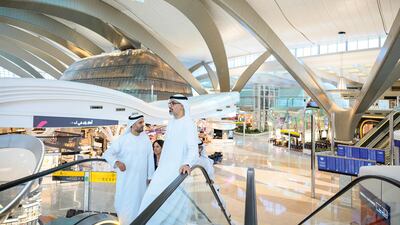
The vast structure of glass and steel is three times the size of the old terminal -
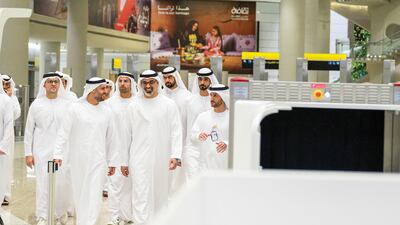
Terminal A will have nine main biometric touchpoints including self-service baggage drops, immigration e-gates and boarding gates -
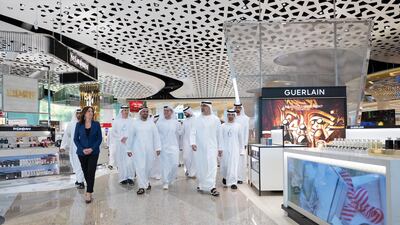
It will use facial recognition technology to screen passengers and minimise waiting times -

An advanced baggage handling system will be able to process up to 19,200 bags an hour -
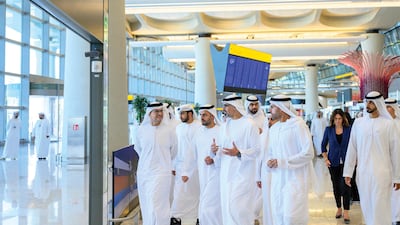
Terminal A, formerly known as the Midfield Terminal, is the airport's most ambitious expansion yet -

Airlines will move to the Terminal A building in three phases over a two-week period, from November 1 to November 14 -
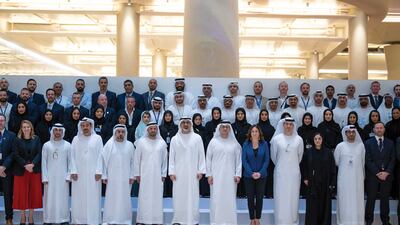
From November 15, all flights will operate solely from the new terminal


In terms of air freight, the airport handled 254,300 tonnes of cargo in the year-to-date, it said. This compares with 259,461 tonnes of freight in the first half of 2023.
Global air cargo markets recorded an “exceptional” first half-year performance, with volumes exceeding even the record-breaking 2021 levels, the International Air Transport Association (Iata) said this week.
“Maritime shipping constraints and a booming e-commerce sector are among the strongest growth drivers,” Willie Walsh, Iata's director general, said.
“The sector has remained largely impervious to ongoing political and economic challenges, and the US customs crackdown on e-commerce deliveries from China.”
Air cargo is on “solid ground” to continue its strong performance into the second half of 2024, according to Iata.
Middle Eastern airlines recorded 13.8 per cent year-on-year growth in air cargo demand in June, even as capacity increased 6.9 per cent.
The Middle East–Europe market performed particularly well with 30.2 per cent annual growth, ahead of Middle East–Asia which grew by 15.1 per cent year-on-year, Iata said.

