


Qatar Airways plans to buy a stake in an airline based in southern Africa as part of its wider plans to grow its route network across the continent following partnerships with Kigali-based RwandAir and Morocco's flagship carrier Royal Air Maroc.
An announcement of the deal could be made in the next two to three weeks, Qatar Airways' chief executive Badr Al Meer said at the Qatar Economic Forum in Doha on Wednesday.
“We are in the final stage of an equity investment in an airline in the southern part of Africa," he said.
Mr Al Meer, who took over the helm in November, said southern Africa is "the last piece in the equation" of the airline's ambitions to serve the whole continent.
While Mr Al Meer did not identify the target of Qatar Airways' equity stake investment, he said southern Africa has just two or three airlines to pick from.
"This airline will complement the operation of Kigali as a hub and the operation of RwandAir as the airline that connects the West, east, north of Africa to the airline we're finalising the investment in."
State-owned Qatar Airways flies to more than 30 destinations in Africa. The Doha-based airline also has plans to buy a 49 per cent stake in the East African airline RwandAir.
In 2019, Qatar Airways also took a 60 per cent share in the $1.3 billion new Bugesera International Airport, located south-east of the Rwandan capital Kigali.
The new airport is expected to be operational by 2027 or 2028, Yvonne Makolo, chief executive of RwandAir, said during the same panel.
Construction packages will be awarded next month or by July at the latest, Mr Al Meer said.

Africa has a population of 1.4 billion people but currently only carries 2 per cent of the global traffic, making it an underserved market with major opportunities for African and international airlines to tap into the air travel demand, Ms Makolo said.
The new hub could rival Addis Ababa, the home base of Africa's biggest carrier Ethiopian Airlines.
"Addis is already a huge hub but I think Kigali will be alternative regional hub, especially given the geographical position of Rwanda, right at the heart of Africa, which gives us access to all the points –north, south, east, west – so we're very strategically positioned," she said.
"There's potential to grow it to compete with the other regional hubs but we're starting small and we'll continue growing it because ... the potential in the continent is immense."
RwandAir flies to Doha six times a week and its extended codeshare agreement with Qatar Airways allows it to tap into more than 70 routes within the Doha-based airline's network.
"The way to go is through partnerships, whether between African airlines, and also African airlines with other international airlines," Ms Makolo said.
"It is a huge continent, 54 countries that we need to connect, and no one airline can do that on their own."
-
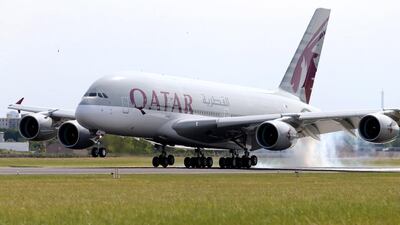
-
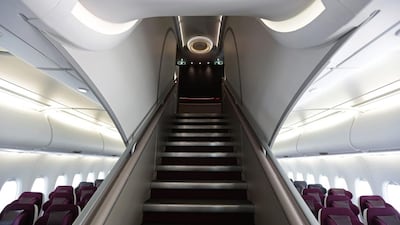
An access stairway leads to the first class cabins on the upper level of an Airbus A380 aircraft, operated by Qatar Airway. Jason Alden / Bloomberg -

Subdued lighting illuminates a first class bathroom. Jason Alden / Bloomberg -
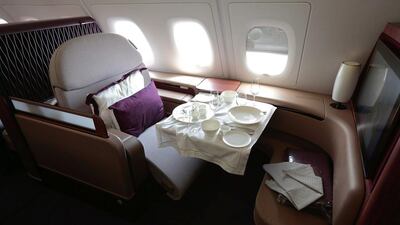
A dining set sits on the table of a first class passenger. Jason Alden / Bloomberg -

A flight attendant welcomes guests aboard an Airbus A380 operated by Qatar Airways. The airline has 37,000 employees. Jason Alden / Bloomberg -
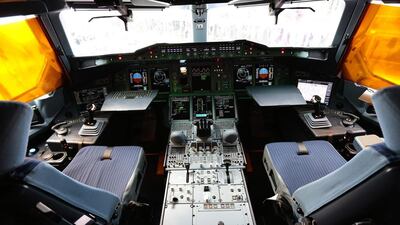
Instruments sit on the flight deck of an Airbus A380 operated by Qatar Airways. Jason Alden / Bloomberg -
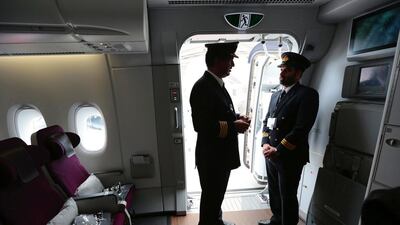
Flight crew stand in the passenger access door of the A380. Jason Alden / Bloomberg -
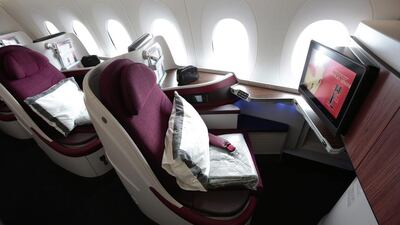
The first class cabin booths in the A380 aircraft. Jason Alden / Bloomberg -
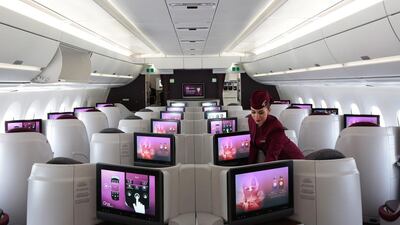
An overview of the business class section on a Qatar Airways A380. Jason Alden / Bloomberg -

The first Class passenger booths on the upper deck of the A380. Jason Alden / Bloomberg -
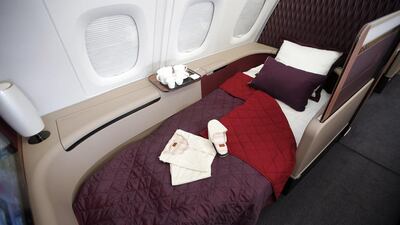
Interior view of the fully lie-flat seat converted into a bed in the first class cabin. Francois Mori / AP Photo


Qatar Airways 2.0
Mr Al Meer said that the next phase of the airline's development, dubbed 'Qatar Airways 2.0', will examine its commercial operations, the profitability of certain routes in the network and its fleet mix.
The airline is reviewing its fleet to reduce the number of aircraft types in order to better "streamline" operations and have more "consistency" in its offering to passengers, he said.
Its fleet includes the Airbus A320 family, A330s, A350s and A380s, while its Boeing aircraft models include the 737 family, 787 Dreamliner and the 777 wide-bodies.
"Having seven different type of aircraft in our fleet mix is putting pressure on us when it comes to maintenance, spare parts, training our pilots and training our cabin crew," he said.
Qatar Airways has issued a tender to Airbus and Boeing a few months ago to "reduce the type of aircraft we have in our fleet, to have more consistency in what we're giving our passengers and to have a better streamline in our operations", Mr Al Meer said.
Strong travel demand
Asked about the impact of Middle East conflict on air travel demand, Mr Al Meer said that Qatar Airways has continued to post growth in its passenger volumes.
Last year, the number of passengers increased by 30 per cent, while year-to-date there was a 27 per cent rise in passengers carried since January, he said.
Load factor, a measure of how well an airline fills available seats, stands at an average of 85 per cent to 88 per cent across the network, he said.

