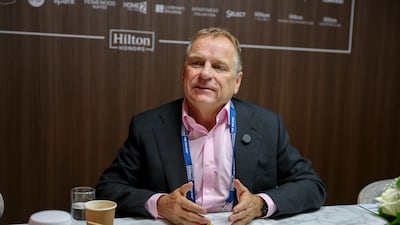

Hilton will press ahead with an aggressive expansion plan in the Middle East despite the global hospitality company suffering a sharp hit to its revenue from the Iran war, its regional head has said.
The US-based hotel operator saw revenue in the region fall “about 30 per cent” in the second quarter but performance “recovered to a 2 per cent year-on-year” decline by the third quarter. The group expects to return to prewar levels next year, Simon Vincent, Hilton’s president for Europe, Middle East and Africa, told The National on Wednesday.
EMEA president, Hilton
“We had a record Q4 [2025] in the UAE, and we started this year with a record January and February,” Mr Vincent said in an interview at the Arabian Travel Market in Dubai.

“Obviously, the crisis hit in March, and March and April were really challenging times. And [in] our second quarter, we went from a record start in January, February to minus 30 in the second quarter in terms of revenue.”
The recovery has been rapid, he said, with revenue in the third quarter expected to be “nearly flat” year on year. “So from minus 30 to minus 2 … it's a really strong recovery,” he said.
Hilton expects that momentum to continue into next year, helped by the resilience of the UAE’s tourism market and the return of international airline capacity.

“Into next year, we'll be there,” Mr Vincent said. “I think we will maintain the momentum. I think we're optimistic about the resilience of the market here.”
Emirates is “pretty much back to capacity”, while other international airlines have yet to fully restore their schedules, he added.
Introducing new brands
Despite the revenue drop, Hilton is maintaining its development push and plans to bring new brands from its global portfolio of 28 to the Middle East, which represents about 3 per cent of Hilton’s total business.
The company is on track to more than double its regional portfolio to in excess of 230 hotels – trading and pipeline – with the latter creating about 32,000 job opportunities, Mr Vincent said.
The UAE is Hilton’s largest operating market in the region, with 36 trading hotels and another 13 in the pipeline. Saudi Arabia accounts for more than 50 per cent of Hilton’s Middle East pipeline. The kingdom is a particularly “important growth market”, with 85 hotels in pipeline, Mr Vincent said.
Hilton is introducing new brands such as Spark and Tempo to Saudi Arabia as it targets a broader mix of luxury, lifestyle and mid-market properties to capture shifting demand in the region.
“We’re looking to build out all of those brands. We want activity in the luxury segment, full-service segment, mid-market, budget segments, lifestyle segments, branded residences. That’s the nature of our portfolio," he said. The company sees particular "potential for mid-market hotels", as more international visitors return to the UAE.
“The one thing that I would say about the crisis, while we saw a reduction in trading levels of business, there was no reduction in pipeline activity,” Mr Vincent said. “There’s still appetite to build new hotels.”
No job cuts during conflict
Meanwhile, Hilton chose to keep hotel teams in place during the Iran conflict rather than cut roles. “We've essentially kept our teams intact in the hotels and I think that's really important from a continuity point of view,” Mr Vincent said. The company did not furlough staff but reduced working hours during the conflict period instead.
The hotel group is now focused on rebuilding Mice (meetings, incentives, conferences and exhibitions) demand, which Mr Vincent described as a “critical part” of strengthening the appeal of Dubai as a destination.
“Leisure transient” demand is expected to return first, he said, while the company works with government and tourism authorities to rebuild business travel and events.
“There was still business to be had,” Mr Vincent said. “It may be a different type of business and it may be much more short-dated. It may be more domestic in its nature. It may be more leisure, less Mice business, less international business.”
AI to support, not replace, staff
Hilton is also expanding its use of artificial intelligence across the customer journey and back-office operations, but does not expect AI to fundamentally change the people-focused nature of hospitality, he said.
The company is integrating AI into areas including holiday research, booking, itinerary planning and the preparation for a hotel stay. “It’s really there to facilitate excellence in customer service rather than to replace individuals,” he said.
AI could also improve back-office efficiency, including recruitment, finance and human resources.
At the customer level, he said, AI could enable greater personalisation, helping travellers find restaurants, activities and other experiences tailored to their preferences.
The technology is therefore more likely to change how hotel employees work than eliminate large numbers of jobs, he said.

