
The UAE and Angola signed a Comprehensive Economic Partnership Agreement (Cepa) and other deals on Monday to boost trade between the two countries as part of President Sheikh Mohamed's state visit to the African country.
Sheikh Mohamed said the Cepa will enhance economic co-operation between the countries while also expanding trade and investment ties, state agency Wam reported.
The agreement marks a critical step in strengthening the UAE's strategic partnerships with African countries, he added.
The Cepa is expected to strengthen ties between the UAE and Angola by reducing or eliminating customs duties, removing “unnecessary” barriers to trade, allowing greater market access for service exports and creating new investment and co-operation opportunities across several sectors.
Dr Thani Al Zeyoudi, Minister of Foreign Trade, said the Cepa would increase bilateral trade between the countries to $10 billion a year by 2033. He also expects the Cepa to add about $1 billion to both countries' gross domestic product, create nearly 30,000 new jobs and reinforce the UAE's role as a key link between the Arab world, Europe, Asia and Africa.
-
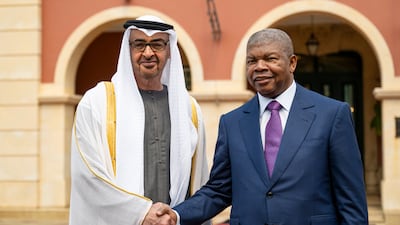
UAE President Sheikh Mohamed is received by Angolan President Joao Manuel Lourenco during a state visit to the African country. All photos: UAE Presidential Court -
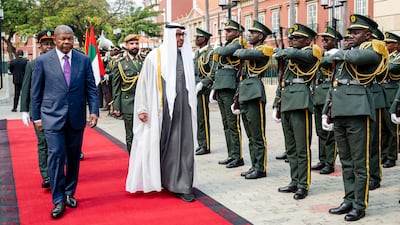
Sheikh Mohamed is given an official reception at the presidential palace in Luanda -
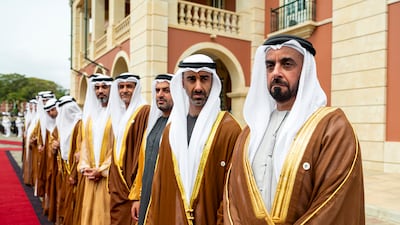
Sheikh Saif bin Zayed, Deputy Prime Minister and Minister of Interior, Sheikh Hamdan bin Mohamed, Deputy Chairman of the Presidential Court for Special Affairs, and Sheikh Mohammed bin Hamad, Adviser to the President, were among the UAE delegation -
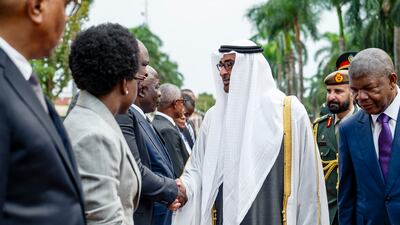
Sheikh Mohamed is greeted by senior Angolan officials, before holding talks with Mr Lourenco -
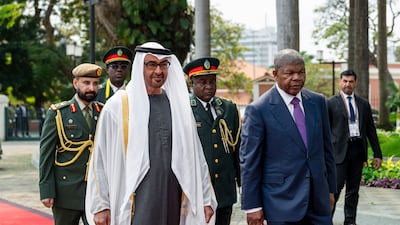
The leaders discussed joint efforts to strengthen ties in fields including energy, technology food security and logistics -
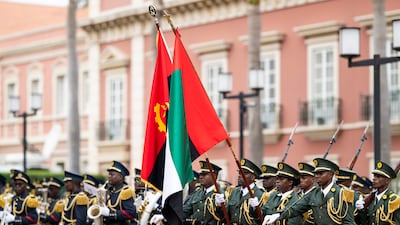
Relations between Angola and the UAE are growing, particularly in investment and development-related fields -
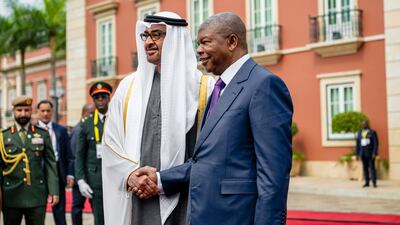
The UAE President with Mr Lourenco at the presidential palace -
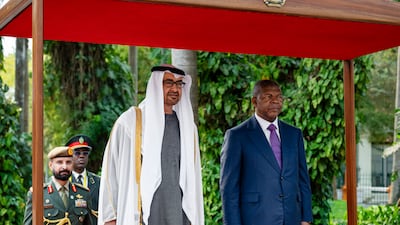
Sheikh Mohamed said the UAE and Angola were bound by their shared vision of sustainable development -

Mr Lourenco welcomes members of the UAE delegation in Luanda -
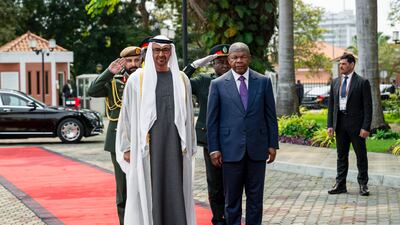
The UAE is committed to building strategic partnerships with African countries, Sheikh Mohamed said -
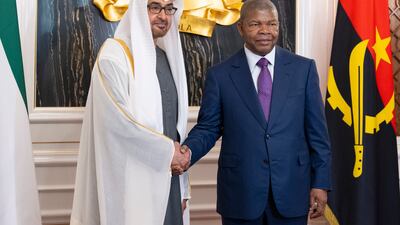
Sheikh Mohamed with Mr Lourenco, during the state visit to Angola -
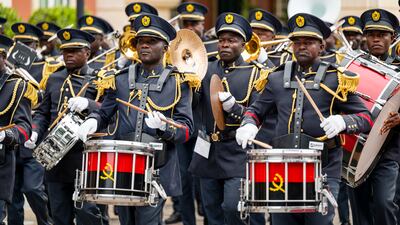
A band plays during the official reception for Sheikh Mohamed


The countries also signed an initial agreement in the field of artificial intelligence, one between the UAE Central Bank and the National Bank of Angola, and one between Al Dahra and the Angolan Ministry of Agriculture and Forestry.
Other agreements focused on tourism, investment, renewable energy, culture, education, climate action and technology, Wam reported. The agreements came as Sheikh Mohamed and Angolan President Joao Manuel Lourenco discussed progress in ties between their countries. Talks also focused on efforts to boost ties in sectors including energy, technology, agriculture, food security and logistics.
During his visit, Sheikh Mohamed noted the UAE's “keenness to further build upon its ties with Angola with the aim of supporting both countries’ aspirations for development”, Wam reported.
Non-oil trade between the UAE and Angola climbed to about $2.2 billion in 2024, and also increased in the first half of 2025 by 29.7 per cent to $1.4 billion. Economic ties between the two countries have strengthened since a 2021 agreement between Masdar and Angola's Energy Ministry on the potential implementation of a solar energy and energy storage programme.
Abu Dhabi Ports Company and Angola’s Ministry of Transport also struck an agreement in 2023 to develop maritime services and infrastructure across the African country.
Dr Al Zeyoudi said the Cepa was a key pillar in advancing the UAE's economic goals. The agreement allows for additional imports from Angola worth up to $993.6 million in products including glass, fish, fruits and optical goods. It also allows the UAE to increase exports by up to $235 million for products such as machinery, electrical equipment, plastics, rubber, ferrous metals and chemicals, as well as mineral products, Wam reported.
The Cepa programme is a key element of the UAE's economic growth plan. The Arab world's second largest economy aims to boost its gross domestic product to $800 billion by 2030, with a target of more than $1.1 trillion in total non-oil trade by 2031.
The UAE's non-oil foreign trade hit a record Dh3 trillion last year − up 14.6 per cent year-on-year − with Cepas contributing Dh135 billion ($36.8 billion), an increase of 42 per cent compared with the previous year.
The country's non-oil foreign trade also rose by 24 per cent annually in the first six months of 2025.
The Emirates has already signed 28 Cepas, with countries including Azerbaijan, Serbia, Malaysia, New Zealand, Kenya, Ukraine, the Central African Republic, Costa Rica and Mauritius. Ten of these deals – with India, Indonesia, Israel, Turkey, Cambodia, Georgia, Costa Rica, Mauritius, Serbia and Jordan – have been implemented and are operational, data from the Ministry of Foreign Trade shows.
Agreements with other trading partners, including Australia, South Korea, Malaysia, New Zealand, Chile, Kenya, Ukraine, Vietnam, the Republic of Congo, Belarus and Azerbaijan, are still to be implemented. Talks have also concluded with the Philippines, Morocco and Armenia.

