


A Dubai company that invests in technology, M Glory Holding Group, is opening an electric vehicle manufacturing plant, marking its foray into the highly competitive EV market amid the UAE's strategy to expand its manufacturing sector.
The Dh1.5 billion facility at Dubai Industrial City – which will have a total land area of 93,000 square metres – will be one of the largest in the Middle East and aims to make 55,000 EVs a year as demand for green mobility rises, the company said on Monday.
M Glory also introduced Al Damani DMV300, its first fully electric car. The venture is expected to create 1,000 jobs.
The factory is "an Emirati industrial facility with international specifications where we will manufacture environmentally-friendly electric cars, contributing to global efforts to reduce carbon emissions and support sustainable development", said Majida Al Azazi, chairwoman of M Glory Holding Group.
Ms Al Azazi laid the plant's foundation stone, together with Omar Al Suwaidi, Undersecretary in the UAE Ministry of Industry and Advanced Technology and Saud Abu Al Shawareb, managing director of Dubai Industrial City.
"The M Glory factory will employ the technologies and techniques of the Fourth Industrial Revolution ... using the latest robots in the manufacturing processes.”
The UAE is expanding efforts to shift to greener technologies, most notably under its Net Zero 2050 Strategic Initiative, which calls for Dh600bn to be invested in clean and renewable energy sources in the next three decades.
EVs play a major part in this programme, as transportation is the biggest contributor to carbon emissions. Global carbon dioxide emissions reached their highest ever annual level in 2021, rising 6 per cent to 36.3 gigatonnes, figures compiled by the International Energy Agency show.

Global sales of EVs, meanwhile, more than doubled to 6.6 million in 2021, the IEA said. The worldwide EV market has a market share of 9 per cent in the overall car industry, more than double the 4.1 per cent share in 2020 when three million units were sold, and more than triple 2019's 2.5 per cent share.
The willingness of consumers in the UAE to use EVs has continued to attract investments, including from major global players. Tesla Motors, the world's biggest EV maker, opened its showroom in Dubai in July 2017, the first in the Middle East amid signs of a maturing market for greener vehicles.
Uber Technologies, the ride-hailing company and parent of Dubai-based Careem, said at its symposium this month that one in four trips booked in the UAE will be emission-free by 2030. While just over 4 per cent of its trips are being made in EVs, the company has committed to multiplying that number six-fold by the end of the decade.
Companies in the country are also going beyond passenger vehicles to meet global green standards. This week, Barq EV, a UAE company, introduced electric delivery vehicles.
Last month, Abu Dhabi said it will host the Middle East and North Africa's first summit focused on EVs from May 23 to 25. The event is expected to attract important players in the burgeoning EV market.
chairman of the board of directors of M Glory Holding Group
The opening of the M Glory plant is also in line with the UAE's key economic diversification programmes — Operation 300bn, Make it in the Emirates and Industry 4.0 — all of which leverage the importance of manufacturing in the economy and encourage more entrepreneurship.
"The aim of these projects is to make vital sectors in the UAE, including the industrial and technological sectors, even more attractive to investors. They will also help industries of the future to develop new competitive advantages and consolidate the position of the UAE as a hub for global companies, investments and talents," Mr Al Suwaidi said.
M Glory said its EVs will be exported to the wider GCC region, Egypt, Tanzania, Senegal, Mali and Kenya. The Al Damani DMV300, with two different models built using European specifications, has a battery capacity of 52.7 kWh and can cover more than 405 kilometres on a single charge.
"Sustainability is a global responsibility and transitioning to alternative, low-emission energy sources is an integral part of achieving a greener future. The manufacturing industry can play an essential role in enabling the national net-zero strategy by delivering innovative, technology-backed solutions," Mr Al Shawareb said.
________________________
Polestar electric cars on sale in UAE as Al-Futtaim signs official deal
-
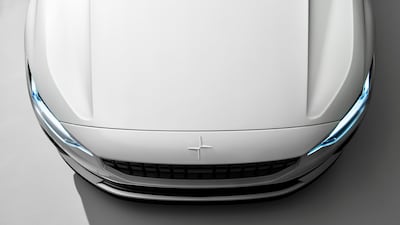
The Polestar 2 is finally available in the UAE. All photos: Polestar -
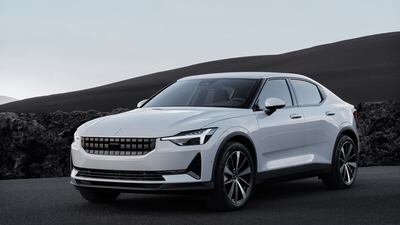
The Polestar 2 made its debut in 2019. -

The "all-vegan" interiors of the Polestar 2. -
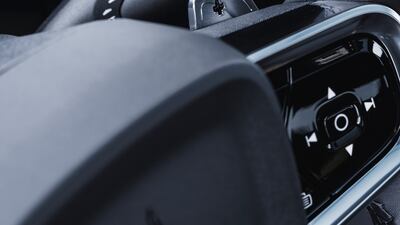
The neat centre console. -
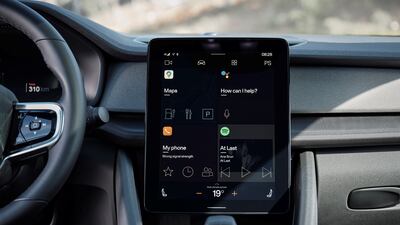
The Polestar 2's Range Assistant app. -
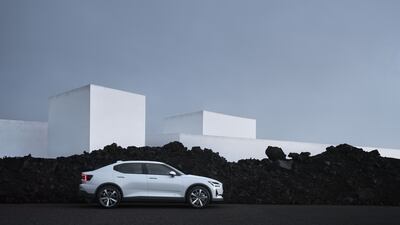
The Polestar 2 was built with sustainability in mind. -
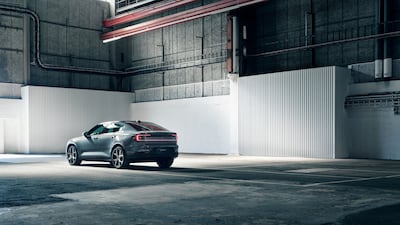
Waiting to go out. -

The Polestar 2 underwent testing in extreme conditions. -
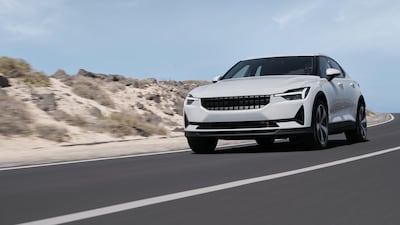
On the road in warmer climes. -
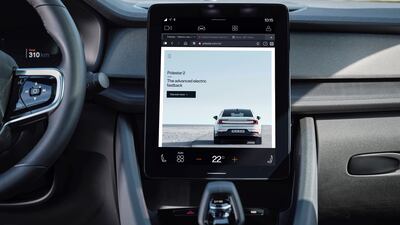
The Polestar 2's Vivaldi web browser. -

Gold-coloured shock absorbers, for when the ride gets rocky. -
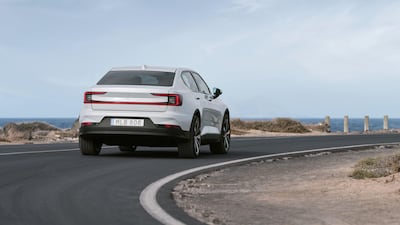
And off it goes, very quietly.



