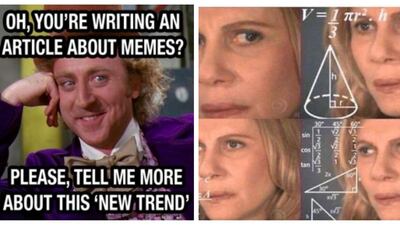
Sarcastic Willy Wonka and Confused Maths Lady are two memes which went viral. Courtesy Knowyourmeme

The meaning of memes: Where did they come from and why are they so comforting?


  • English
  • Arabic

Memes – pronounced meems, not me-mes, because you’d be surprised how many people still don’t know that – are one of those global cultural touchstones that have become synonymous with the internet.

Pre-world wide web, it used to be global events that united us, such as the 650 million people who watched the 1969 Moon landing, or the 750 million who came together to watch Prince Charles and Diana's 1981 wedding. But these days, with the dissemination of content across too many platforms to count, it's unlikely the world will ever collectively come together in the same way to witness history in the making.

Instead, the internet's democratisation of information, as well as who can access that information and when, has created an infinite number of ways in which we unify and relate to one another in a digitised world. And memes have emerged as one of those ways.

The 'It's fine' dog meme is used to communicate situations that aren't at all fine, and came from part of a comic strip created by artist KC Green. Courtesy KC Green

‘Cultural units of information’

The term "meme" was first used back in 1976. Coined by British evolutionary biologist and author Richard Dawkins in his book The Selfish Gene, Dawkins, when searching for a word to describe the concept of the transmission of an idea, blended the Greek word "mimeme" – meaning something that is imitated – with gene.

Of course, back then, Dawkins wasn’t referring to cats that “can haz cheeseburgers” or dogs claiming they’re “fine” in a house that’s burning down around them, but rather was talking about culture and memes were, as he put it, “cultural units of information".

Fittingly, thanks to his invention of the word, Dawkins went on to become a meme himself in a meta move he thankfully seems to find amusing.

Richard Dawkins, who coined the word 'meme' back in 1976, has himself become a meme thanks to his contribution. Courtesy LifeWire

Fast-forward 45 years and memes, along with gifs and emojis, have become the currency of communication, not only online, but also segueing easily into daily conversations, whether face-to-face or via WhatsApp.

With the right app and a soupcon of observational creativity, anyone can become a maker of memes, plugging their own little snippets of culture directly into the relentless machine that is the internet.

‘Memes unify people … they make them feel less alone’

"Our Instagram was an organic transition from a group chat we had, wherein we would discuss our lives and our misadventures, which we then humourised and turned into memes," Lola Tash tells The National.

The actress and writer, along with her sisters Nora and Gina Tash, and best friend Nicole Argiris, run the meme-based Instagram account MyTherapistSays, which currently has more than 6.1 million followers.

Clockwise from top left: Gina Tash, Lola Tash, Nora Tash and Nicole Argiris, the founders of, and content creators for, Instagram meme account @MyTherapistSays, which has more than 6.1 million followers. Courtesy @MyTherapistSays

“We would validate the bad advice we were giving each other constantly by saying, ‘Well, my therapist said …’, although our therapists never actually advised any such thing. We were dealing with a lot personally, and satirising it helped alleviate some of the more severe aspects of the hands we'd been dealt. From that, we thought it would be a fun outlet to channel our stresses and anxieties into creating memes, anonymously, based on our lives.”

You want to forget your life for a few silly moments and laugh at the misadventures of others, instead of being so focused on your own

Often featuring memes that are liked by and commented on by celebrities including Gwyneth Paltrow, Chrissy Teigen and a whole host of A-listers and supermodels, MyTherapistSays, which launched in July 2015, has, along with TheFatJewish, LadBible and TankSinatra, become one of the most popular meme accounts on social media.

“We think, and especially now, there is a need for both escapism and unity,” says Argiris of the inherent value of memes in modern society.

“You want to forget your life for a few silly moments and laugh at the misadventures of others, instead of being so focused on your own. But when you see a whole community dealing with what you’re dealing with and overcoming these challenges together, it fills you with a sense of strength. That’s why memes tend to unify people since they see others, just like them, with their struggles and their quirks, and it makes them feel less alone.”

‘They break down topics in a format that is more easily consumed’

One of the earliest memes featured the cartoon character Pepe the Frog, created by Matt Furie in 2005 for the comic Boy's Club. Unfortunately for Pepe, his appropriation by the alt-right saw him fall out of favour in mainstream meme-making, while for many others, the Dancing Baby – which then made the leap on to the small screen in TV show Ally McBeal – was their first brush with meme culture.

Followers of @MyTherapistSays visit the account for memes that reflect their own lives and which the creators say help 'channel our stresses and anxieties'. Courtesy @MyTherapistSays

Since then, even your grandparents are likely to have forwarded you memes featuring Blinking Guy, Confused Math Woman or Success Kid. And who among us hasn’t been soothed by a stressed-out Spongebob Squarepants, been judged by Grumpy Cat or related to a zeitgeisty Distracted Boyfriend zinger? But why do some memes go viral, while others don’t? What makes a meme stick in the global collective consciousness?

“A crossover from two distinct sides,” explains Dubai creative social strategist Alexandra Maia, founder of @alexhouseofsocial, of why some memes just make it. “For example, politics to cultural current trends, or something mainstream with something from pop culture – two very opposite or random things getting mixed together.”

Creative social strategist Alexandra Maia. Courtesy @alexhouseofsocial

And according to Maia, the benefits of memes are far-reaching.

“Memes not only show there is a great appetite for humour on social media – people want to laugh, they want a break from their troubles – they have also created a lot of opportunities for talented people who can create this type of content,” she says.

“A larger impact is the ability of memes that cross over from politics to cultural current trends, allowing for certain topics to gain larger attention in a format that is more easily consumed.”

This is an insight the MyTherapistSays creators agree with. “There is something to be said for our attention span not being able to process too much long-form content, but never tiring of the short-and-quick nature of memes,” says Argiris.

‘Be cheerful, Live your life’: The first meme from 3 BC

Salt Bae, AKA chef and restaurateur Nusret Gokce, inadvertently became a global meme thanks to his unique way of seasoning food. Courtesy Knowyourmeme

Just as the modern world didn’t invent graffiti, with ancient Greeks and Romans scrawling slogans and insults on public walls, and initials being carved into tree trunks since humans first encountered bark, nor are memes a particularly modern invention.

Anthropologists have long joked that the first meme dates back to 3 BC after archaeologists uncovered in what used to be the ancient city of Antioch, now modern Turkey, a mosaic image of a skeleton above the inscription: “Be cheerful, live your life.”

The world’s first Yolo, anyone?

“We think memes take the complexities of life, the struggles and inconsistencies, and summarise them in such a quick and quippy way where you're almost taken aback by the brutally funny honesty,” says Nora Tash.

“However, at the same time, it is incredibly creative, in its own special way, to be able to verbalise so aptly and honestly the trials and tribulations of everyday life in a way in which millions of people from different backgrounds, genders and experiences can still all come together and say: ‘This is so me!’”

Teri%20Baaton%20Mein%20Aisa%20Uljha%20Jiya
%3Cp%3E%3Cstrong%3EDirectors%3A%3C%2Fstrong%3E%20Amit%20Joshi%20and%20Aradhana%20Sah%3C%2Fp%3E%0A%3Cp%3E%3Cstrong%3ECast%3A%3C%2Fstrong%3E%20Shahid%20Kapoor%2C%20Kriti%20Sanon%2C%20Dharmendra%2C%20Dimple%20Kapadia%2C%20Rakesh%20Bedi%3C%2Fp%3E%0A%3Cp%3E%3Cstrong%3ERating%3A%3C%2Fstrong%3E%204%2F5%3C%2Fp%3E%0A

Mercer, the investment consulting arm of US services company Marsh & McLennan, expects its wealth division to at least double its assets under management (AUM) in the Middle East as wealth in the region continues to grow despite economic headwinds, a company official said.

Mercer Wealth, which globally has $160 billion in AUM, plans to boost its AUM in the region to $2-$3bn in the next 2-3 years from the present $1bn, said Yasir AbuShaban, a Dubai-based principal with Mercer Wealth.

Within the next two to three years, we are looking at reaching $2 to $3 billion as a conservative estimate and we do see an opportunity to do so,” said Mr AbuShaban.

Mercer does not directly make investments, but allocates clients’ money they have discretion to, to professional asset managers. They also provide advice to clients.

“We have buying power. We can negotiate on their (client’s) behalf with asset managers to provide them lower fees than they otherwise would have to get on their own,” he added.

Mercer Wealth’s clients include sovereign wealth funds, family offices, and insurance companies among others.

From its office in Dubai, Mercer also looks after Africa, India and Turkey, where they also see opportunity for growth.

Wealth creation in Middle East and Africa (MEA) grew 8.5 per cent to $8.1 trillion last year from $7.5tn in 2015, higher than last year’s global average of 6 per cent and the second-highest growth in a region after Asia-Pacific which grew 9.9 per cent, according to consultancy Boston Consulting Group (BCG). In the region, where wealth grew just 1.9 per cent in 2015 compared with 2014, a pickup in oil prices has helped in wealth generation.

BCG is forecasting MEA wealth will rise to $12tn by 2021, growing at an annual average of 8 per cent.

Drivers of wealth generation in the region will be split evenly between new wealth creation and growth of performance of existing assets, according to BCG.

Another general trend in the region is clients’ looking for a comprehensive approach to investing, according to Mr AbuShaban.

“Institutional investors or some of the families are seeing a slowdown in the available capital they have to invest and in that sense they are looking at optimizing the way they manage their portfolios and making sure they are not investing haphazardly and different parts of their investment are working together,” said Mr AbuShaban.

Some clients also have a higher appetite for risk, given the low interest-rate environment that does not provide enough yield for some institutional investors. These clients are keen to invest in illiquid assets, such as private equity and infrastructure.

“What we have seen is a desire for higher returns in what has been a low-return environment specifically in various fixed income or bonds,” he said.

“In this environment, we have seen a de facto increase in the risk that clients are taking in things like illiquid investments, private equity investments, infrastructure and private debt, those kind of investments were higher illiquidity results in incrementally higher returns.”

The Abu Dhabi Investment Authority, one of the largest sovereign wealth funds, said in its 2016 report that has gradually increased its exposure in direct private equity and private credit transactions, mainly in Asian markets and especially in China and India. The authority’s private equity department focused on structured equities owing to “their defensive characteristics.”

The%20Boy%20and%20the%20Heron
%3Cp%3E%3Cstrong%3EDirector%3A%C2%A0%3C%2Fstrong%3EHayao%20Miyazaki%3C%2Fp%3E%0A%3Cp%3E%3Cstrong%3EStarring%3A%3C%2Fstrong%3E%C2%A0Soma%20Santoki%2C%20Masaki%20Suda%2C%20Ko%20Shibasaki%3C%2Fp%3E%0A%3Cp%3E%3Cstrong%3ERating%3A%20%3C%2Fstrong%3E5%2F5%3C%2Fp%3E%0A
Avatar: Fire and Ash

Director: James Cameron

Starring: Sam Worthington, Sigourney Weaver, Zoe Saldana

Rating: 4.5/5

Sweet%20Tooth
%3Cp%3E%3Cstrong%3ECreator%3A%20%3C%2Fstrong%3EJim%20Mickle%3Cbr%3E%3Cstrong%3EStarring%3A%20%3C%2Fstrong%3EChristian%20Convery%2C%20Nonso%20Anozie%2C%20Adeel%20Akhtar%2C%20Stefania%20LaVie%20Owen%3Cbr%3E%3Cstrong%3ERating%3A%20%3C%2Fstrong%3E2.5%2F5%3C%2Fp%3E%0A
UAE currency: the story behind the money in your pockets
