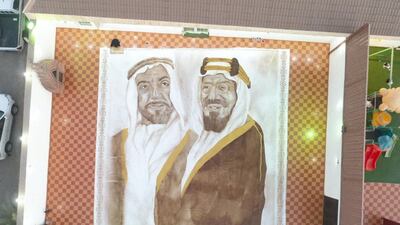
Ohud Abdullah Almalki has just become the first Saudi woman to achieve a Guinness World Records title single-handedly, according to the global authority on record-breaking achievements.
The Saudi artist created the world’s largest coffee painting in the Al Naseem neighbourhood in Jeddah using expired granules.
The painting, called Naseej 1, is spread over 220.968 square metres. It is 15.84 meters long, and 13.95 metres wide, and has been made out of seven connected cotton cloths; each measuring 15.84 metres long and 2 metres wide.
Prior to this, the largest coffee painting created was 158.37 square metres and was achieved by Alex Dzaghigian in Greece in January 2020.
Almalki, a student in fifth year of College of Law at King AbdulAziz University, used 4.5kg of coffee powder to create the artwork. She used only expired coffee powder to be mindful of waste.
“It took me 45 days of continuous work to complete, under the watchful eyes of two witnesses, video recording and drone footage,” Almalki said.
“Normally, only one kind of coffee is used in such paintings, but I have used four different shades of brown coffee. I used several rollers and paint brushes of different sizes to finish this project.”
The painting illustrates seven renowned figures of Saudi Arabia and the United Arab Emirates.
The two largest portraits are that of the founding fathers of the two nations, the late King Abdulaziz bin Abdul Rahman, and the late Sheikh Zayed Bin Sultan Al Nahyan.
Below are paintings of Saudi and UAE rulers including the Custodian of the Two Holy Mosques King Salman bin Abdulaziz, Sheikh Khalifa bin Zayed, Sheikh Mohammed bin Rashid, Sheikh Mohammed bin Zayed, and Prince Mohammed bin Salman bin Abdulaziz.
The artist said that the piece was created to “remind the world of the centuries-old entente between the two nations.”
Women of Saudi Arabia have taken part in Guinness World Records attempts in the past, but this is the first time a Saudi woman has achieved a GWR world record on her own.
In 2015, the largest human awareness ribbon consisted of 8,264 participants and was achieved by the women of Saudi Arabia at an event organised by 10KSA in Riyadh.
“This tremendous feat would have been impossible without the support of the people around me. I wish this will contribute to empowering the women in Saudi Arabia and beyond,” says Almalki.

In numbers: PKK’s money network in Europe
Germany: PKK collectors typically bring in $18 million in cash a year – amount has trebled since 2010
Revolutionary tax: Investigators say about $2 million a year raised from ‘tax collection’ around Marseille
Extortion: Gunman convicted in 2023 of demanding $10,000 from Kurdish businessman in Stockholm
Drug trade: PKK income claimed by Turkish anti-drugs force in 2024 to be as high as $500 million a year
Denmark: PKK one of two terrorist groups along with Iranian separatists ASMLA to raise “two-digit million amounts”
Contributions: Hundreds of euros expected from typical Kurdish families and thousands from business owners
TV channel: Kurdish Roj TV accounts frozen and went bankrupt after Denmark fined it more than $1 million over PKK links in 2013
Whiile you're here
Damien McElroy: Anti-science attitudes in America are proving lethal
Editorial: What makes the UAE such a good place to test vaccines?
Editorial: The fight against Covid-19 should be guided by science
Terror attacks in Paris, November 13, 2015
- At 9.16pm, three suicide attackers killed one person outside the Atade de France during a foootball match between France and Germany
- At 9.25pm, three attackers opened fire on restaurants and cafes over 20 minutes, killing 39 people
- Shortly after 9.40pm, three other attackers launched a three-hour raid on the Bataclan, in which 1,500 people had gathered to watch a rock concert. In total, 90 people were killed
- Salah Abdeslam, the only survivor of the terrorists, did not directly participate in the attacks, thought to be due to a technical glitch in his suicide vest
- He fled to Belgium and was involved in attacks on Brussels in March 2016. He is serving a life sentence in France
Mercer, the investment consulting arm of US services company Marsh & McLennan, expects its wealth division to at least double its assets under management (AUM) in the Middle East as wealth in the region continues to grow despite economic headwinds, a company official said.
Mercer Wealth, which globally has $160 billion in AUM, plans to boost its AUM in the region to $2-$3bn in the next 2-3 years from the present $1bn, said Yasir AbuShaban, a Dubai-based principal with Mercer Wealth.
“Within the next two to three years, we are looking at reaching $2 to $3 billion as a conservative estimate and we do see an opportunity to do so,” said Mr AbuShaban.
Mercer does not directly make investments, but allocates clients’ money they have discretion to, to professional asset managers. They also provide advice to clients.
“We have buying power. We can negotiate on their (client’s) behalf with asset managers to provide them lower fees than they otherwise would have to get on their own,” he added.
Mercer Wealth’s clients include sovereign wealth funds, family offices, and insurance companies among others.
From its office in Dubai, Mercer also looks after Africa, India and Turkey, where they also see opportunity for growth.
Wealth creation in Middle East and Africa (MEA) grew 8.5 per cent to $8.1 trillion last year from $7.5tn in 2015, higher than last year’s global average of 6 per cent and the second-highest growth in a region after Asia-Pacific which grew 9.9 per cent, according to consultancy Boston Consulting Group (BCG). In the region, where wealth grew just 1.9 per cent in 2015 compared with 2014, a pickup in oil prices has helped in wealth generation.
BCG is forecasting MEA wealth will rise to $12tn by 2021, growing at an annual average of 8 per cent.
Drivers of wealth generation in the region will be split evenly between new wealth creation and growth of performance of existing assets, according to BCG.
Another general trend in the region is clients’ looking for a comprehensive approach to investing, according to Mr AbuShaban.
“Institutional investors or some of the families are seeing a slowdown in the available capital they have to invest and in that sense they are looking at optimizing the way they manage their portfolios and making sure they are not investing haphazardly and different parts of their investment are working together,” said Mr AbuShaban.
Some clients also have a higher appetite for risk, given the low interest-rate environment that does not provide enough yield for some institutional investors. These clients are keen to invest in illiquid assets, such as private equity and infrastructure.
“What we have seen is a desire for higher returns in what has been a low-return environment specifically in various fixed income or bonds,” he said.
“In this environment, we have seen a de facto increase in the risk that clients are taking in things like illiquid investments, private equity investments, infrastructure and private debt, those kind of investments were higher illiquidity results in incrementally higher returns.”
The Abu Dhabi Investment Authority, one of the largest sovereign wealth funds, said in its 2016 report that has gradually increased its exposure in direct private equity and private credit transactions, mainly in Asian markets and especially in China and India. The authority’s private equity department focused on structured equities owing to “their defensive characteristics.”
Lexus LX700h specs
Engine: 3.4-litre twin-turbo V6 plus supplementary electric motor
Power: 464hp at 5,200rpm
Torque: 790Nm from 2,000-3,600rpm
Transmission: 10-speed auto
Fuel consumption: 11.7L/100km
On sale: Now
Price: From Dh590,000
More from this story
What is tokenisation?
Tokenisation refers to the issuance of a blockchain token, which represents a virtually tradable real, tangible asset. A tokenised asset is easily transferable, offers good liquidity, returns and is easily traded on the secondary markets.
COMPANY%20PROFILE%20
Zayed Sustainability Prize
Dubai works towards better air quality by 2021
Dubai is on a mission to record good air quality for 90 per cent of the year – up from 86 per cent annually today – by 2021.
The municipality plans to have seven mobile air-monitoring stations by 2020 to capture more accurate data in hourly and daily trends of pollution.
These will be on the Palm Jumeirah, Al Qusais, Muhaisnah, Rashidiyah, Al Wasl, Al Quoz and Dubai Investment Park.
“It will allow real-time responding for emergency cases,” said Khaldoon Al Daraji, first environment safety officer at the municipality.
“We’re in a good position except for the cases that are out of our hands, such as sandstorms.
“Sandstorms are our main concern because the UAE is just a receiver.
“The hotspots are Iran, Saudi Arabia and southern Iraq, but we’re working hard with the region to reduce the cycle of sandstorm generation.”
Mr Al Daraji said monitoring as it stood covered 47 per cent of Dubai.
There are 12 fixed stations in the emirate, but Dubai also receives information from monitors belonging to other entities.
“There are 25 stations in total,” Mr Al Daraji said.
“We added new technology and equipment used for the first time for the detection of heavy metals.
“A hundred parameters can be detected but we want to expand it to make sure that the data captured can allow a baseline study in some areas to ensure they are well positioned.”
Our legal columnist
Name: Yousef Al Bahar
Advocate at Al Bahar & Associate Advocates and Legal Consultants, established in 1994
Education: Mr Al Bahar was born in 1979 and graduated in 2008 from the Judicial Institute. He took after his father, who was one of the first Emirati lawyers
You might also like
BUNDESLIGA FIXTURES
Saturday, May 16 (kick-offs UAE time)
Borussia Dortmund v Schalke (4.30pm)
RB Leipzig v Freiburg (4.30pm)
Hoffenheim v Hertha Berlin (4.30pm)
Fortuna Dusseldorf v Paderborn (4.30pm)
Augsburg v Wolfsburg (4.30pm)
Eintracht Frankfurt v Borussia Monchengladbach (7.30pm)
Sunday, May 17
Cologne v Mainz (4.30pm),
Union Berlin v Bayern Munich (7pm)
Monday, May 18
Werder Bremen v Bayer Leverkusen (9.30pm)
World Mental Health Day
Analysis
Members of Syria's Alawite minority community face threat in their heartland after one of the deadliest days in country’s recent history. Read more
'Midnights'
White hydrogen: Naturally occurring hydrogen
Chromite: Hard, metallic mineral containing iron oxide and chromium oxide
Ultramafic rocks: Dark-coloured rocks rich in magnesium or iron with very low silica content
Ophiolite: A section of the earth’s crust, which is oceanic in nature that has since been uplifted and exposed on land
Olivine: A commonly occurring magnesium iron silicate mineral that derives its name for its olive-green yellow-green colour
Ten tax points to be aware of in 2026
1. Domestic VAT refund amendments: request your refund within five years
If a business does not apply for the refund on time, they lose their credit.
2. E-invoicing in the UAE
Businesses should continue preparing for the implementation of e-invoicing in the UAE, with 2026 a preparation and transition period ahead of phased mandatory adoption.
3. More tax audits
Tax authorities are increasingly using data already available across multiple filings to identify audit risks.
4. More beneficial VAT and excise tax penalty regime
Tax disputes are expected to become more frequent and more structured, with clearer administrative objection and appeal processes. The UAE has adopted a new penalty regime for VAT and excise disputes, which now mirrors the penalty regime for corporate tax.
5. Greater emphasis on statutory audit
There is a greater need for the accuracy of financial statements. The International Financial Reporting Standards standards need to be strictly adhered to and, as a result, the quality of the audits will need to increase.
6. Further transfer pricing enforcement
Transfer pricing enforcement, which refers to the practice of establishing prices for internal transactions between related entities, is expected to broaden in scope. The UAE will shortly open the possibility to negotiate advance pricing agreements, or essentially rulings for transfer pricing purposes.
7. Limited time periods for audits
Recent amendments also introduce a default five-year limitation period for tax audits and assessments, subject to specific statutory exceptions. While the standard audit and assessment period is five years, this may be extended to up to 15 years in cases involving fraud or tax evasion.
8. Pillar 2 implementation
Many multinational groups will begin to feel the practical effect of the Domestic Minimum Top-Up Tax (DMTT), the UAE's implementation of the OECD’s global minimum tax under Pillar 2. While the rules apply for financial years starting on or after January 1, 2025, it is 2026 that marks the transition to an operational phase.
9. Reduced compliance obligations for imported goods and services
Businesses that apply the reverse-charge mechanism for VAT purposes in the UAE may benefit from reduced compliance obligations.
10. Substance and CbC reporting focus
Tax authorities are expected to continue strengthening the enforcement of economic substance and Country-by-Country (CbC) reporting frameworks. In the UAE, these regimes are increasingly being used as risk-assessment tools, providing tax authorities with a comprehensive view of multinational groups’ global footprints and enabling them to assess whether profits are aligned with real economic activity.
Contributed by Thomas Vanhee and Hend Rashwan, Aurifer
The specs: Fenyr SuperSport
Price, base: Dh5.1 million
Engine: 3.8-litre twin-turbo flat-six
Transmission: Seven-speed automatic
Power: 800hp @ 7,100pm
Torque: 980Nm @ 4,000rpm
Fuel economy, combined: 13.5L / 100km
ESSENTIALS
The flights
Emirates, Etihad and Swiss fly direct from the UAE to Zurich from Dh2,855 return, including taxes.
The chalet
Chalet N is currently open in winter only, between now and April 21. During the ski season, starting on December 11, a week’s rental costs from €210,000 (Dh898,431) per week for the whole property, which has 22 beds in total, across six suites, three double rooms and a children’s suite. The price includes all scheduled meals, a week’s ski pass, Wi-Fi, parking, transfers between Munich, Innsbruck or Zurich airports and one 50-minute massage per person. Private ski lessons cost from €360 (Dh1,541) per day. Halal food is available on request.
Profile of Udrive
Date started: March 2016
Founder: Hasib Khan
Based: Dubai
Employees: 40
Amount raised (to date): $3.25m – $750,000 seed funding in 2017 and a Seed round of $2.5m last year. Raised $1.3m from Eureeca investors in January 2021 as part of a Series A round with a $5m target.
Who is Allegra Stratton?
- Previously worked at The Guardian, BBC’s Newsnight programme and ITV News
- Took up a public relations role for Chancellor Rishi Sunak in April 2020
- In October 2020 she was hired to lead No 10’s planned daily televised press briefings
- The idea was later scrapped and she was appointed spokeswoman for Cop26
- Ms Stratton, 41, is married to James Forsyth, the political editor of The Spectator
- She has strong connections to the Conservative establishment
- Mr Sunak served as best man at her 2011 wedding to Mr Forsyth
if you go
The flights
Etihad, Emirates and Singapore Airlines fly direct from the UAE to Singapore from Dh2,265 return including taxes. The flight takes about 7 hours.
The hotel
Rooms at the M Social Singapore cost from SG $179 (Dh488) per night including taxes.
The tour
Makan Makan Walking group tours costs from SG $90 (Dh245) per person for about three hours. Tailor-made tours can be arranged. For details go to www.woknstroll.com.sg
• Remittance charges will be tackled by blockchain
• UAE's monumental and risky Mars Mission to inspire future generations, says minister
• Could the UAE drive India's economy?
• News has a bright future and the UAE is at the heart of it
• Architecture is over - here's cybertecture
• The National announces Future of News journalism competition
• Round up: Experts share their visions of the world to come


