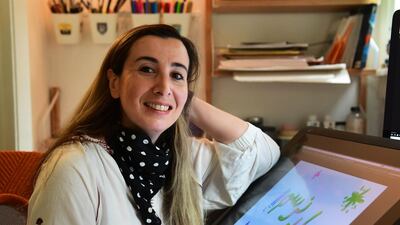
Artist Reem Ali Adeeb poses in her studio apartment in Los Angeles, California, where she is developing online tutorials in Arabic. AFP

‘There is a lack of videos for Arabic speakers’: Syrian animator in Hollywood creates content for children in lockdown


Katy Gillett
  • English
  • Arabic

Reem Ali Adeeb, an animation artist who works for Warner Bros Entertainment, might be safe from the coronavirus in her Los Angeles home, working on Netflix series Green Eggs and Ham, but her thoughts lie with the children struggling in her homeland.

"My biggest concern is for the Syrian children, who are, in fact, not at home but in tents in camps," she tells The National. "Refugee children are the most vulnerable demographic during these times. Me and every Syrian I know are concerned for them and wish for these kids to be protected."

It’s children in the Middle East that she and her sister, Sandi, who is based in Qatar, started their new project for. It’s a YouTube channel called Susupreemo that is full of interactive Arabic-language tutorials that focus on arts and crafts.

“We are producing fun, entertaining videos for kids,” Adeeb says. “All the video titles start with ‘yallah’ or ‘let us’, so it’s not a tutorial so much as an interactive experience, whether to draw, read or do crafts together.

The words 'Let's Draw' in Arabic on Reem Ali Adeeb's screen. AFP

“Our hope is for kids to [have] fun but with creative and beneficial screen time, and to watch content that feels like it’s specially made for them.”

Adeeb believes there is a huge lack of Arabic-language content on the internet. Why? “That is a great but big question,” she says. “There are a lot of reasons, but my guess would be the lack of funding. Not a lot of Arab investors seem to be interested in creating content that benefits and nourishes the young generation. And those who do invest usually come with an agenda, whether it’s cultural or to sell children toys or magazines.”

While there is plenty of dubbed entertainment coming from the East and West, Adeeb believes there should be more content tailor-made for Arabic-speaking youth, including animation, educational and musical shows.

“Entertainment that is true to their reality and speaks their language,” she says. “Things to watch on TV that carry a positive, happy message.”

That is why this project is so dear to her heart. “I want to make content that makes the Arabic-speaking kid feel special and creative,” says Adeeb. “I want them to listen to these stories and feel like she or he has a place in the world, and the world is encouraging her or him to create and be themselves.”

At the moment, there are seven videos that have been co-created by the siblings and uploaded to their YouTube channel. These are basic tutorials on drawing, making origami or simply reading children’s books aloud. There is also a Facebook page, where the pair interact with parents and children, who send in drawings and suggestions for other content.

I'm thinking of a kid who loves to draw or just spend time with paper and colour

“We are hoping to lift their spirits and distract them from the current events, but at the same time [encourage them to] not stay passively watching but actually create and draw along with the video – and hopefully make something they could be proud of, and show their parents or put on the fridge door,” she says.

While Adeeb insists she did not have a specific type of child in mind when creating the content, she believes the videos would be most beneficial to those aged between 5 and 12. “When making the videos, I’m thinking of a kid who loves to draw or just spend time with paper and colour. I want to give him or her the encouragement they need to keep drawing and maybe a few tips that will improve their skills and therefore [allow them to] enjoy drawing more.”

Hollywood animation artist Reem Ali Adeeb in her studio apartment. AFP

Drawing is Adeeb's life after all. She was born and raised in Damascus, and got her first job in animation in the city at the age of 19. It was with a studio called Star Animation, where she co-directed a short film called Laila and the Wolf, which got accepted in Syria's Shabablek Film Festival. Her second film, The Traveller, was created for her graduation project at Damascus University.

After winning a grant from the Syrian government to co-create a short for the Damascus Arab Cultural Capital event, Adeeb moved to San Francisco in 2008 to pursue her passion for animation and study a master’s in the subject at the Academy of Art University. She has been in the US ever since, working with studios as a character designer and with prominent artists she respects, such as Pascal Campion and Bill Perkins.

My goal is to feature more Arabic-speaking artists and offer a platform where they can speak to the younger generation

The pandemic has seen the animation industry in Los Angeles shift to working from home, a change she has found difficult to adjust to. “I tend to thrive in a group set-up where I’m surrounded by my coworkers,” she says. “The nice thing about it is now there is a little bit more time for a project like [Susupreemo]. The lack of commute and social events gave me a little more time.

"My sister Sandi cannot say the same thing because she is a working mum who is now also home-schooling her 7-year-old.”

With the extra time, Adeeb is planning to produce more valuable content for children. “We are looking to create more reading videos, more drawing videos and hopefully dance and music videos in the near future,” she says. “And for the far future, my goal is to feature more Arabic-speaking artists and offer a platform where established artists can speak to the younger generation about art and literature, and inspire them.”


Mercer, the investment consulting arm of US services company Marsh & McLennan, expects its wealth division to at least double its assets under management (AUM) in the Middle East as wealth in the region continues to grow despite economic headwinds, a company official said.

Mercer Wealth, which globally has $160 billion in AUM, plans to boost its AUM in the region to $2-$3bn in the next 2-3 years from the present $1bn, said Yasir AbuShaban, a Dubai-based principal with Mercer Wealth.

Within the next two to three years, we are looking at reaching $2 to $3 billion as a conservative estimate and we do see an opportunity to do so,” said Mr AbuShaban.

Mercer does not directly make investments, but allocates clients’ money they have discretion to, to professional asset managers. They also provide advice to clients.

“We have buying power. We can negotiate on their (client’s) behalf with asset managers to provide them lower fees than they otherwise would have to get on their own,” he added.

Mercer Wealth’s clients include sovereign wealth funds, family offices, and insurance companies among others.

From its office in Dubai, Mercer also looks after Africa, India and Turkey, where they also see opportunity for growth.

Wealth creation in Middle East and Africa (MEA) grew 8.5 per cent to $8.1 trillion last year from $7.5tn in 2015, higher than last year’s global average of 6 per cent and the second-highest growth in a region after Asia-Pacific which grew 9.9 per cent, according to consultancy Boston Consulting Group (BCG). In the region, where wealth grew just 1.9 per cent in 2015 compared with 2014, a pickup in oil prices has helped in wealth generation.

BCG is forecasting MEA wealth will rise to $12tn by 2021, growing at an annual average of 8 per cent.

Drivers of wealth generation in the region will be split evenly between new wealth creation and growth of performance of existing assets, according to BCG.

Another general trend in the region is clients’ looking for a comprehensive approach to investing, according to Mr AbuShaban.

“Institutional investors or some of the families are seeing a slowdown in the available capital they have to invest and in that sense they are looking at optimizing the way they manage their portfolios and making sure they are not investing haphazardly and different parts of their investment are working together,” said Mr AbuShaban.

Some clients also have a higher appetite for risk, given the low interest-rate environment that does not provide enough yield for some institutional investors. These clients are keen to invest in illiquid assets, such as private equity and infrastructure.

“What we have seen is a desire for higher returns in what has been a low-return environment specifically in various fixed income or bonds,” he said.

“In this environment, we have seen a de facto increase in the risk that clients are taking in things like illiquid investments, private equity investments, infrastructure and private debt, those kind of investments were higher illiquidity results in incrementally higher returns.”

The Abu Dhabi Investment Authority, one of the largest sovereign wealth funds, said in its 2016 report that has gradually increased its exposure in direct private equity and private credit transactions, mainly in Asian markets and especially in China and India. The authority’s private equity department focused on structured equities owing to “their defensive characteristics.”

ETFs explained

Exhchange traded funds are bought and sold like shares, but operate as index-tracking funds, passively following their chosen indices, such as the S&P 500, FTSE 100 and the FTSE All World, plus a vast range of smaller exchanges and commodities, such as gold, silver, copper sugar, coffee and oil.

ETFs have zero upfront fees and annual charges as low as 0.07 per cent a year, which means you get to keep more of your returns, as actively managed funds can charge as much as 1.5 per cent a year.

There are thousands to choose from, with the five biggest providers BlackRock’s iShares range, Vanguard, State Street Global Advisors SPDR ETFs, Deutsche Bank AWM X-trackers and Invesco PowerShares.

Ten tax points to be aware of in 2026

1. Domestic VAT refund amendments: request your refund within five years

If a business does not apply for the refund on time, they lose their credit.

2. E-invoicing in the UAE

Businesses should continue preparing for the implementation of e-invoicing in the UAE, with 2026 a preparation and transition period ahead of phased mandatory adoption. 

3. More tax audits

Tax authorities are increasingly using data already available across multiple filings to identify audit risks. 

4. More beneficial VAT and excise tax penalty regime

Tax disputes are expected to become more frequent and more structured, with clearer administrative objection and appeal processes. The UAE has adopted a new penalty regime for VAT and excise disputes, which now mirrors the penalty regime for corporate tax.

5. Greater emphasis on statutory audit

There is a greater need for the accuracy of financial statements. The International Financial Reporting Standards standards need to be strictly adhered to and, as a result, the quality of the audits will need to increase.

6. Further transfer pricing enforcement

Transfer pricing enforcement, which refers to the practice of establishing prices for internal transactions between related entities, is expected to broaden in scope. The UAE will shortly open the possibility to negotiate advance pricing agreements, or essentially rulings for transfer pricing purposes. 

7. Limited time periods for audits

Recent amendments also introduce a default five-year limitation period for tax audits and assessments, subject to specific statutory exceptions. While the standard audit and assessment period is five years, this may be extended to up to 15 years in cases involving fraud or tax evasion. 

8. Pillar 2 implementation 

Many multinational groups will begin to feel the practical effect of the Domestic Minimum Top-Up Tax (DMTT), the UAE's implementation of the OECD’s global minimum tax under Pillar 2. While the rules apply for financial years starting on or after January 1, 2025, it is 2026 that marks the transition to an operational phase.

9. Reduced compliance obligations for imported goods and services

Businesses that apply the reverse-charge mechanism for VAT purposes in the UAE may benefit from reduced compliance obligations. 

10. Substance and CbC reporting focus

Tax authorities are expected to continue strengthening the enforcement of economic substance and Country-by-Country (CbC) reporting frameworks. In the UAE, these regimes are increasingly being used as risk-assessment tools, providing tax authorities with a comprehensive view of multinational groups’ global footprints and enabling them to assess whether profits are aligned with real economic activity. 

Contributed by Thomas Vanhee and Hend Rashwan, Aurifer