

Russell Peters is all set to perform at Maraya, AlUla for the first time on Friday evening.
The world-renowned stand-up comedian, 51, says he is excited to hit the stage, telling The National: "I had never heard of AlUla before. When I got here, I was like, 'Wow this is amazing!'"
Peters is bringing his latest world tour, Act Your Age, to Saudi Arabia, which includes conversations about cancel culture, the world today and how he's evolved over the years.
"I talk about a lot of things, the history of how we got to such an extreme space in this world. I talk about how every part of our life is extreme nowadays and there's nothing normal any more," he says. "Just think about what we came out of, the pandemic, that was just to remind you things were extreme."
Peters was in Los Angeles when the pandemic hit and says: "I hadn't been to Canada for two years. But it changed my life. I started in one direction in life and ended up in a completely different direction by the end of it."

Fans of the comedian should expect a different pace with the Act Your Age World Tour.
"It's a bit different from the rest of my shows, it's a little bit more mature ... trying to reason with the immature me. I'm going to be 52 this year. So I'm not a young kid anymore who can get away with 'why do people do this'. Now, I have to take responsibility for why things are that the way they are."
And it's going to be a significant year as he's also getting married this month, two days after his AlUla gig, in fact. "Yes, I'm here, two days before I get married," he says. "That says a lot about how much I want to be here. I'm happy to be here."
Peters is marrying Ali Peters, who regularly appears on his Culturally Cancelled podcast.
When asked if it's a tough time to be a comedian now, with audiences becoming more sensitive, he said: "Maybe it is tough for new comedians, not for me.
"People aren't coming to see me change, they're coming to see me do what I do. As for somebody from cancel culture, they're never going to watch me to begin with, so I'm okay."

Of his preconceived notions about performing in Saudi Arabia, Peters said he knew the country was "completely different from what is portrayed in western media" the moment he arrived.
"I wanted to come back and explore it even further," he says of the country. "I loved the first time I came [here] in 2016. So it's been six years and when they asked if I wanted to come back, I said of course."
Peters says his goal while visiting countries is "not to perpetuate stereotypes" but to discover what the real people are like "and what the real situation" is.
"And I think that's why people connect with what I'm saying because they realise 'oh he's been there, he's done that and he knows what we are really about', so I think people trust me to come in and see what's really happening and spread that word," he says.
"I remember the last time I came [here], I made a couple of friends and one of them was a Bedouin guy who didn't speak a word of English and even though we didn't speak the same language, I had such a great time. We were just communicating through facial expressions, he just made me laugh."
Peters arrived in AlUla on Wednesday. "I would love to come back and visit Jeddah." Explaining that he will continue his world tour after the wedding, he revealed that "in about two weeks I will be performing in Bahrain and Dubai."
Since this interview, Peters has announced a Dubai gig at City Walk's Coca-Cola Arena on Tuesday, March 8.
See highlights from Russell Peters's 2019 Coca-Cola Arena performance here:
-
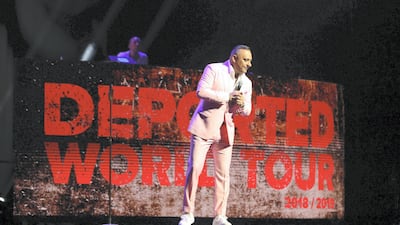
Russell Peters , stand-up comedian and actor performing at the new Coca Cola Arena, City Walk in Dubai. Pawan Singh / The National -
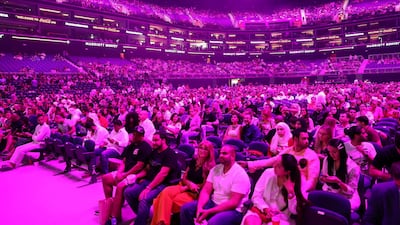
People enjoying the Russell Peters show held at the new Coca Cola Arena, City Walk in Dubai. Pawan Singh / The National -
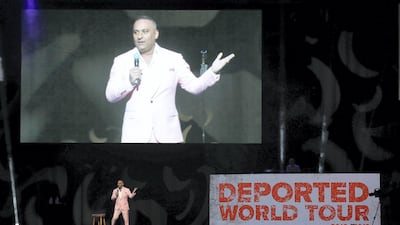
Russell Peters , stand-up comedian and actor performing at the new Coca Cola Arena, City Walk in Dubai. Pawan Singh / The National -
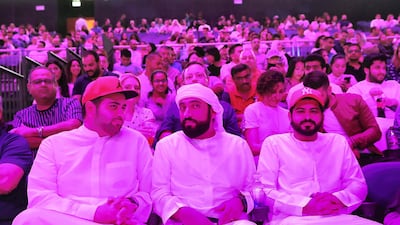
People enjoying the Russell Peters show held at the new Coca Cola Arena, City Walk in Dubai. Pawan Singh / The National -
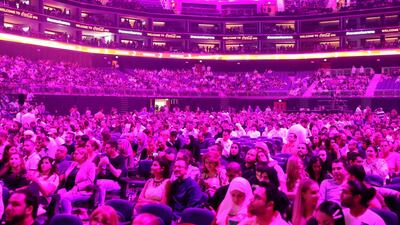
People enjoying the Russell Peters show held at the new Coca Cola Arena, City Walk in Dubai. Pawan Singh / The National -

People enjoying the Russell Peters show held at the new Coca Cola Arena, City Walk in Dubai. Pawan Singh / The National -
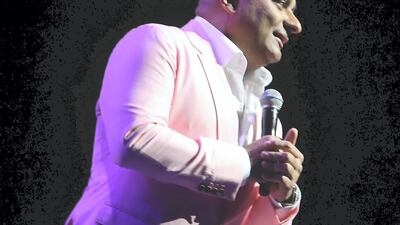
Russell Peters , stand-up comedian and actor performing at the new Coca Cola Arena, City Walk in Dubai. Pawan Singh / The National



