


Nancy Ajram has officially proven she is the undisputed Arab music queen of this generation.
The Lebanese pop star made history recently through her collaboration with award-winning, multi-platinum American DJ Marshmello.
Their single Sah Sah made it into the US Billboard Dance Charts two weeks after its initial release. It is the first Arabic-language song to enter the prestigious charts.
Sah Sah, which translates as wake up, has also amassed 26 million views on YouTube, more than two million streams on Spotify and more than 19,000 Shazam streams. It’s the first Arabic-language song to make it into the Top 10 iTunes chart, and it topped the iTunes electro-dance category in the UAE and Saudi Arabia. It’s also well on its way to becoming one of the most popular songs on TikTok.
There’s no arguing that Sah Sah is this year’s summer hit from the region.
“People are loving Sah Sah for more than one reason,” Egyptian composer Moody Saeed, who worked on the track with Ajram and Marshmello, tells The National. “The lyrics are light and the words, sah sah, are fun and easy to remember. It’s also the music, the beat, it has a mix of east and west.”
From Akhasmak Ah to Ya Tabtab to Inta Meen, Ajram is known for her distinctive voice. While classically trained, she has become synonymous with Arab pop.
“Nancy Ajram can sing in more than one way, it’s part of her charm,” says Saeed. “She has a large fan base — children, teenagers, men, women, all of them enjoy her music. It makes her really different from other singers. She’s a big reason why Sah Sah reached a wide range of people and why it's seen such success.”
Combining classic Arab sounds with an upbeat pop sensibility and playful lyrics is what has cemented Ajram in the Arab world as an artist, one who reflects the mood and style of contemporary Arab culture.
And now with Sah Sah, she’s managed to take that formula and globalise it.
The collaboration was also marketed well. At the start of July, both Ajram and Marshmello shared vague posts about their collaboration on social media. Ajram posted a photo of herself with the DJ in a recording studio to her 33.2 million Instagram followers.
Marshmello, the stage persona of Christopher Comstock, famous for wearing a white helmet that resembles a marshmallow, also posted a similar photo to his 29.4m followers on the platform.
Both artists only had the words "Sah Sah" in their caption.
The intersections of their very different, diverse fan base created plenty of anticipation for the song’s release.
Even with a curated online marketing strategy and two powerhouses such as Ajram and Marshmello combining forces, the single still had to be good to gain global attention.
With Ajram’s signature Arab pop sound, and classic Middle Eastern instrumentals such as the qanun, fused with Marshmello's bass-heavy electronic touch, Sah Sah is undeniably catchy. Add to that its upbeat and easy lyrics, and Sah Sah couldn't fail.
“Nancy is infectious. The moment you hear one of her songs, you instantly like it,” says Palestinian-American DJ and radio host Ibrahim Abu-Ali, also known as DJ Habibeats, who recently won attention online for his remix of Ajram’s hit Ya Tabtab.
“People who listen to Nancy Ajram or Arabic music have heard a lot of the same sounds. It’s the same with any type of music. The fact that you’re hearing certain elements (in Sah Sah) that sound really Arabic and are mixed with certain elements that sound very western, is new and exciting to the ear. It’s an interesting combination that you don’t hear often or isn’t always done well.”
The official music video for Sah Sah, which had its premiere on July 8, also combined eastern and western musical pop aesthetics. Ajram is seen dressed in a number of sparkling outfits, while Marshmello plays the qanun, both of them surrounded by dancers at an underground party.
Like any quintessential summer hit, it makes you want to get up and dance.
Nancy Ajram's fashion evolution — in pictures
-

Nancy Ajram wears a black turtleneck and denim shirt during a TV appearance in Beirut on December 5, 2001. AFP -

Performing in a black dress with lace detail after receiving her 2003 Murrex D'or award in Jounieh on November 29, 2003. AFP -

The singer in a black shirt and jacket with fishnet tights after a press conference in Kuwait on February 2, 2004. EPA -

In a white halter neck dress at the Arabic Music Awards in Dubai on May 15, 2004. EPA -
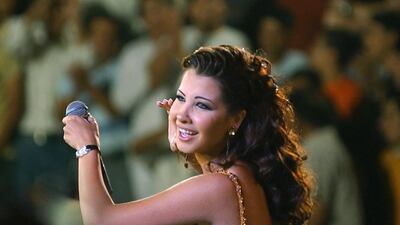
The singer wears an orange floral dress while performing at the Jerash Festival of Culture and Arts in Jordan on July 28, 2004. AFP -

Sporting a leather shearling jacket and jeans during a tsunami benefit concert at Biel in Beirut, Lebanon on February 1, 2005. EPA -

In a black top and skirt while performing at Al-Behira Theatre in Al-Qarm Garden, Muscat, Oman on January 26, 2006. EPA -

Pretty in a pink top and high-waisted trousers while visiting the Dunniyeh mountains of northern Lebanon on June 26, 2006. AFP -

In a delicate green and orange dress at a concert in Manama, Bahrain on May 18, 2006. EPA -

This yellow gown is her performance outfit at a Manama concert on January 2, 2007. EPA -

Striking in a leopard print gown while performing in Cairo, Egypt on July 24, 2007. EPA -

In a cream gown at Jumeirah Mina A'Salam, Dubai on October 12, 2007. AFP -

Classic white shirt with jeans and a statement metallic belt on the set of the 'Moshta'aa Leek' video in Beirut, Lebanon on November 6, 2007. EPA -

The singer goes casual in jeans and a grey top to perform in Muscat, Oman on December 3, 2007. EPA -

In a bright red strapless dress, Nancy Ajram holds up the Kuwaiti flag while performing in Kuwait on February 29, 2008. EPA -
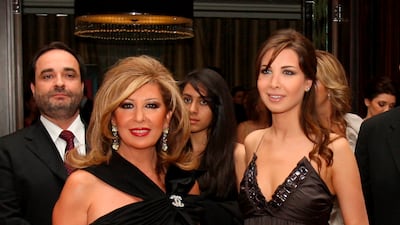
In a black gown at the Big Ball gala in Dubai, UAE, on June 1, 2008. EPA -

Making an entrance in a silver sequinned gown at the World Music Awards 2008 in Monaco on November 9, 2008. Getty Images -

Sleek in a black velvet sequinned gown at the Miss Lebanon 2009 contest in Adma, north of Beirut, Lebanon on June 26, 2009. EPA -

A purple dress for another performance at the Miss Lebanon 2009 contest on June 26, 2009. EPA -

In a draped one-shoulder grey gown at the Zouk Mikael International Festival, Lebanon on July 31, 2009. EPA -

Going fashionably green at the 15th Cairo Festival for Arab Media on November 15, 2009. EPA -

Quite the picture in a white satin dress with bow detailing, to promote her album 'Nancy 7' in Beirut, Lebanon on December 13, 2010. EPA -
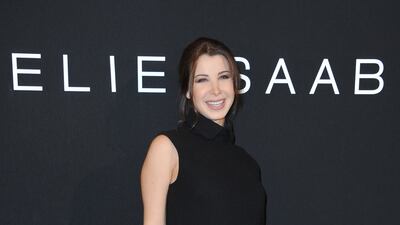
Classic LBD with sheer tights for the Elie Saab show at Paris Haute Couture Fashion Week on January 26, 2011. Getty Images -

Cheerful in a cream blouse and red trousers for an appearance at Mall of the Emirates, Dubai on October 9, 2013. Antonie Robertson / The National -
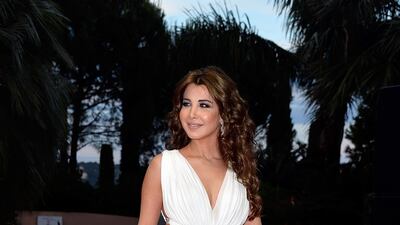
Statuesque in a white Grecian gown for the World Music Awards at Sporting Monte-Carlo, Monaco, on May 27, 2014. Getty Images -
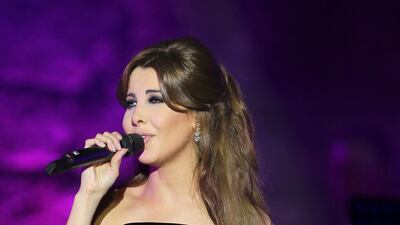
Performing in a panelled black gown during the 50th International Festival of Carthage in Tunis, Tunisia on August 12, 2014. EPA -

The singer in a cream gown during the DSF 20th anniversary celebrations in Dubai on January 10, 2015. Jeffrey E Biteng / The National -
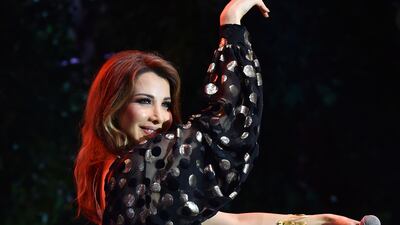
Peppy in a black dress with silver polka dots at Live Achrafieh Music Festival in Beirut, Lebanon on June 17, 2017. EPA -

A deep red gown with floral detailing is her stage outfit at the International Festival of Carthage in Tunis, Tunisia on August 9, 2017. EPA -

Striking in a sequinned gown at the 2019 Jerash Festival of Culture and Arts in Jordan on July 20, 2019. EPA -

Nancy Ajram performs in a sequinned dress and fur coat at the German University in Cairo, Egypt on December 14, 2019. EPA



