


Live updates: Follow the latest news on Israel-Gaza
Music can be a beacon of hope during the Gaza crisis, according to the organisers of a concert raising support for the Edward Said National Conservatory in Palestine, as the war threatens younger generations of musicians.
Palestinians Lamar Elias, 24, and Mira Abualzulof, 31, who perform and write music together under the name MiraLamar, performed in London on Thursday in aid of UK charity PalMusic, which supports the musical education of young Palestinians and children.
On stage in the background was an image of the only Yamaha Grand Piano in Gaza, which is at the Conservatory there. The Conservatory’s music activities for children have continued despite the war, in the refugee camps and in schools in northern Gaza.
The Conservatory has branches in Gaza, Bethlehem, Ramallah and East Jerusalem.
France-based Elias and Abualzulof first met at the Bethlehem branch as children, before crossing paths again at Conservatoire a Rayonnement Regional de Toulouse where they both studied.
“Never has there been a time when the Edward Said National Conservatory needed more support,” said Sal Sherrat, director of PalMusic. “Music is a source of great collaboration, camaraderie. An outlet for emotion, and a beacon of hope.”
“While the tragedy in Gaza continues, music continues as well,” she said. “We are living in a time of great tragedy and to not continue to support this generation of young musicians will just extend one tragedy even further.”
As a child, violinist and conductor Elias resisted the idea that her music could also be a symbol of her Palestinian identity. “I always felt, why? Why should you have a message at the beginning. It was such a heavy thing,” she told The National after the London concert.
But with time, it became important for the musician to be on stage and tell that story. Last year, aged 23, she made history when she became Palestine’s first female conductor, after her appointment as artistic director of the Toulouse Student Symphony Orchestra.
Music was a language that could change perceptions and move people. “Music is the right way to show them we’re human, and even more human than you can imagine,” she said. “We have a story to tell and music is the most powerful way of saying that.”

Today, with the war unfolding in Gaza, this message has become more urgent. “Music is the best way to describe anything, not just Palestine. In this moment, it’s even more important, because we’re facing dehumanisation of the Palestinian people.”
MiraLamar Duo compose and play their own music blending classical, jazz and Arabic styles. The pair will be performing at the Brighton Fringe festival on Saturday.
They opened the London gig on Thursday with a piece dedicated to the shores of Gaza. The music for Gaza Beach was composed well before the war, in part to give their traditionally French audience a “different image” of the place.
“If you hear the improvisation and jazz composition, it’s almost a Latino dance. The idea was imagining these people on the beach having fun, and not forgetting what’s happening. Telling [the audience] that we’re still human,” Elias said.
They wanted to evoke people enjoying the beach, children playing and families going on picnics, with the sea as the only border, according to Palestinian pianist Abualzulof. But this had changed with the continuing war. “Since what’s happening in Gaza, we play it differently. That’s only normal, we are musicians, we play what we feel,” she said.
Another piece was dedicated to the markets of Bethlehem, where the pair are from. “When we were young and living there we hated the place, it was noisy. But when we came back, we understood its magic,” said Elias.

The concert was the first for PalMusic since their 10th anniversary concert was postponed for security reasons in the aftermath of the October 7 attacks. The anniversary event will take place in November this year, with Palestinian pianist Marc Kawwas, oud player Saied Silbak and composer Faris Ishaq.
Abualzulof hopes to also challenge perceptions about Palestinian women, which they have encountered in France and elsewhere. “We’re not the first Palestinian women who have done something, or have had careers. We don't like this image of us as 'the poor Palestinian people'. We are people with dreams and hopes and lots of courage,” she said.
The iconic Egyptian singer Umm Kulthum, and the violinist Al Girsha who played all of her songs, shaped Lamar’s understanding of Arabic violin music, which was not formally taught at the Conservatory. “Learning Arabic violin was not that easy. When you asked how do you play Arabic violin (the teachers) would say, go listen to Umm Kulthum and repeat,” Elias recalled.
Now immersing herself in conducting, she has been reading letters of 19th century Russian composer Tchaikovsky, and is an admirer of the late Argentinian conductor Carlos Kleiber, known for his temperamental perfectionism.
Abualzulof is a devoted fan of the 82-year-old Argentinian pianist Martha Agerich, who she saw play a couple of weeks ago. “I’ve had posters and all her CDs since I was a kid. Any concert of hers that is 200km around me, I go watch. She was one of the first women who got to perform [the piano] in the '40s,” she said.
Elias has been watching the UK’s protest movement in support of Palestine unfold with excitement. “It’s magical, because it's not the case all around [in Europe]. There is a big percentage of people finally understanding what this is about,” she said.
Rallies in support of Palestine were initially banned in France, and a student encampment at the Sorbonne last week was removed by the police. “So for us, it's very emotional to be here in London,” she added.
Yet the struggle to get UK visas in time for their trip was a brutal reminder of the challenges Palestinians face crossing borders. The pair have French residency and have become used to travelling across Europe for shows. “You forget about [the challenges]. It’s a wake up call that you’re still Palestinian, you still need a visa, and maybe it won’t work,” Elias said.
Palestine museum's show challenges establishment – in photos
-
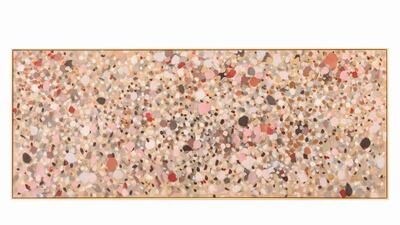
Massacre of the Innocents in Gaza (2024) by Samia Halaby. All Photos: Palestine Museum US -
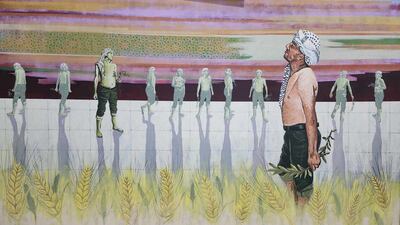
You Have the right, They Have the Land (2023) by Mohammed Alhaj -
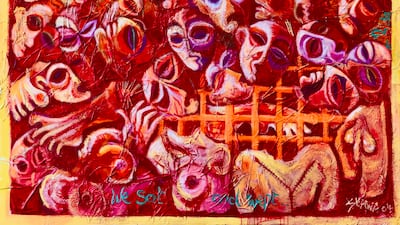
Democracy in Red (2004) by Laila Shawa -
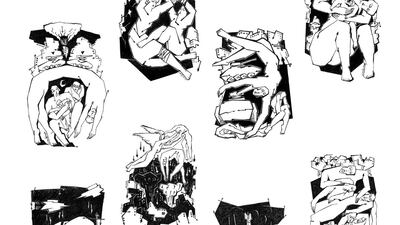
I'm Still Alive (2023-2024) by Maisara Baroud -

Gaza (2024) by Jacqueline Bejani -
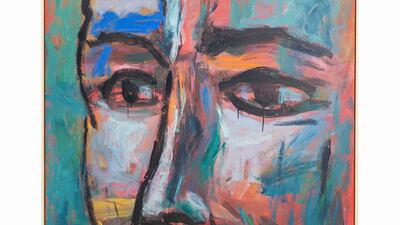
Portrait II (2016) by Mohamed Khalil -
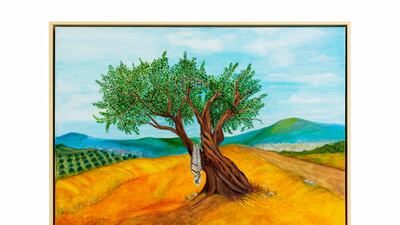
Returning (2018) by Zeinab Shaath -
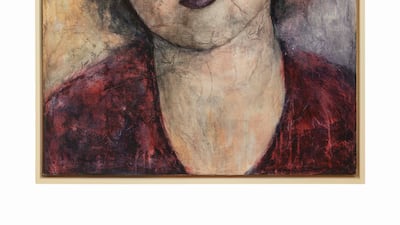
Untitled (2019) by Khair Alah Salim -
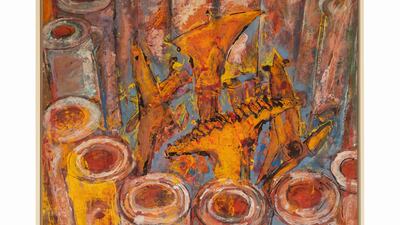
Siege (1994) by Samira Badran



