

Foreigners in their Homeland, an exhibition by Palestine Museum US, is currently taking place in Venice. It shares the same opening and closing dates as the city’s biennial. Yet, to say the exhibition is running alongside the prestigious art event is perhaps erroneous.
If anything, the exhibition is running despite a rejected proposal by the Venice Biennale and in the face of the event’s scant representation of Palestinian artists. Its perseverance is important. The exhibition is bringing together works of 26 Palestinian artists, both from within Palestine as well as its diaspora. It touches more than a century’s worth of culture and history at a time when the Palestinian experience is especially marked by heartbreak. The war in Gaza is raging onwards, and more than 34,500 Palestinians have been killed since it began.
-
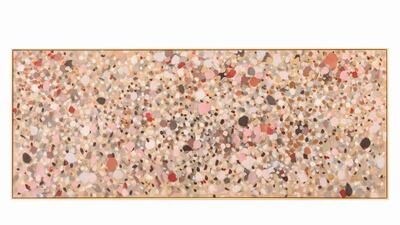
Massacre of the Innocents in Gaza (2024) by Samia Halaby. All Photos: Palestine Museum US -
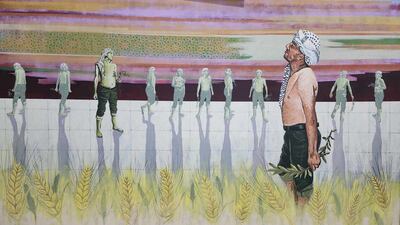
You Have the right, They Have the Land (2023) by Mohammed Alhaj -
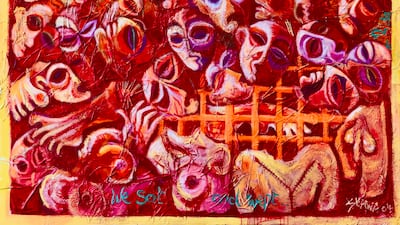
Democracy in Red (2004) by Laila Shawa -
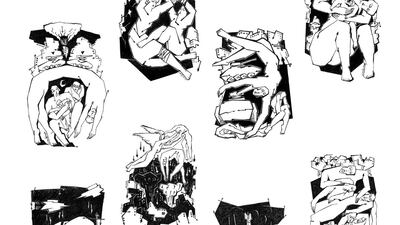
I'm Still Alive (2023-2024) by Maisara Baroud -

Gaza (2024) by Jacqueline Bejani -
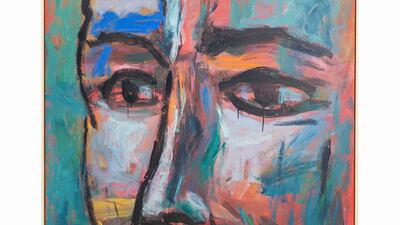
Portrait II (2016) by Mohamed Khalil -
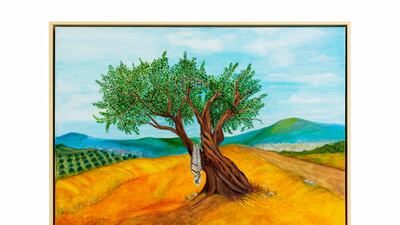
Returning (2018) by Zeinab Shaath -
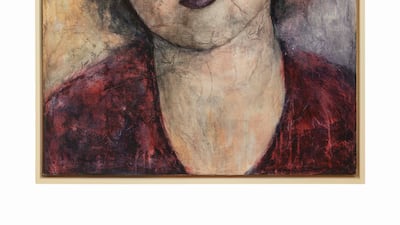
Untitled (2019) by Khair Alah Salim -
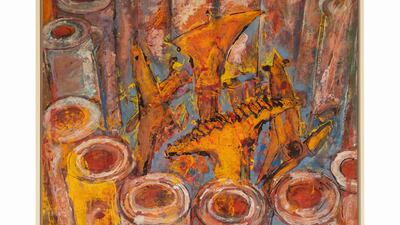
Siege (1994) by Samira Badran


To be clear, Palestine does have a presence in the 2024 biennial.
In its international section, the event is hosting two Palestinians, Samia Halaby and Dana Awartani. A collateral exhibition, meanwhile, features a collection of works by Palestinian artists that explores themes related to heritage and collective memory. Titled South West Bank, the exhibition is organised by Artists and Allies of Hebron and Dar Jacir for Art and Research. The former is an initiative founded by South African artist Adam Broomberg and Palestinian activist Isso Amro. The latter is an art space founded by Emily, Annemarie and Yusuf Nasri Jacir in their 19th-century family home in Bethlehem.
South West Bank is significant for its spotlighting of Palestinian culture and heritage within the official realm of the biennial. However, the exhibition came only after criticisms were raised against the biennial’s curator Adriano Pedrosa for hosting an Israeli national pavilion while minimising Palestinian representation. That fact gives the exhibition a certain lack of credence.
The show grew out of an initial proposal by the AAH that would have featured photographs by Broomberg and Rafael Gonzalez that focus on the importance of olive trees within Palestinian identity.
Broomberg’s drive to highlight Palestinian experiences in his art is noteworthy. However, in the context of the biennial, having him almost exclusively representing Palestine is problematic.

“He has very close family ties with Israel, and his relatives are in the [Israeli] army [fighting] in Gaza,” Faisal Saleh, founder of Palestine Museum US, says. “He’s just not the kind of person I would have picked to represent the Palestinian project. Why do we need that when we have Palestinian artists? At the minimum, [Pedrosa] could have accepted our project as well.”
The proposal’s rejection was especially surprising, given that Palestine Museum US participated in the previous iteration of the art biennial in 2022. The exhibition was called From Palestine with Art, a version of which was recently held at London’s P21 Gallery.
“It’s very disheartening to see 26 Palestinian artists sidelined and replaced by what’s there now as a collateral event,” Saleh says. “I don't have a problem with foreign activists being on our side and working with us. But they should not allow themselves to be a replacement of the indigenous Palestinian people.”
It is uncommon for proposals selected to participate in the biennial to be retroactively developed. As such, the development of South West Bank begs the question whether the exhibition came as a sincere effort by the biennial to admit fault and include Palestinians as part of the official event or whether it was simply a quick assemblage designed to circumvent controversy.
The answer to this question veers towards the latter when considering that officials from the Venice Biennale asked to meet with Saleh and “tried to talk him down”, the Palestinian businessman says. He adds that he was told his proposal was rejected because the biennial wanted to focus on art that wasn’t steeped in the political realm.

“They tried to convince me that what they did was right. That politics has no room in here and that [the biennial] is all about art,” Saleh says. “I told [them] I disagree and that art does not happen in a vacuum.”
This is perhaps especially true for artists who hail from countries steeped in conflict and injustice, such as Palestine. Reflecting upon the ongoing cruelties in Gaza is inescapable for a Palestinian artist, even if their work does not directly deal with the conflict. “Any Palestinian has had to deal with that fact throughout their work,” Halaby says. “Whether subjectively or objectively.”
The revered artist is presenting a new painting in Foreigners in their Homeland. Entitled Massacre of the Innocents in Gaza, the painting brings to attention the continuing war in Gaza. With ochre, grey, black, red and pink brushstrokes, the painting is wrought with anxiety as it touches on the many tragedies rippling across the Palestinian enclave.
Halaby is known for reflecting on Palestinian history and identity within her work. Her pieces revolving around the Kafr Qassem massacre are probably the most renowned in that category. Yet, those were conceived with a documentarian’s touch. Massacre of the Innocents in Gaza, however, falls much more in line with the artist’s famed and dynamic mode of abstraction.
To ask why it was conceived in that way is to “short circuit” the creative process, Halaby says. The artist stresses that she did not set out to produce a painting related to Gaza.

“But as I was listening to all the news, it penetrated my very being and my consciousness,” she says. Halaby chose to title the painting Massacre of the Innocents in Gaza to give it a historical dimension. It references the Biblical story that tells of King Herod’s order to kill all boys under the age of two born in the Bethlehem area – a decision made based on the prophecy that foretold a child was destined to become the king of the Jews. The story was also a common European motif across the period of the renaissance. “In a way, I'm putting a nail into the feelings of people who understand art history, and saying ‘Look, this is happening now also’,” the artist says.
Halaby is the sole artist showing work in Foreigners in their Homeland and within the official realm of the Venice Biennale. At the Central Pavilion, she is displaying a 1969 piece called Black is Beautiful, which is dedicated to the Pan-African activist Elombe Brath.
“That painting is dedicated to African-American liberation, and indicates our Palestinian solidarity with the African Americans of the US,” Halaby says. She adds that she was dismayed at the fact her own description of the work was watered down in the official Biennale literature to a merely aesthetic dimension. It was another move by the biennial, it seems, to minimise the political within art.
While each of the works within Foreigners in their Homeland depict some aspect of the Palestinian experience – whether subjectively or objectively – there is one group of ink drawings that are squarely grounded in Gaza's present. Halaby says the “outstanding” work by Maisara Baroud could have easily been the sole work presented in Foreigners in Their Homeland, and with aptly dramatic effect.
Baroud’s I'm Still Alive hangs as a grid away from the windows of the exhibition space at the Palazzo Mora. Displayed on translucent paper, the sunlight streaming from the windows accentuates the blank ink of the works. The pieces show human forms contorting against the belligerence of tanks. Winged angelic figures, meanwhile, take flight carrying the dead away from the rubbled landscape. Some of the works show people embracing the corpses of their loved ones, to protect them from yet another missile that is nosediving towards them. In others, it is the dead protecting the living.
Baroud’s 120 works are displayed alongside 20 drawings by Mohammed Alhaj, which also similarly depict scenes from Gaza in black and white albeit in a distinctive style. The grouping is also notable as both artists come from Gaza and are currently sheltering in tents in Rafah.
The wall of drawings is described by Saleh as the answer to Israel’s West Bank barrier. He credits the notion to a person on the Palazzo Mora team. “We didn't realize how good it was until it was put together,” he says. “It looks stunning. It’s a Gaza wall. It's our answer to the Israeli war. We have documented their atrocities on a wall of light.”

Another work by Alhaj is also on display; however, it is not the original painting but a canvas-printed copy. The original was destroyed during Israel’s attack on Gaza. The work is entitled You Have the right, They Have the Land, and Saleh says it was important to include in the exhibition, even if the printed reproduction is notably smaller and less defined. “We thought it was important to show the work no matter how degraded the size and the resolution, rather than not do it,” Saleh says.
Several other notable works are also featured, including pieces by renowned artists such as Samira Badran and Nabil Anani, alongside works by emerging Palestinian artists. Saleh emphasizes the importance of including these emerging artists to present a wider range of Palestinian artwork. There is also an animated piece that, Saleh says, is a “very quick artistic introduction to the history of Palestine and what our acute issues now are”.
Another piece is a two-metre-long Palestinian flag prepared by 85 women in the highlands of Scotland. The flag is composed of 2,500 names of those killed in Gaza, displayed on small strips of cloth woven to make a whole. The piece is a testament to international solidarity with the Palestinian cause.
Foreigners in their Homeland also reprises one of Palestine Museum US’s signature elements: a map on the floor of the exhibition space. “There is a map of the West Bank laying on the floor like a carpet. It is a map of all the checkpoints and obstacles in the West Bank,” Saleh says.
Like with its previous exhibitions, Foreigners in their Home aims to introduce the Palestinian experience to those who may not be familiar with the nation’s history. Perhaps more importantly, it hopes to evoke feelings of belonging in those with cultural ties to Palestine.
“I think having Palestinian representation in Venice is very important,” Halaby says. Allowing Israel to have its own national pavilion within the biennial is “criminal”, she adds. “We must do our best to make our voices heard.”

However, she also notes the biennial, in its nature, is a “bourgeoisie” event, an organisation that emanates from governments and only allows governments to choose. “In all my life as an artist, I am chosen rather than choosing, I am the subject, not the do-er,” Halaby says, hinting that there was a refreshing sense of agency in participating within the exhibition of Foreigners in Their Homeland.
If granted sufficient agency to challenge the institution of the biennial, Halaby says: “A great idea right now would be to go to the Palestine Museum in the West Bank and borrow from them the exhibition they’ve organised on Gaza, and replace the Israeli pavilion with that exhibition. It is really criminal to include the Israeli pavilion.”
Halaby also stresses that she is paying no attention to what is being exhibited there, though the exhibit is currently closed, and is adamant about “disregarding the discourse of the enemy.
“I don’t ever put [myself] in a weak position of answering their accusations or their discourse,” she says. “I have my own discourse and [if] they don’t like it, that’s alright.”
In regard to the exhibition by Palestine Museum US, she says: “I think there's a discourse in this show that says ‘we are here’ and what’s important is that Palestinians themselves find a home in this exhibition.” Halaby adds that while garnering friends for Palestine has been important as part of the exhibition, what is equally important is the “Palestinian contingencies' reaction, their delight at finding the map on the floor, at finding their village.
“There's so much propaganda out there that silences Palestine that many don’t even know that there was a high level of art during the Intifada.”
Foreigners in their Homeland: Occupation, Apartheid, Genocide is running at the Palazzo Mora until November 24

