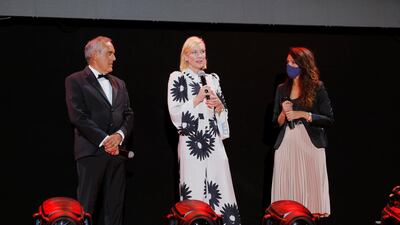
Cate Blanchett, centre, is jury president at this year's Venice Film Festival Getty

Venice Film Festival gears up to award masked Golden Lion winner


  • English
  • Arabic

The Venice Film Festival will present its coveted Golden Lion award on Saturday after a competition marked by face masks and missing stars but billed as a relaunch of global cinema, which has been bruised by the coronavirus crisis.

Throughout the 11-day event on the glitzy beachfront Lido, elbow bumps replaced handshakes, audiences were masked and the red carpet was eerily devoid of screaming fans.

The 77th iteration of the festival has taken place in a year when theatres have been closed, film sets shut down and moviegoers forced to embrace streaming video at home, during months of restricitons imposed because of the outbreak.

Many directors saluted the festival's organisers for going ahead with the event.

"The Venice Film Festival has given us the opportunity and the privilege to start dreaming again," Italian director Emma Dante said in Ciak magazine, distributed daily at the festival.

Leading contenders among the 18 films vying for the top prize include Michel Franco's Nuevo Orden (New Order), a dystopian view of Mexico, Gianfranco Rosi's documentary Notturno, filmed on the borders of Syria, Quo Vadis, Aida? by Bosnia's Jasmila Zbanic about the 1995 Srebrenica massacre and Dear Comrades from veteran Russian director Andrei Konchalovsky, a film about the 1962 shooting of striking factory workers in the USSR by the army.

The last entry in the competition lineup to have its premiere was the much-anticipated Nomadland by US director Chloe Zhao, starring Frances McDormand – one of the few films from the US at the festival and which received sustained applause during its earlier press screening.

Normally attended by more than 10,000 film industry executives, critics, journalists and moviegoers, the festival was the first major international movie competition to go ahead after others around the world, including its main rival, the Cannes Film Festival, were cancelled.

Venice festival director Alberto Barbera called the event "a sort of test" for the film industry, which is slowly regaining its footing, with some production resuming and cinemas reopening, even as the number of Covid-19 cases continue to increase in many parts of the world.

Scroll through our gallery above to see more photos from the last day of the festival.

In Italy, the festival was also viewed as a sign of hope and normalcy for a country hit hard by the pandemic.

Nevertheless, big-budget blockbusters that have had premieres in Venice in years past were missing, as was the bevy of Hollywood A-listers, who have fans screaming for autographs on the sidelines of the red carpet.

Actress Tilda Swinton wears a mask as she sits in the auditorium during the opening ceremony of the 77th Venice Film Festival in Venice, Italy. AP Photo

Instead, the 2020 version was decidedly low-key, with about half the usual number of people in attendance, fewer films and seating in theatres that was staggered to respect physical distancing rules.

Masks were mandatory, hand sanitiser bountiful, people had their temperatures taken when they entered the festival grounds and ubiquitous red signs warned people to respect the anti-coronavirus measures.

Still, organisers said the scaled-down event offered a diverse panorama of cinema today, with 50 countries represented in the line-up.

Of the contenders for the top prize, eight were directed by women, which some people hope reflects a new direction for festivals after criticism over a lack of gender diversity.

Brad Pitt, Meryl Streep and Scarlett Johansson were among those to have supplied the celebrity panache at last year's festival.

But travel restrictions – especially a travel ban from the USt into Europe – mean most big Hollywood names were no-shows this year, along with actors and directors from China, India and South America.

Director of the 77th Mostra Internazionale d'Arte Cinematografica Alberto Barbera and Cate Blanchett at the Venice Film Festival. Getty Images

However, Cate Blanchett, as jury president, provided some much-needed star power, telling an opening night audience that the festival's launch seemed to be "some kind of wonderous miracle".

"The way is uncertain, but tonight is a beginning," she said.

As well as Blanchett, the judges are US actor Matt Dillon, Austrian director Veronika Franz, British director Joanna Hogg, Italian writer Nicola Lagioia, German director Christian Petzold and French actress Ludivine Sagnier.

Last year, Joker, by US director Todd Phillips, took home the Golden Lion and Roman Polanski won the runner-up Grand Jury Prize for An Officer and a Spy.


THE SPECS

Engine: 6.75-litre twin-turbocharged V12 petrol engine 

Power: 420kW

Torque: 780Nm

Transmission: 8-speed automatic

Price: From Dh1,350,000

On sale: Available for preorder now

Afro%20salons
%3Cp%3E%3Cstrong%3EFor%20women%3A%3C%2Fstrong%3E%3Cbr%3ESisu%20Hair%20Salon%2C%20Jumeirah%201%2C%20Dubai%3Cbr%3EBoho%20Salon%2C%20Al%20Barsha%20South%2C%20Dubai%3Cbr%3EMoonlight%2C%20Al%20Falah%20Street%2C%20Abu%20Dhabi%3Cbr%3E%3Cstrong%3EFor%20men%3A%3C%2Fstrong%3E%3Cbr%3EMK%20Barbershop%2C%20Dar%20Al%20Wasl%20Mall%2C%20Dubai%3Cbr%3ERegency%20Saloon%2C%20Al%20Zahiyah%2C%20Abu%20Dhabi%3Cbr%3EUptown%20Barbershop%2C%20Al%20Nasseriya%2C%20Sharjah%3C%2Fp%3E%0A

Mercer, the investment consulting arm of US services company Marsh & McLennan, expects its wealth division to at least double its assets under management (AUM) in the Middle East as wealth in the region continues to grow despite economic headwinds, a company official said.

Mercer Wealth, which globally has $160 billion in AUM, plans to boost its AUM in the region to $2-$3bn in the next 2-3 years from the present $1bn, said Yasir AbuShaban, a Dubai-based principal with Mercer Wealth.

Within the next two to three years, we are looking at reaching $2 to $3 billion as a conservative estimate and we do see an opportunity to do so,” said Mr AbuShaban.

Mercer does not directly make investments, but allocates clients’ money they have discretion to, to professional asset managers. They also provide advice to clients.

“We have buying power. We can negotiate on their (client’s) behalf with asset managers to provide them lower fees than they otherwise would have to get on their own,” he added.

Mercer Wealth’s clients include sovereign wealth funds, family offices, and insurance companies among others.

From its office in Dubai, Mercer also looks after Africa, India and Turkey, where they also see opportunity for growth.

Wealth creation in Middle East and Africa (MEA) grew 8.5 per cent to $8.1 trillion last year from $7.5tn in 2015, higher than last year’s global average of 6 per cent and the second-highest growth in a region after Asia-Pacific which grew 9.9 per cent, according to consultancy Boston Consulting Group (BCG). In the region, where wealth grew just 1.9 per cent in 2015 compared with 2014, a pickup in oil prices has helped in wealth generation.

BCG is forecasting MEA wealth will rise to $12tn by 2021, growing at an annual average of 8 per cent.

Drivers of wealth generation in the region will be split evenly between new wealth creation and growth of performance of existing assets, according to BCG.

Another general trend in the region is clients’ looking for a comprehensive approach to investing, according to Mr AbuShaban.

“Institutional investors or some of the families are seeing a slowdown in the available capital they have to invest and in that sense they are looking at optimizing the way they manage their portfolios and making sure they are not investing haphazardly and different parts of their investment are working together,” said Mr AbuShaban.

Some clients also have a higher appetite for risk, given the low interest-rate environment that does not provide enough yield for some institutional investors. These clients are keen to invest in illiquid assets, such as private equity and infrastructure.

“What we have seen is a desire for higher returns in what has been a low-return environment specifically in various fixed income or bonds,” he said.

“In this environment, we have seen a de facto increase in the risk that clients are taking in things like illiquid investments, private equity investments, infrastructure and private debt, those kind of investments were higher illiquidity results in incrementally higher returns.”

The Abu Dhabi Investment Authority, one of the largest sovereign wealth funds, said in its 2016 report that has gradually increased its exposure in direct private equity and private credit transactions, mainly in Asian markets and especially in China and India. The authority’s private equity department focused on structured equities owing to “their defensive characteristics.”