



Russia is all set to beat Hollywood in the space game. The country will launch an actress and a film director into space on Tuesday for the world's first feature film to be shot at the International Space Station.
Actress Yulia Peresild, 37, and film director Klim Shipenko, 38, are expected to take off from the Baikonur Cosmodrome in ex-Soviet Kazakhstan at 8.55am GMT (12.55pm in the UAE).
You can watch a livestream of the launch here.
If successful, the Russian crew will beat a Hollywood project that was announced last year by Mission Impossible star Tom Cruise together with Nasa and Elon Musk's SpaceX.
The two-member film crew, led by veteran cosmonaut Anton Shkaplerov, are expected to take off from the Baikonur Cosmodrome in ex-Soviet Kazakhstan. They will travel in a Soyuz MS-19 spaceship for a 12-day mission at ISS to film scenes for a movie called The Challenge.

The movie's plot, which has been mostly kept under wraps along with its budget, was revealed by Russia's space agency Roscosmos to centre around a female surgeon who is dispatched to the ISS to save an astronaut.
Clad in a flight suit, director Shipenko called the film "an experiment" at an online press conference on Monday.
"Some things will work out and some things won't," he conceded.
Peresild, who auditioned for the role earlier this year in a competition with dozens of other actresses, has spent months training for the mission, according to The New York Times. Alyona Mordovina, the competition’s runner-up, is Peresild’s backup, and would go to orbit if something prevented the primary crew from launching to space.
Shipenko and Peresild are expected to return to Earth on Sunday, October 17 in a capsule with cosmonaut Oleg Novitsky, who has been on the ISS for the past six months.
The launch comes at a challenging time for Russia's space industry, which is struggling to secure state funding with the Kremlin prioritising military spending.
Compared to the Soviet era – when Moscow launched the first satellite Sputnik and sent the first man, Yuri Gagarin, into space – Russia has struggled to innovate.
Its space agency is still reliant on Soviet-designed technology and has faced a number of setbacks, including corruption scandals and botched launches.
Russia is also falling behind in the global space race, facing tough competition from the United States and China, with Beijing showing growing ambitions in the industry.
Roscosmos was also dealt a blow after SpaceX last year successfully delivered astronauts to the ISS, costing Russia its monopoly for journeys to the orbital station.
-
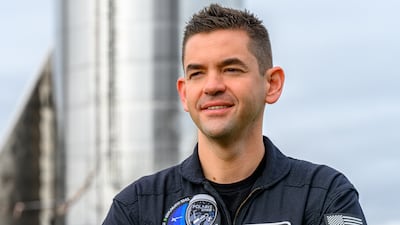
Jared "Rook" Isaacman, Polaris Dawn Mission Commander. Photo: Polaris Program / John Kraus -
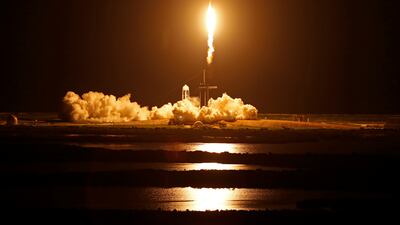
The all-amateur crew of SpaceX Inspiration4 embark on an historic mission. Reuters -
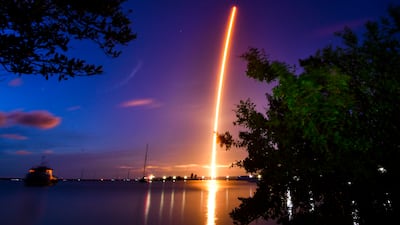
They have lift off in Cape Canaveral, Florida. AP Photo -

Inspiration4 crew members Chris Sembroski, Sian Proctor, Jared Isaacman and Hayley Arceneaux are all smiles before the flight. Reuters -

The moment the rocket blasts off from Kennedy Space Centre's Launch Pad 39-A in Cape Canaveral. AP Photo -
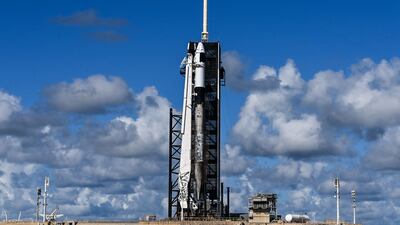
The SpaceX Falcon 9 rocket prepares to launch from Nasa's Kennedy Space Centre, Florida. AFP -
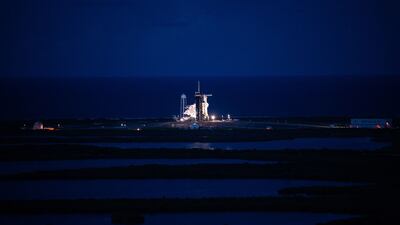
The Inspiration4 mission, the first to send an all-civilian crew to orbit, will venture deeper into space than the International Space Station. AFP -
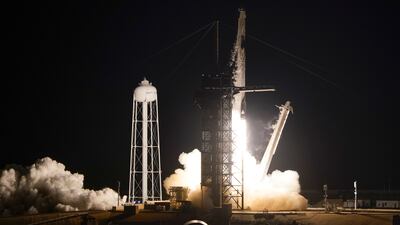
The SpaceX Falcon 9 lifts off with four private citizens onboard. AP Photo -
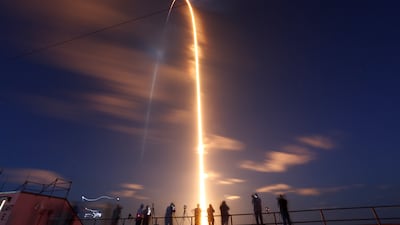
The crew will spend three days orbiting the Earth before splashing back down off the coast of Florida. Reuters -
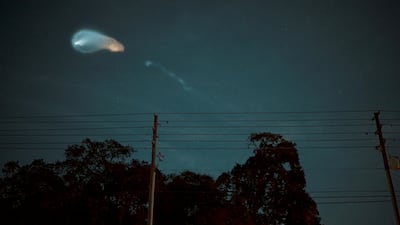
'The Inspiration4 launch reminds us of what can be accomplished when we partner with private industry,' tweeted Nasa administrator Bill Nelson before the launch. Reuters -
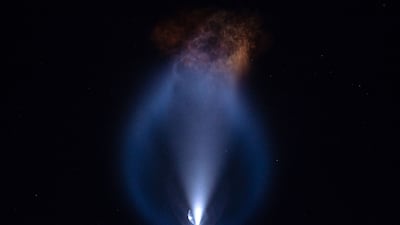
The Inspiration4 mission is being financed and led by Jared Isaacman, 38, the founder of Shift4 Payments. AFP -
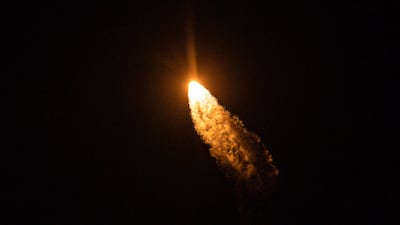
Mr Isaacman is the latest billionaire entrepreneur to set his sights on the stars, after Richard Branson and Jeff Bezos both blasted into space this summer. AFP -
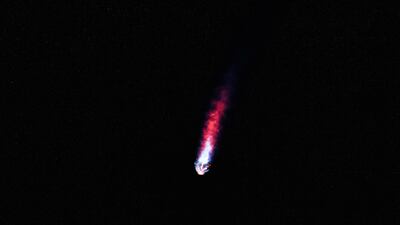
Mr Isaacman hopes to outdo other space tourism pioneers with an even more ambitious mission. AFP -
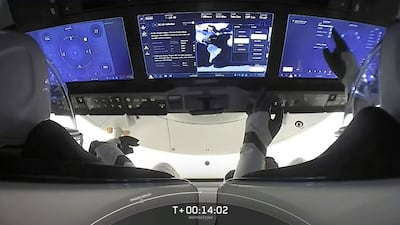
The SpaceX webcast livestreamed what pilot Sian Proctor could see as the rocket headed for the stars. AFP -
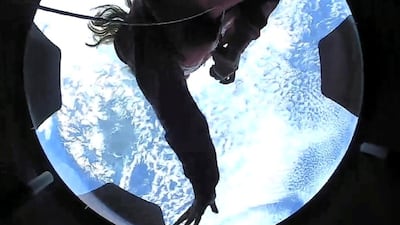
Inspiration4 crew on their first day in space. Reuters -
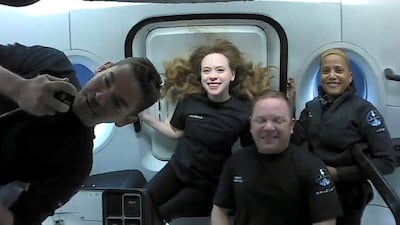
First day at the office. Inspiration4 crew Jared Isaacman, Sian Proctor, Hayley Arceneaux, and Chris Sembroski in zero gravity. Reuters -
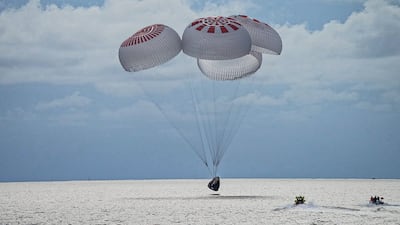
The citizen astronauts splash down safely in SpaceX's Crew Dragon capsule off Florida. Reuters -
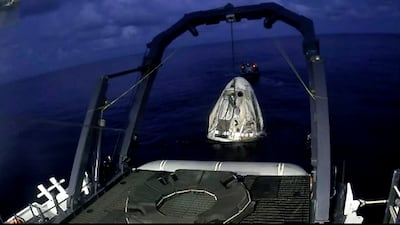
A SpaceX capsule carrying four people is lifted from the Atlantic Ocean on to a recovery vessel. AP -

Jared Isaacman emerges from the capsule after it was recovered following its splashdown. AP -

Chris Sembroski celebrates their return to Earth. AP -

Sian Proctor sets foot on Earth for the first time after completing the mission. AP -
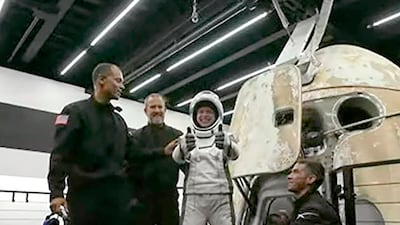
Next amateur astronaut out is Hayley Arceneaux. AP -
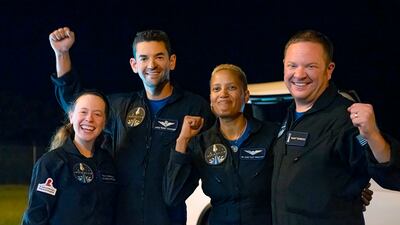
The crew was the first to circle the Earth without a professional astronaut. AP


But for political analyst Konstantin Kalachev, the space film is a matter of PR and a way to "distract" Russians from the "problems" that Roscosmos is facing.
"This is supposed to inspire Russians, show how cool we are, but I think Russians have completely lost interest in the space industry," Kalachev told AFP.
In a bid to spruce up its image and diversify its revenue, Russia revealed this year that it will be reviving its space tourism programme to ferry fee-paying adventurers to the ISS.
After a decade-long pause, Russia will send two Japanese tourists – including billionaire Yusaku Maezawa – to the ISS in December, capping a year that has been a milestone for amateur space travel.
Last month, SpaceX completed the first all-civilian mission to space that took four untrained astronauts on a three-day loop around the Earth's orbit.
The trip followed the missions of billionaire Richard Branson, who spent several minutes in weightlessness in July aboard his VSS Unity. Amazon-founder Jeff Bezos completed a similar mission just days later via his company Blue Origin, which he founded in 2020, to help create space tourism.
On Monday, Star Trek actor William Shatner announced he was also travelling to space in the second Blue Origin flight on Tuesday, October 12.
Shatner, known for playing Captain James T Kirk in the sci-fi series and films, will be one of four crew members, which includes Blue Origin’s vice president of mission and flight operations Audrey Powers, Planet Labs co-founder Chris Boshuizen and Medidata co-founder Glen de Vries.
"I've heard about space for a long time now," Shatner said. "I'm taking the opportunity to see it for myself. What a miracle."
– Additional reporting by AFP

