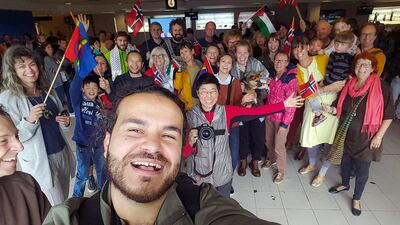
Palestinian filmmaker Mohamed Jabaly, front, in Life is Beautiful, a documentary about how his life was put on hold when the borders to Gaza closed while he was in Norway. Photo: Safar Film Festival

Safar Film Festival shines light on a Palestinian in search of solidarity


Lemma Shehadi
  • English
  • Arabic

For Mohamed Jabaly, watching the Israel-Gaza conflict unfold from his adopted new home in Norway is a reminder of the circumstances that led to the making of his latest film while stranded as a stateless Palestinian during the 2014 Gaza war.

Jabaly had been visiting a film festival in Tromsø when the borders closed. It would be seven years before he could see his family again.

The stark arctic winter serves as Life is Beautiful's backdrop as Jabaly seeks to navigate sullen European bureaucracy to have his papers recognised, finds support in some of the local communities around him, and tries to keep in touch with relatives in the beleaguered city.

With his family trapped in Gaza’s ruins a decade later, coming to the UK this week to speak about the documentary for the 2024 Safar Film Festival is a chance for Jabaly to engage with audiences to inspire change.

“People are dying, there is no time even to mourn,” he told The National ahead of the initial screening this week in London.

“The world suddenly woke up. It’s never too late, but the cost has been super high. We’re talking about almost 37,000 people who lost their lives. Every second of every day, this death toll is increasing.

“The solidarity movement is growing, but did that stop the genocide? Did that help stop the war? No."

Norway, unlike the UK, has recognised Palestine, and Jabaly recalled the sense of pride he felt at the announcement from the Cannes Film Festival last month.

His parents and siblings have fled from Gaza city to the south, but aunts, uncles and cousins have remained in their neighbourhood where they have spent months without proper access to food and medical aid.

Highlights of the festival include Mohamed Kordofani’s Goodbye Julia. Photo: Safar Film Festival

There is pain and disbelief in his voice when Jabaly speaks about the war as it enters its ninth month, but the growing unity behind the Palestinian cause has made him optimistic.

Asked recently about his film’s title and whether life really is beautiful, given the continuing horrors of Gaza, he determinedly clung to hope.

“The question of life being beautiful speaks to what I want to see,” Jabaly told a Canadian publication. “This is a future not necessarily today or tomorrow… [it] goes to the motto of ‘life is beautiful’ that I carried with me all the time, even while growing up in Gaza. It’s a motive for being hopeful and trying to mobilise our life’s struggle.”

The 2024 Safar festival - promoted under the theme of On Dreams, Hopes and Realities - is the largest to date, with films spanning 15 Arab countries being screened across 13 cities and accompanied by a range of events, Q&As and talks until June 30.

While never shying away from the region’s difficulties, the festival, organised by the Arab British Centre, has for 12 years sought to shine a light on the Middle East’s burgeoning talent, and portray alternative perspectives to the images of war-torn cities more commonly seen on the news.

In Jordanian Amjad Al Rasheed's Inshallah A Boy, a mother battles to save her daughter's inheritance. Photo: Safar Film Festival

Yet, as it opened this week, the continuing, bloody conflicts in Sudan, Yemen, and particularly Gaza were inevitably and starkly at the forefront.

Conflict would be difficult to ignore during such tumultuous times, the festival’s curator Rabih El Khoury conceded, explaining that this year’s theme addressed the fragility of hope when confronted with the brutal truth of war.

“You can’t do a programme this year without thinking about Palestine, but also the raging war that is happening in Sudan, and the crisis in Yemen,” he told The National.

"How does bearing witness to the realities of the Arab region empower us to confront them? Are we allowed to envision hope beyond these realities? And can we achieve our dreams individually, or must we collectively dream to ensure their realisation?”

Among the programme’s other highlights is Mohamed Kordofani’s Goodbye Julia, the first Sudanese feature film to screen at the Cannes Film Festival.

Focused on two women from North and South Sudan - played by Eiman Yousif and Siran Riak - who meet in Khartoum, it recalls their day-to-day lives in the final years of Sudan as a united country.

Lina Soualem’s Bye Bye Tiberias explores four generations of Palestinian women, centred around the life of her mother, the acclaimed actress Hiam Abbas, who stars as Marcia Roy in the HBO series Succession and Maysa Hassan in Hulu’s Ramy.

In Bye Bye Tiberias, Lina Soualem, right, explores four generations of Palestinian women, centred around her mother, the actress Hiam Abbas. Frida Marzouk / Beall Productions

Shot over several years, Tunisian director Sonia Ben Slama’s Machtat, showing the struggles of four Tunisian women who play music at weddings, has its premiere in the UK, as does the Yemeni film The Burdened by Amr Gamal.

The films of pioneers such as the Palestinian director Michel Khleifi and Egyptian documentary filmmaker Tahani Rached will feature alongside debuts, including Jordanian Amjad Al Rasheed's Inshallah A Boy, in which a mother battles to save her daughter's inheritance, which is usually reserved for sons in Islamic law.

El Khoury is based in Berlin, where protests in support of Palestine have been heavily policed, and many events and awards have been called off.

The scenes of “massive” protests in London every two weeks had led him to expect that the UK would be a more liberal environment, yet El Khoury also encountered raised tensions behind the scenes when the festival was being organised.

“Most, if not all, of our venues are thrilled to have us,” he said, but added that some had hesitated to screen Palestinian films, with additional discussions needed about provisional measures and security concerns.

Despite the shadows cast by the difficult realities faced across the region, Safar invites us to come together and find solace
Nadia El-Sebai,
executive director of the Arab British Centre

The festival will also include three guest curated programmes. Shorts from across the Gulf have been curated by Butheina Kazim, the founder of Dubai’s Cinema Akil, the only art house cinema in the UAE. British-Palestinian filmmaker Saeed Taji Farouk has selected new and archival Palestinian films addressing resistance. A selection of contemporary Sudanese shorts and others from the archive will be screened by film producer Talal Afifi.

Nadia El-Sebai, the executive director of the Arab British Centre, said the Safar Film Festival formed a key part of the charity’s work to further understanding of the Arab world in the UK.

“Every year, we share compelling stories from across the region, from the everyday to the extraordinary, highlighting relatable and distinct societal issues and building cross-cultural understanding and solidarity,” she said.

“Despite the shadows cast by the difficult realities faced across the region, Safar invites us to come together and find solace, hopes and dreams, in the universal language of cinema.”


SPECS
%3Cp%3E%3Cstrong%3EEngine%3A%20%3C%2Fstrong%3E2-litre%204-cylinder%20petrol%20(V%20Class)%3B%20electric%20motor%20with%2060kW%20or%2090kW%20powerpack%20(EQV)%0D%3Cbr%3E%3Cstrong%3EPower%3A%3C%2Fstrong%3E%20233hp%20(V%20Class%2C%20best%20option)%3B%20204hp%20(EQV%2C%20best%20option)%0D%3Cbr%3E%3Cstrong%3ETorque%3A%3C%2Fstrong%3E%20350Nm%20(V%20Class%2C%20best%20option)%3B%20TBA%20(EQV)%0D%3Cbr%3E%3Cstrong%3EOn%20sale%3A%20%3C%2Fstrong%3EMid-2024%0D%3Cbr%3E%3Cstrong%3EPrice%3A%20%3C%2Fstrong%3ETBA%0D%3C%2Fp%3E%0A
Company%C2%A0profile
%3Cp%3E%3Cstrong%3ECompany%20name%3A%20%3C%2Fstrong%3EOutsized%0D%3Cbr%3E%3Cstrong%3EStarted%3A%20%3C%2Fstrong%3E2016%0D%3Cbr%3E%3Cstrong%3EFounders%3A%20%3C%2Fstrong%3EAzeem%20Zainulbhai%2C%20Niclas%20Thelander%2C%20Anurag%20Bhalla%20and%20Johann%20van%20Niekerk%20%0D%3Cbr%3E%3Cstrong%3EBased%3A%20%3C%2Fstrong%3EIndia%2C%20South%20Africa%2C%20South-East%20Asia%2C%20Mena%0D%3Cbr%3E%3Cstrong%3ESector%3A%3C%2Fstrong%3E%20Recruitment%0D%3Cbr%3E%3Cstrong%3EInvestment%20raised%3A%3C%2Fstrong%3E%20%241%20million%0D%3Cbr%3E%3Cstrong%3ECurrent%20staff%20count%3A%3C%2Fstrong%3E%2040%0D%3Cbr%3E%3Cstrong%3EInvestors%3A%20%3C%2Fstrong%3ESeed%20and%20angel%20investors%0D%3Cbr%3E%3C%2Fp%3E%0A
Key figures in the life of the fort

Sheikh Dhiyab bin Isa (ruled 1761-1793) Built Qasr Al Hosn as a watchtower to guard over the only freshwater well on Abu Dhabi island.

Sheikh Shakhbut bin Dhiyab (ruled 1793-1816) Expanded the tower into a small fort and transferred his ruling place of residence from Liwa Oasis to the fort on the island.

Sheikh Tahnoon bin Shakhbut (ruled 1818-1833) Expanded Qasr Al Hosn further as Abu Dhabi grew from a small village of palm huts to a town of more than 5,000 inhabitants.

Sheikh Khalifa bin Shakhbut (ruled 1833-1845) Repaired and fortified the fort.

Sheikh Saeed bin Tahnoon (ruled 1845-1855) Turned Qasr Al Hosn into a strong two-storied structure.

Sheikh Zayed bin Khalifa (ruled 1855-1909) Expanded Qasr Al Hosn further to reflect the emirate's increasing prominence.

Sheikh Shakhbut bin Sultan (ruled 1928-1966) Renovated and enlarged Qasr Al Hosn, adding a decorative arch and two new villas.

Sheikh Zayed bin Sultan (ruled 1966-2004) Moved the royal residence to Al Manhal palace and kept his diwan at Qasr Al Hosn.

Sources: Jayanti Maitra, www.adach.ae

Indoor Cricket World Cup - Sept 16-20, Insportz, Dubai

Empires%20of%20the%20Steppes%3A%20A%20History%20of%20the%20Nomadic%20Tribes%20Who%20Shaped%20Civilization
%3Cp%3E%3Cstrong%3EAuthor%3A%20%3C%2Fstrong%3EKenneth%20W%20Harl%3Cstrong%3E%3Cbr%3EPublisher%3A%20%3C%2Fstrong%3EHanover%20Square%20Press%3Cstrong%3E%3Cbr%3EPages%3A%20%3C%2Fstrong%3E576%3C%2Fp%3E%0A
Silent Hill f

Publisher: Konami

Platforms: PlayStation 5, Xbox Series X/S, PC

Rating: 4.5/5

Brief scores:

Juventus 3

Dybala 6', Bonucci 17', Ronaldo 63'

Frosinone 0

Groom and Two Brides

Director: Elie Semaan

Starring: Abdullah Boushehri, Laila Abdallah, Lulwa Almulla

Rating: 3/5

Ashes 2019 schedule

August 1-5: First Test, Edgbaston

August 14-18: Second Test, Lord's

August 22-26: Third Test, Headingley

September 4-8: Fourth Test, Old Trafford

September 12-16: Fifth Test, Oval

Benefits of first-time home buyers' scheme
  • Priority access to new homes from participating developers
  • Discounts on sales price of off-plan units
  • Flexible payment plans from developers
  • Mortgages with better interest rates, faster approval times and reduced fees
  • DLD registration fee can be paid through banks or credit cards at zero interest rates
Company%20profile
%3Cp%3E%3Cstrong%3EName%3A%3C%2Fstrong%3E%20WonderTree%3Cbr%3E%3Cstrong%3EStarted%3A%3C%2Fstrong%3E%20April%202016%3Cbr%3E%3Cstrong%3ECo-founders%3A%3C%2Fstrong%3E%20Muhammad%20Waqas%20and%20Muhammad%20Usman%3Cbr%3E%3Cstrong%3EBased%3A%3C%2Fstrong%3E%20Karachi%2C%20Pakistan%2C%20Abu%20Dhabi%2C%20UAE%2C%20and%20Delaware%2C%20US%3Cbr%3E%3Cstrong%3ESector%3A%3C%2Fstrong%3E%20Special%20education%2C%20education%20technology%2C%20assistive%20technology%2C%20augmented%20reality%3Cbr%3EN%3Cstrong%3Eumber%20of%20staff%3A%20%3C%2Fstrong%3E16%3Cbr%3E%3Cstrong%3EInvestment%20stage%3A%20%3C%2Fstrong%3EGrowth%3Cbr%3E%3Cstrong%3EInvestors%3A%3C%2Fstrong%3E%20Grants%20from%20the%20Lego%20Foundation%2C%20UAE's%20Anjal%20Z%2C%20Unicef%2C%20Pakistan's%20Ignite%20National%20Technology%20Fund%3C%2Fp%3E%0A
Email sent to Uber team from chief executive Dara Khosrowshahi

From: Dara

To: Team@

Date: March 25, 2019 at 11:45pm PT

Subj: Accelerating in the Middle East

Five years ago, Uber launched in the Middle East. It was the start of an incredible journey, with millions of riders and drivers finding new ways to move and work in a dynamic region that’s become so important to Uber. Now Pakistan is one of our fastest-growing markets in the world, women are driving with Uber across Saudi Arabia, and we chose Cairo to launch our first Uber Bus product late last year.

Today we are taking the next step in this journey—well, it’s more like a leap, and a big one: in a few minutes, we’ll announce that we’ve agreed to acquire Careem. Importantly, we intend to operate Careem independently, under the leadership of co-founder and current CEO Mudassir Sheikha. I’ve gotten to know both co-founders, Mudassir and Magnus Olsson, and what they have built is truly extraordinary. They are first-class entrepreneurs who share our platform vision and, like us, have launched a wide range of products—from digital payments to food delivery—to serve consumers.

I expect many of you will ask how we arrived at this structure, meaning allowing Careem to maintain an independent brand and operate separately. After careful consideration, we decided that this framework has the advantage of letting us build new products and try new ideas across not one, but two, strong brands, with strong operators within each. Over time, by integrating parts of our networks, we can operate more efficiently, achieve even lower wait times, expand new products like high-capacity vehicles and payments, and quicken the already remarkable pace of innovation in the region.

This acquisition is subject to regulatory approval in various countries, which we don’t expect before Q1 2020. Until then, nothing changes. And since both companies will continue to largely operate separately after the acquisition, very little will change in either teams’ day-to-day operations post-close. Today’s news is a testament to the incredible business our team has worked so hard to build.

It’s a great day for the Middle East, for the region’s thriving tech sector, for Careem, and for Uber.

Uber on,

Dara

Founder: Ayman Badawi

Date started: Test product September 2016, paid launch January 2017

Based: Dubai, UAE

Sector: Software

Size: Seven employees

Funding: $170,000 in angel investment

Funders: friends

Updated: June 21, 2024, 5:10 PM