

In Islamic history, there’s a story about a crying tree. The Prophet Mohammed used to give sermons while leaning against the trunk of a date palm until a more formal prayer space was built and a pulpit placed in the mosque.
It was said that people heard a painful wailing sound and traced it back to the tree trunk. The Prophet Mohammed held the tree until it stopped crying and explained that it missed him and his followers’ company. A sweet story that highlights the Prophet’s gentle nature. Though, when I first heard this story, all I could think was: ‘What does a crying tree sound like?’
There are lots of stories about trees in Islamic literature – from gargantuan trees worshipped as gods, to the tree still standing in Syria today believed to have once given shade to the Prophet Mohammed as a child.
The most significant tree in Islamic teachings has a name: Sidratul Muntaha.
Sidr is a type of lote tree mostly known for the honey that bees make from its flowers. Highly sought-after for its antioxidant properties, Sidr honey can sell for over £300 ($378) a kilo. Muntaha is an Arabic word, most commonly used today as a woman’s name, that means "utmost".
Sidratul Muntaha, the utmost lote tree, sits at the boundary of all known worlds. It is the last entity between everything in existence and the realm that only Allah inhabits.
I’ve googled lote trees. There’s nothing spectacular about their appearance. They are how most people would line-draw a tree with leaves. But it’s this humbly shaped tree that exists at the crossroads between the heavens and the Earth where, it is said, even the knowledge of the angels stops. A guardian between what is known and what is not.
I think back over the history of Islam, from the very first word of Allah revealed to the Prophet Mohammed being ‘read’ to Al-Qarawiyyin, the world’s first university, established in 857 by Fatima al Fihri in Morocco – learning and gaining knowledge has always been a core part of the faith: an achievable, attainable, noble quest.

Early on in our marriage, my husband and I used to hike in the Bannau Brecheiniog most weekends. We would often collapse halfway under a tree somewhere and fall asleep, faces shaded by what Kahlil Gibran once described as "poems the earth writes upon the sky".
I’d like to think we thanked the tree for what it provided but I don’t remember.
You can find folklore and customs that range the spectrum of opinions on trees and rest. In certain Indian traditions, it is considered unsafe to sleep under certain types of trees, the Peepal for example, as that, it is believed, is where vengeful ghosts like to hang about.
Alternatively, part of some Aboriginal death rituals is to wrap the remains of the dead and leave them in the fork of a tree to rest.
This tie between trees and spirituality is present in almost every faith on the planet. Their strength, longevity and flexibility have inspired people throughout time to connect with the intangible – the unknown, spiritual soul.
Any time I sit under splayed branches for shade or hear the susurration whispering through leaves, I am reminded of the centuries this tree has witnessed. An almost immortal guardian with which we live in an eternal cycle of reciprocation: its oxygen for our CO2, over and over again. In recent years, science has revealed that even traces of our DNA have been found within the trunks of trees.
Trees have come to fit a very specific aesthetic, particularly within the modern wellness industry. Sanctuaries of peace, woodland is a space to recharge and relax.
Guided meditations talk you through a forest walk in a bid to destress and take a break from day-to-day worries. But what if your work is in the forest? A friend told me she knew a forestry worker who gave up on guided meditations since they often asked listeners to imagine a woodland to relax, and all she saw was work.
During lockdown, my husband, son and I would pile into the car driving the allowed miles from our home to a nearby stretch of woodland. My son hunted for goblins masquerading as stumps while my husband found his favourite hollow tree, peering out from between the cracked bark. I liked looking up at the canopy.
I’m reminded of how similar the curved stretches of tall trees are to the architecture of a cathedral. Both spaces invite spiritual reflection, full of hopeful susurrant prayers for a future where all the love and sacrifice shown to us is appreciated and returned.

But universality is tricky. It’s hard to homogenise anything, even trees, knowing how varied the world’s interpretations are for their presence. Is it a tree of knowledge or immortality that tempts the most? Are trees symbols of rest or work? Will sleeping beneath the boughs of an oak provide a sense of eternal peace or encourage vengeful spirits to haunt us?
One thing we do know is that trees do an awful lot of work for us. They provide us with the air we breathe or are chopped down and used to make other essentials such as paper.
Shel Silverstein’s The Giving Tree exemplifies this somewhat unreciprocated relationship perfectly. The boy takes from his love, a tree, first its fruit, then its branches until all that remains is a stump. The tree is willing to give everything of herself to make the boy happy, who blithely continues to take and take and take without a care for the consequences.
-
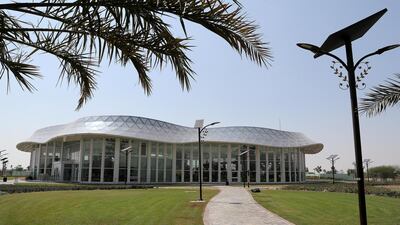
A view of the Glass House at the Quranic Park in Dubai. Pawan Singh / The National -
The entrance of the Quranic Park in Dubai. Pawan Singh / The National -
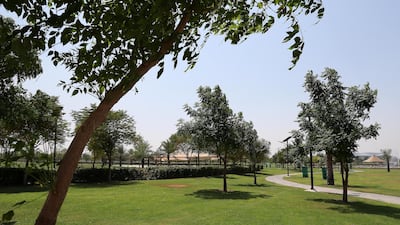
A view of the Quranic Park in Dubai. Pawan Singh / The National -
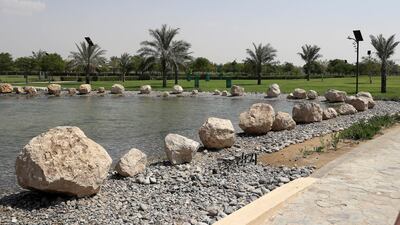
A view of the pond at the Quranic Park in Dubai. Pawan Singh / The National -

Solar panel trees are seen on the pathway at Dubai's Quranic Park in Dubai. Reuters -
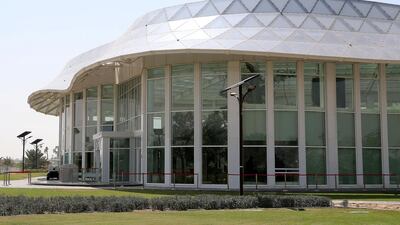
The Glass House at the Quranic Park in Dubai. Pawan Singh / The National -
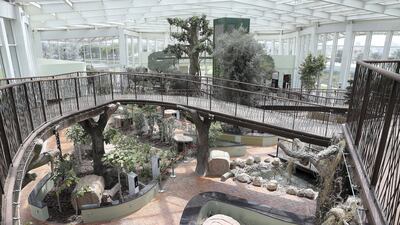
The trees planted inside the Glass House are those mentioned in the Quran. Pawan Singh / The National -
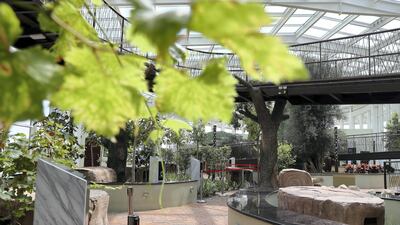
Various types of trees planted inside the Glass House at the Quranic Park in Dubai. (Pawan Singh / The National -

The Glass House is home to 29 different plants and trees, including the olive tree, figs, aloe vera and more. Pawan Singh / The National -
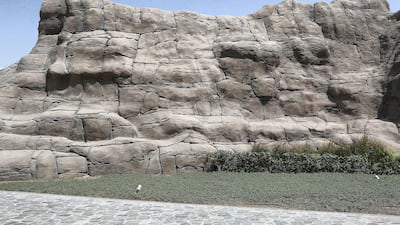
A view of the Cave of Miracles at the Quranic Park in Dubai. Pawan Singh / The National -

The man-made cave depicts miracles that occurred in the Quran. Pawan Singh / The National -
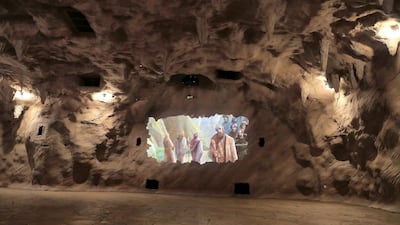
Video displays appear in various sections of the cave. Pawan Singh / The National


I’m wondering if this is a reality. Are we still forcing trees to give everything for almost nothing in return?
It is surprisingly difficult to get any definitive stats on deforestation in 2023 but, according to the World Wildlife Foundation, there was a 60 per cent drop in deforestation in the Amazon from January 2022 to January 2023. I’m quietly hopeful this points to, at least, a slow shift away from us re-enacting Silverstein’s boy character simply taking and taking and taking.
The importance of caring for the environment is intrinsically part of the Islamic faith. One verse describes "the servants of the Most Compassionate [as those who] walk gently/humbly on this earth". I only felt truly connected to this verse very recently.
Eid prayers during the summer months are held in a local park when the weather is good. Hundreds, if not thousands, of Muslim families come decked out in their most beautiful clothes, ready to spread greetings of Salam and many, many sweets.
This year, I drove past an hour or so afterwards and the field was empty. No littering or uprooted patches of grass left from the bouncy castle. No evidence of this huge gathering remained. We had tread softly on this patch of earth.

I am, unashamedly, biased when I say that this is faith at its most nourishing, when based on a sense of care – for self, for others, for the landscape, for the future.
Dod yn ôl at fy nghoed is a Welsh phrase commonly used to mean a healthy mindset or coming back to one’s senses. Interestingly, the literal translation is ‘to return to my trees’. Trees as bringers of sense, of balance, of wisdom, of transition, of life.
Our relationship with these ancient beings continues to shift over time. Here’s hoping the next phase will emerge as reciprocal, rooted in care and curiosity, not crying.
This is an edited extract from Hanan Issa's essay called 'The Sacred Arbor' in the anthology 'Gathering: Women of Colour on Nature', edited by Durre Shahwar and Nasia Sarwar-Skuse (404 Ink, £10.99), which is available now.


