


The biennial Sarah Maguire Prize for Poetry in Translation has been awarded to the poetry collection Exhausted on the Cross, written by Palestinian poet Najwan Darwish and translated by Egyptian-American editor, writer and scholar, Kareem James Abu-Zeid.
Commenting on the work, Rosalind Harvey, chairwoman of judges, says: “In its direct, stripped-back lines, the collection demonstrates both the limits and the necessity of language, inviting us to ask, together, how we can move through and beyond suffering.”
Meanwhile, Abu-Zeid says the prize, named after poet Maguire, who was “a champion of international poetry”, was a huge honour.
“Najwan and I both poured an immense amount of time and creative energy into Exhausted on the Cross, as did the whole team at NYRB Poets, and it is very rewarding to be recognised for our work by such an esteemed panel of judges.”
Exhausted on the Cross was selected from a shortlist of six books which included poets from the Democratic Republic of Congo, Korea, Mauritius, Mexico and Syria. Darwish and Abu-Zeid, who have been working together for 13 years, will share their winnings of £3,000 ($3,460).
Abu-Zeid is no stranger to accolades, having received both the 2017 PEN Centre USA Translation Prize and the 2018 National Endowment for the Arts translation grant.
However, having his translation of Najwan Darwish’s Exhausted On the Cross shortlisted for four awards in two countries is unprecedented.
“I’ve received recognition for my translations before, but this is the first time I’ve had four different prizes — three in the US and one in the UK — acknowledge a single book before in some way. It’s great for the book, which of course makes me very happy,” says Abu-Zeid.
Darwish, a Palestinian writer who lives between Haifa and his birthplace of Jerusalem, has been described by the New York Review of Books as “one of the foremost contemporary Arab poets”.
When selecting the Exhausted on the Cross for its shortlist, the 2022 National Translation Award judges described Darwish’s second volume of poetry as “poignant, raw, unflinching, and deeply humane, infusing the sorrow and suffering of occupation and the human condition with a startling lyricism”.
They added: “Kareem James Abu-Zeid’s unforgettable translation in its stark, clean, yet melodic register, invites us into the complexity of Darwish’s poetry, the suppleness of his Arabic, and the uncompromising vision of resistance in the face of oppression that beats at the heart of this marvellous book.”

Abu-Zeid is a long-time admirer of Darwish’s writing, having spent more than a decade translating his work. “Honestly, I love all of Najwan’s work,” Abu-Zeid tells The National. “I feel that his poetry keeps getting better and better.
“His work resonates both spiritually and politically with me. There’s a variety of themes and styles, and also of tone, so that I’m always learning something new.”
The translator says he appreciates the nuanced ways in which history and politics appear in Darwish’s work.
“Things are almost never black and white in his poetry, even though it never shies away from forcefully calling out injustice. And although he’s very much a Palestinian poet, he’s completely against all forms of nationalism.”
Despite focusing on events and issues that are specific to Palestine, Abu-Zeid says that there is a “universal” feel, which seems to transcend time and space.
Amid Darwish’s eight published books, translated into more than 20 languages, Abu-Zeid believes this particular strand stands out the most in Exhausted on the Cross.
“Several of Najwan’s collections are more anchored in a specific place and time. He has one collection that arose from an extended period of time he spent in London; and another that is centred on the city of Akka [Acre]; and another that is anchored in Granada.
“Haifa does emerge repeatedly in Exhausted on the Cross, but there’s a lot more travelling across space and time in this book — present-day Gaza, medieval Baghdad, Samarkand, Nepal, Aswan and so on — the geography and epoch are constantly slipping.”
One of the poems included in the collection, My Defeated Banner, reads: “If I could come back, I wouldn’t come under any other banner / I’d still embrace you with two severed hands / I don’t want wings in paradise, I just want your graves by the river / I want eternity at the breakfast table with the bread and oil / I want you — earth, my defeated banner.”
Acclaimed Chilean poet Raul Zurita describes the poem “in its devastating beauty”, not just as one of the peak moments of Darwish’s poetry, but “the writing of our time”.
Zurita says: “Expelled from their ancestral land, permanently besieged and persecuted, women who have lost everything — their houses, their neighbourhoods, their children — make present to … the reader that in this land of victims and perpetrators, displaced and disappeared, all the rest of us are survivors.
“Exhausted … on a cross made of rubble and death, of love and shame, we glimpse the limits of an immortality we cannot escape, an immortality that condemns us to death. Yet by reading this poetry one can come to love that condemnation and thus love the whole earth — our defeated banner.”

Exhausted on the Cross is Darwish’s second collection to appear in English after his book, Nothing More to Lose, was also translated into English by Abu-Zeid.
That earlier collection describes events such as the 2008 Israeli air raids on Gaza with intensity, “The earth is three nails / and mercy a hammer: / Strike, Lord / Strike with the planes.”
However, his newer collection merges this with what Abu-Zeid calls “a certain weariness of spirit — the tedium of an endless occupation, but also the suffering inherent in the human condition itself”.
“There is no quick crucifixion any more,” says Abu-Zeid, “and certainly no resurrection in glory on the third day.”
The works ebb and flow with the tides of a uniquely Palestinian experience of humanity; carried upwards by waves of hope, before crashing into the inevitability of despair.
“The ones hanging / are tired, / so bring us down / and give us some rest,” begins the titular poem, only to later descend into “Lord, / sharpen your knife / and give your sacrifice its rest.”
Abu-Zeid says Darwish’s work draws upon a broad array of traditions, including pre-Islamic poetry, the music of Umm Kulthum, contemporary Iranian cinema, classical and modern Chinese poetry, art history and Latin American literature, among others.
“Unlike most of the authors I’ve translated, we work quite closely together,” Abu-Zeid says.
On their winning formula, he says: “Our guiding criteria with the translations is almost always, ‘Does it work well as poetry in English?’ in addition, of course, to accurately conveying the meanings of the Arabic.”
Abu-Zeid attributes his success to a “holistic” approach to translation. “I’ve seen so many translations of great poetry that translate all the words correctly, without an eye to the overall context, and the result is almost nonsensical.
“We could say that a poem produces a set of effects: semantic, sonic, emotional, spiritual. The literary translation’s job is to attempt to reproduce those effects, insofar as possible.”
“Some questions that I always ask myself – and these are very important for Najwan’s poetry: How does the poem hit home? What’s the feel of this poem? What impression or feeling does it leave the reader with?
“After all, what good is a word-for-word translation if all the potency of the original is lost?”
Although his translations begin with a technical process of understanding the various possibly meanings of a poem in Arabic, “after that, it becomes much more creative”, he says.
“The best solutions always come to me from a space of silence … It’s not about struggle; it’s about finding a flow.” Rather than an “intellectual grappling” with the text, he describes this phases as an “empathetic or spiritual engagement” with it.
“For me at least, literary translation is definitely an art, and perhaps a meditation, but certainly not a science.”
Scroll through images of rare Arabic manuscripts and books on show at this year's Sharjah International Book Fair below
-

Visitors to the 41st Sharjah International Book Fair will be treated to a rare sight this year as the emirate displays manuscripts previously unseen in the region. Photo: SIBF -

The centuries-old Arabic and Islamic books, some as old as the 13th Century, will be on show. Photo: SIBF -

The works will be shown at a special exhibition during the 12-day event, and is organised in collaboration with Italy's Catholic University of the Sacred Heart and Ambrosian Library. Photo: SIBF -
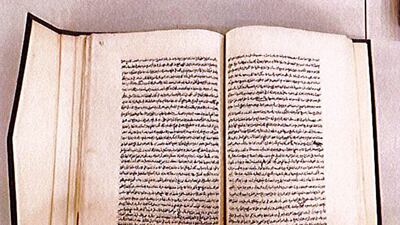
The fair will be held under the theme Spread the Word. Photo: SIBF -

The 41st annual event will take place between November 2 and 13 at the Expo Centre Sharjah. Photo: SIBF -
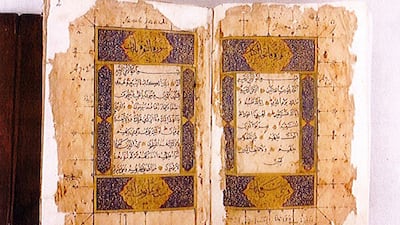
Included in the display will be embossed and gilded pages copied from the Holy Quran that date back to 15th and 16th centuries and a 17th century cosmology manuscript titled ‘Miracles of Existence’. Photo: SIBF



