Mohammed Kazem in front of his new painting 'Window' (2022), in his Alserkal Avenue studio ahead of its inclusion at the Lyon Biennale. The work depicts migrant workers boarding a bus at the end of the day. Photo Altamash Urooj
Mohammed Kazem in front of his new painting 'Window' (2022), in his Alserkal Avenue studio ahead of its inclusion at the Lyon Biennale. The work depicts migrant workers boarding a bus at the end of th

Arab artists lead the way in a Lyon Biennale exploring empathy at a time of uncertainty


Melissa Gronlund
  • English
  • Arabic

This year, the UAE has a strong showing at the Lyon Biennale — with a stand-out painting by Mohammed Kazem, a complex installation by Hashel Al Lamki, and frescoes by Chafa Ghaddar navigating between past and present. It is a connection that begins with the curators themselves.

Having curated the UAE's National Pavilion at the Venice Biennale in 2019 and Abu Dhabi Art's Beyond: Emerging Artists show in 2021, Sam Bardaouil and Till Fellrath, who collaborate as Art Reoriented, have co-curated the Lyon exhibition with a sweeping contemporary, international focus.

This year, the Lyon Biennale, which runs until December, is inspired by the idea of fragility — or, as Bardaouil puts it, “that we are all going to die”. The two curators aim to capture the worldwide mood of insecurity and fear amid the Covid-19 pandemic, with the war in Ukraine, the cost of living crisis and the looming ecological catastrophe lurking in the background.

“Art history helps remind us that we are all part of a larger cycle of fragility and resistance,” says Bardaouil. “We wanted to ask: 'How does fragility manifest itself across time and space, and also in the life of one person?”

Ugo Schiavi's 'Grafted Memory System' (2022), the centrepiece installation for the Lyon Biennale at the Musee Guimet. Photo: Lyon Biennale

They elaborated on this idea, coming up with what they call a "Manifesto of Fragility", spread out with a cogent sense of staging across the city's 12 venues.

The exhibition mixes together commissioned and contemporary artworks alongside historical genre and religious paintings, artefacts and exhibition posters, as well as a showing of Beirut and The Golden Sixties: A Manifesto of Fragility, an exhibition that the pair originally put on in Berlin.

The connection to Beirut — Bardaouil's home town, and one in a prolonged state of fragility — is a key strand of the event, which maps out links between Lyon and the wider Middle East.

This theme reflects Bardaouil and Fellrath's long engagement with the region, producing partnerships such as the one between the Lyon Biennale and the Diriyah Biennale in Saudi Arabia. A number of works came to Lyon from the Saudi show, such as the installations by Filwa Nazer, Dana Awartani and Abdullah Al Othman.

More generally, however, the curators' use of the city's Roman-era ruins, gathered together in Lugdunum, suggests a reorientation around the Mediterranean, in which cities such as Beirut and Lyon would have been connected for centuries via empire and trade.

This link proved crucial to the most unusual device of their biennial: the historical persona of Louise Brunet, a 19th-century Lyonnais woman who took part in a revolution of the city’s silk-weavers and then wound up in Beirut, which at that time had substantial business interests with Lyon’s silk industries.

“We started conceiving the biennial, on the one hand, with this horizontal axis of artists coming from all over the world — in the current moment, that [kind of curation] is the standard thing,” says Fellrath.

"But I think it's equally important to make a point for the universality of art and artists creating works — so looking at the vertical axis of time, which we see in this panorama of the world of endless promise. And Louise Brunet is the figure that cuts across everything and wraps it all together.”

In the presentation at the city's Museum of Contemporary Art, titled the Many Lives and Deaths of Louise Brunet, Brunet becomes a historical fiction that Bardaouil and Fellrath imagine in different scenarios of fragility and resistance.

Sam Bardaouil and Till Fellrath's idiosyncratic curation includes Abraham van der Eyk's 'Allegory on the Disputes Between the Remonstrants and the Counter-Remonstrants' (1618), on loan from the Musee des Beaux-Arts in Lyon. Photo: Lyon MBA; Alain Basset

Signalled by works in the show and elaborated in texts for the visitors, Brunet becomes not only the striking Lyonnais factory worker but also the artistic community in New York in the 1980s, decimated by AIDS, or the 19th-century woman brought to Lyon as a representative African who ran away — fleeing up the very hill of Fourviere where the biennial’s Roman venues now stand.

This section of the biennial is the most ambitious — as well as the most difficult to navigate. Through a variety of forms of visual culture, the exhibition broadens perceptions of what contemporary art can talk about and how it gets across its message.

The Brunet installation juxtaposes, for example, Gabriel Arantes’s funny video A Brief History of Princess X (2016) — a rumination on a Brancusi sculpture with Freudian connections — with a portrait of a beautiful, bejewelled King Henry III of France. The comparison suggests how art has always involved a negotiation between a high cultural elite and a more progressive, inclusive impulse, never fully reconciling the two.

It's a strategy the curators have used before, and is to an extent part of their positioning as outsiders to the art world. With Bardaouil coming from a theatre background and Fellrath having taught at the London School of Economics, they approach curation from a different angle than the realm of critical theory and post-war conceptualism that still rules curatorial programmes.

Though, it’s questionable how long they can claim this outsider status, having won the Golden Lion for the French Pavilion at this year’s Venice Biennale, and now directing the prestigious contemporary art space of the Hamburger Bahnhof in Berlin.

Mixed works from different eras with an international focus on view at Lyon's Museum of Contemporary Art. Photo: Lyon Biennial

At the Lyon Biennial, their broad curation freely mixes work from different time periods allowing more ideas in — but at times it blurs important distinctions between different contexts, particularly in the use of religious paintings or artefacts that came to Lyon via colonial extraction.

As with other shows, such as Cecilia Alemani's Venice Biennale exhibition, that weave together time periods, occasionally, the connections seem more formal than historical. While many of us might be "fragile", not all of us are vulnerable in the same way: some have more power than others.

The combination of works from different eras was particularly pointed at Lyon’s Roman museum, the Lugdunum, and the Renaissance-era mansion of the Gadagne, where biennial artworks are placed among the existing museum displays. Here they clearly functioned as memento moris — a reminder that we all will die, and that contemporary art will itself one day be in ruins.

Saudi artist Nazer’s three forms made of gauzy fabric float like wraiths above a Roman mosaic, as if ghosts of the life that once tripped over its tiles. At the Gadagne, meanwhile, Leo Fourdrinier has made pseudo-decorative statues of dogs, with a concrete ball wedged awkwardly between them, commemorating the long history of metamorphosis.

Filwa Nazer's 'H. A.' (2021), an installation of sewn textiles giving the impression of ghosts dancing on the past. It was brought over from Saudi Arabia's Diriyah Biennale, one of the Lyon Biennale's sponsors. Melissa Gronlund / The National

The selection is more straightforward at the primary venue, the Usines Fagor, where many works speak to representation and justice. The Polish artist Marta Gornicka’s rousing video Grundgesetz (2022) shows a diverse group of singers performing a choral rendition of Germany’s post-war constitution and its commitment to gender and racial equality, arrayed in front of Berlin’s Brandenburg Gate.

Emirati artist Kazem here presents his extraordinary history-sized painting of migrant workers in the UAE boarding their bus at the end of the day, jostled close to one other. Their rumpled clothes and crinkled plastic bags are rendered in minute detail, while the bright yellows of the hard hats and blues of their clothing are reflected in the colours of the bus and the hats of those already seated inside, in the kind of calm, even-handed approach that Kazem brings to his compositions.

The painting, Window (2022), is juxtaposed with Kazem’s earlier series that explore the invisibility of these workers, such as his monochrome depictions of building sites where they are deliberately absent, and a painting from 2019 (Windows) of the same scene that this time shows the workers receding into the background.

And the show’s tour de force comes at its most theatrical: the Musee Guimet presentation in the spooky former natural history museum. The space has been shuttered owing to asbestos in some of the rooms. These remain closed, however, the exhibition is housed in the others that remain unaffected. Many of the artists lean into the museum as a symbol of a rotten past, including Ugo Schiavi's centrepiece reflecting on environmental catastrophe.

Palestinian-Swedish artist Tarik Kiswanson flaked paint off the windows to expose light into an abandoned gallery, and mounted its furniture on the ceiling, with elegant, egg-like sculptures underneath. It is an Alice in Wonderland display, as if the removal of the artefacts from the vitrines had lifted off the weight of the past, and they simply floated upwards. In reality, the vitrine and sculpture weigh 450 kilogrammes together and they had to be drilled into the floor above.

Palestinian-Swedish artist Tarik Kiswanson asked what it would be like to stand underneath the past. He drilled the Musee Guimet galleries' vitrines and desks into the ceiling, placing futuristic egg-like sculptures beneath them. Melissa Gronlund / The National

“I thought, what would it be like to walk under the past?” asks Kiswanson. “Underneath, I put an ambiguous structure, somewhere between an egg and a cocoon and a grain,” suggesting at once home and migration.

Chinese artist Zhang Ruyi retrofitted other galleries into bathrooms, with white tiles echoing the endless grids of dystopian fantasy. Her inspiration was the monotonous entrapment of the Covid-19 pandemic. In a subtle, disquieting section, she covered a tiled wall with plastic sheeting into which she placed thin aluminium shards at regular intervals, creating the feel of the two extremes of total sterility and human frailty that the pandemic rattled between.

Gripped by multiple crises, Beirut itself functions as a potent symbol of fragility. The blast is the subject of two outstanding works: an animation by Nadine Labaki and Khaled Mouzanar, and a video installation by Joana Hadjithomas and Khalil Joreige.

In the latter, a circle screens of footage from the Sursock museum showing the moment of the Beirut port blast. The footage is moving enough that little had to be done to it. Stained glass windows explode; a painting slumps to the side; a bride being photographed on her wedding day trips over her dress and falls to the ground.

Again and again she turns, trips, falls, and gets up and races inside. Depending on when one looks away, it’s a story of optimism — her new husband, as he leans down to help her; her resolve to get up — or of repeated catastrophe. The same is true of the biennial overall: is it a manifesto to fragility, or to resistance?

For Bardaouil, the answer is clear: “We have to keep resisting, we have to keep moving forward."

Lyon Biennale runs until December 31. For more information, visit labiennaledelyon.com

Scroll through images of Emirati artist Mohamed Ahmed Ibrahim's installation at the Venice Biennale 2022 below

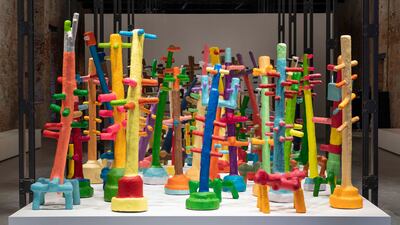
  • Emirati artist Mohamed Ahmed Ibrahim’s installation of 128 sculptures, Between Sunrise and Sunset, has opened at the Venice Biennale's National Pavilion UAE. All photos: Ismail Noor / National Pavilion UAE
    Emirati artist Mohamed Ahmed Ibrahim’s installation of 128 sculptures, Between Sunrise and Sunset, has opened at the Venice Biennale's National Pavilion UAE. All photos: Ismail Noor / National Pavilion UAE
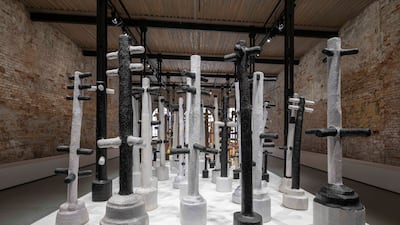
  • Arranged in a thick column in the cavernous Arsenale room, the tree-like sculptures are inspired by Ibrahim's hometown of Khorfakkan
    Arranged in a thick column in the cavernous Arsenale room, the tree-like sculptures are inspired by Ibrahim's hometown of Khorfakkan
  • The forms remain the same but the colours change as one walks towards the back of the room, with beiges and taupes taking the place of formerly lurid shades
    The forms remain the same but the colours change as one walks towards the back of the room, with beiges and taupes taking the place of formerly lurid shades
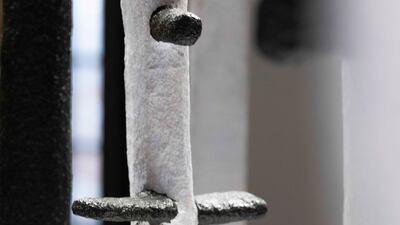
  • Made of papier-mache, the objects seem painted but actually gain their colour from the paper used to create them
    Made of papier-mache, the objects seem painted but actually gain their colour from the paper used to create them
  • Ibrahim mixed coloured sheaves of paper as a painter mixes paint, and also incorporated everyday, organic material from around him — leaves from trees in his garden in Khorfakkan, tobacco, tea, coffee, and even the cardboard packaging from toys which his grandchildren would save for him
    Ibrahim mixed coloured sheaves of paper as a painter mixes paint, and also incorporated everyday, organic material from around him — leaves from trees in his garden in Khorfakkan, tobacco, tea, coffee, and even the cardboard packaging from toys which his grandchildren would save for him
  • Curated by Maya Allison, executive director of NYU Abu Dhabi Art Gallery, the exhibition presents a major new work by an Emirati artist
    Curated by Maya Allison, executive director of NYU Abu Dhabi Art Gallery, the exhibition presents a major new work by an Emirati artist
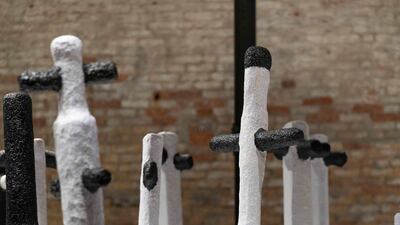
  • Bright colours change into a more desolate landscape of blacks and whites as you walk through the installation
    Bright colours change into a more desolate landscape of blacks and whites as you walk through the installation
  • The work, and the performative walk around it, affect the transition from day to night, as seen by the eye
    The work, and the performative walk around it, affect the transition from day to night, as seen by the eye
  • In some ways, the sculptures resemble trees and animals, but Ibrahim says they represent neither
    In some ways, the sculptures resemble trees and animals, but Ibrahim says they represent neither
  • Mohamed Ahmed Ibrahim: Between Sunrise and Sunset is now open to the public at the Venice Biennale and runs until November 27, 2022
    Mohamed Ahmed Ibrahim: Between Sunrise and Sunset is now open to the public at the Venice Biennale and runs until November 27, 2022
UAE currency: the story behind the money in your pockets
Kanguva
Director: Siva
Stars: Suriya, Bobby Deol, Disha Patani, Yogi Babu, Redin Kingsley
Rating: 2/5
 
The specs

A4 35 TFSI

Engine: 2.0-litre, four-cylinder

Transmission: seven-speed S-tronic automatic

Power: 150bhp

Torque: 270Nm

Price: Dh150,000 (estimate)

On sale: First Q 2020

A4 S4 TDI

Engine: 3.0-litre V6 turbo diesel

Transmission: eight-speed PDK automatic

Power: 350bhp

Torque: 700Nm

Price: Dh165,000 (estimate)

On sale: First Q 2020

The%20specs
%3Cp%3E%3Cstrong%3EEngine%3A%3C%2Fstrong%3E%20Twin-turbocharged%204-litre%20V8%0D%3Cbr%3E%3Cstrong%3EPower%3A%20%3C%2Fstrong%3E542bhp%0D%3Cbr%3E%3Cstrong%3ETorque%3A%20%3C%2Fstrong%3E770Nm%0D%3Cbr%3E%3Cstrong%3ETransmission%3A%20%3C%2Fstrong%3EEight-speed%20automatic%0D%3Cbr%3E%3Cstrong%3EPrice%3A%20%3C%2Fstrong%3EFrom%20Dh1%2C450%2C000%3Cbr%3E%3Cstrong%3EOn%20sale%3A%20%3C%2Fstrong%3ENow%3C%2Fp%3E%0A
T20 World Cup Qualifier fixtures

Tuesday, October 29

Qualifier one, 2.10pm – Netherlands v UAE

Qualifier two, 7.30pm – Namibia v Oman

Wednesday, October 30

Qualifier three, 2.10pm – Scotland v loser of qualifier one

Qualifier four, 7.30pm – Hong Kong v loser of qualifier two

Thursday, October 31

Fifth-place playoff, 2.10pm – winner of qualifier three v winner of qualifier four

Friday, November 1

Semi-final one, 2.10pm – Ireland v winner of qualifier one

Semi-final two, 7.30pm – PNG v winner of qualifier two

Saturday, November 2

Third-place playoff, 2.10pm

Final, 7.30pm

MATCH INFO

England 241-3 (20 ovs)

Malan 130 no, Morgan 91

New Zealand 165 all out (16.5ovs)

Southee 39, Parkinson 4-47

England win by 76 runs

Series level at 2-2

Key facilities
  • Olympic-size swimming pool with a split bulkhead for multi-use configurations, including water polo and 50m/25m training lanes
  • Premier League-standard football pitch
  • 400m Olympic running track
  • NBA-spec basketball court with auditorium
  • 600-seat auditorium
  • Spaces for historical and cultural exploration
  • An elevated football field that doubles as a helipad
  • Specialist robotics and science laboratories
  • AR and VR-enabled learning centres
  • Disruption Lab and Research Centre for developing entrepreneurial skills
Get inspired

Here are a couple of Valentine’s Day food products that may or may not go the distance (but have got the internet talking anyway).

Sourdough sentiments: Marks & Spencer in the United Kingdom has introduced a slow-baked sourdough loaf dusted with flour to spell out I (heart) you, at £2 (Dh9.5). While it’s not available in the UAE, there’s nothing to stop you taking the idea and creating your own message of love, stencilled on breakfast-inbed toast.  

Crisps playing cupid: Crisp company Tyrells has added a spicy addition to its range for Valentine’s Day. The brand describes the new honey and chilli flavour on Twitter as: “A tenderly bracing duo of the tantalising tingle of chilli with sweet and sticky honey. A helping hand to get your heart racing.” Again, not on sale here, but if you’re tempted you could certainly fashion your own flavour mix (spicy Cheetos and caramel popcorn, anyone?). 

'Fantastic Beasts: The Secrets of Dumbledore'

Rating: 3/5

Directed by: David Yates

Starring: Mads Mikkelson, Eddie Redmayne, Ezra Miller, Jude Law

Classification of skills

A worker is categorised as skilled by the MOHRE based on nine levels given in the International Standard Classification of Occupations (ISCO) issued by the International Labour Organisation. 

A skilled worker would be someone at a professional level (levels 1 – 5) which includes managers, professionals, technicians and associate professionals, clerical support workers, and service and sales workers.

The worker must also have an attested educational certificate higher than secondary or an equivalent certification, and earn a monthly salary of at least Dh4,000. 

Fourth-round clashes for British players

- Andy Murray (1) v Benoit Paire, Centre Court (not before 4pm)

- Johanna Konta (6) v Caroline Garcia (21), Court 1 (4pm)

MATCH INFO

Manchester United 1 (Rashford 36')

Liverpool 1 (Lallana 84')

Man of the match: Marcus Rashford (Manchester United)

The biog

Most memorable achievement: Leading my first city-wide charity campaign in Toronto holds a special place in my heart. It was for Amnesty International’s Stop Violence Against Women program and showed me the power of how communities can come together in the smallest ways to have such wide impact.

Favourite film: Childhood favourite would be Disney’s Jungle Book and classic favourite Gone With The Wind.

Favourite book: To Kill A Mockingbird for a timeless story on justice and courage and Harry Potters for my love of all things magical.

Favourite quote: “We make a living by what we get, but we make a life by what we give.” — Winston Churchill

Favourite food: Dim sum

Favourite place to travel to: Anywhere with natural beauty, wildlife and awe-inspiring sunsets.

Dust and sand storms compared

Sand storm

  • Particle size: Larger, heavier sand grains
  • Visibility: Often dramatic with thick "walls" of sand
  • Duration: Short-lived, typically localised
  • Travel distance: Limited 
  • Source: Open desert areas with strong winds

Dust storm

  • Particle size: Much finer, lightweight particles
  • Visibility: Hazy skies but less intense
  • Duration: Can linger for days
  • Travel distance: Long-range, up to thousands of kilometres
  • Source: Can be carried from distant regions

Mercer, the investment consulting arm of US services company Marsh & McLennan, expects its wealth division to at least double its assets under management (AUM) in the Middle East as wealth in the region continues to grow despite economic headwinds, a company official said.

Mercer Wealth, which globally has $160 billion in AUM, plans to boost its AUM in the region to $2-$3bn in the next 2-3 years from the present $1bn, said Yasir AbuShaban, a Dubai-based principal with Mercer Wealth.

Within the next two to three years, we are looking at reaching $2 to $3 billion as a conservative estimate and we do see an opportunity to do so,” said Mr AbuShaban.

Mercer does not directly make investments, but allocates clients’ money they have discretion to, to professional asset managers. They also provide advice to clients.

“We have buying power. We can negotiate on their (client’s) behalf with asset managers to provide them lower fees than they otherwise would have to get on their own,” he added.

Mercer Wealth’s clients include sovereign wealth funds, family offices, and insurance companies among others.

From its office in Dubai, Mercer also looks after Africa, India and Turkey, where they also see opportunity for growth.

Wealth creation in Middle East and Africa (MEA) grew 8.5 per cent to $8.1 trillion last year from $7.5tn in 2015, higher than last year’s global average of 6 per cent and the second-highest growth in a region after Asia-Pacific which grew 9.9 per cent, according to consultancy Boston Consulting Group (BCG). In the region, where wealth grew just 1.9 per cent in 2015 compared with 2014, a pickup in oil prices has helped in wealth generation.

BCG is forecasting MEA wealth will rise to $12tn by 2021, growing at an annual average of 8 per cent.

Drivers of wealth generation in the region will be split evenly between new wealth creation and growth of performance of existing assets, according to BCG.

Another general trend in the region is clients’ looking for a comprehensive approach to investing, according to Mr AbuShaban.

“Institutional investors or some of the families are seeing a slowdown in the available capital they have to invest and in that sense they are looking at optimizing the way they manage their portfolios and making sure they are not investing haphazardly and different parts of their investment are working together,” said Mr AbuShaban.

Some clients also have a higher appetite for risk, given the low interest-rate environment that does not provide enough yield for some institutional investors. These clients are keen to invest in illiquid assets, such as private equity and infrastructure.

“What we have seen is a desire for higher returns in what has been a low-return environment specifically in various fixed income or bonds,” he said.

“In this environment, we have seen a de facto increase in the risk that clients are taking in things like illiquid investments, private equity investments, infrastructure and private debt, those kind of investments were higher illiquidity results in incrementally higher returns.”

The Abu Dhabi Investment Authority, one of the largest sovereign wealth funds, said in its 2016 report that has gradually increased its exposure in direct private equity and private credit transactions, mainly in Asian markets and especially in China and India. The authority’s private equity department focused on structured equities owing to “their defensive characteristics.”

Paatal Lok season two

Directors: Avinash Arun, Prosit Roy 

Stars: Jaideep Ahlawat, Ishwak Singh, Lc Sekhose, Merenla Imsong

Rating: 4.5/5

Pari

Produced by: Clean Slate Films (Anushka Sharma, Karnesh Sharma) & KriArj Entertainment

Director: Prosit Roy

Starring: Anushka Sharma, Parambrata Chattopadhyay, Ritabhari Chakraborty, Rajat Kapoor, Mansi Multani

Three stars

MATCH INFO

Hoffenheim v Liverpool
Uefa Champions League play-off, first leg
Location: Rhein-Neckar-Arena, Sinsheim
Kick-off: Tuesday, 10.45pm (UAE)

Ferrari 12Cilindri specs

Engine: naturally aspirated 6.5-liter V12

Power: 819hp

Torque: 678Nm at 7,250rpm

Price: From Dh1,700,000

Available: Now

57%20Seconds
%3Cp%3E%3Cstrong%3EDirector%3A%3C%2Fstrong%3E%20Rusty%20Cundieff%0D%3Cbr%3E%3Cstrong%3EStars%3A%20%3C%2Fstrong%3EJosh%20Hutcherson%2C%20Morgan%20Freeman%2C%20Greg%20Germann%2C%20Lovie%20Simone%0D%3Cbr%3E%3Cstrong%3ERating%3A%20%3C%2Fstrong%3E2%2F5%0D%3Cbr%3E%0D%3Cbr%3E%3C%2Fp%3E%0A
The currency conundrum

Russ Mould, investment director at online trading platform AJ Bell, says almost every major currency has challenges right now. “The US has a huge budget deficit, the euro faces political friction and poor growth, sterling is bogged down by Brexit, China’s renminbi is hit by debt fears while slowing Chinese growth is hurting commodity exporters like Australia and Canada.”

Most countries now actively want a weak currency to make their exports more competitive. “China seems happy to let the renminbi drift lower, the Swiss are still running quantitative easing at full tilt and central bankers everywhere are actively talking down their currencies or offering only limited support," says Mr Mould.

This is a race to the bottom, and everybody wants to be a winner.

Updated: October 07, 2022, 8:17 AM