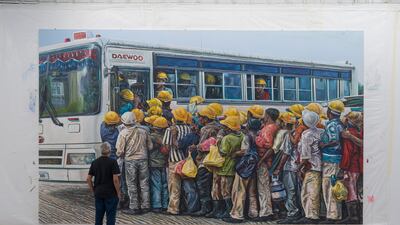

This year, the UAE has a strong showing at the Lyon Biennale — with a stand-out painting by Mohammed Kazem, a complex installation by Hashel Al Lamki, and frescoes by Chafa Ghaddar navigating between past and present. It is a connection that begins with the curators themselves.
Having curated the UAE's National Pavilion at the Venice Biennale in 2019 and Abu Dhabi Art's Beyond: Emerging Artists show in 2021, Sam Bardaouil and Till Fellrath, who collaborate as Art Reoriented, have co-curated the Lyon exhibition with a sweeping contemporary, international focus.
This year, the Lyon Biennale, which runs until December, is inspired by the idea of fragility — or, as Bardaouil puts it, “that we are all going to die”. The two curators aim to capture the worldwide mood of insecurity and fear amid the Covid-19 pandemic, with the war in Ukraine, the cost of living crisis and the looming ecological catastrophe lurking in the background.
“Art history helps remind us that we are all part of a larger cycle of fragility and resistance,” says Bardaouil. “We wanted to ask: 'How does fragility manifest itself across time and space, and also in the life of one person?”

They elaborated on this idea, coming up with what they call a "Manifesto of Fragility", spread out with a cogent sense of staging across the city's 12 venues.
The exhibition mixes together commissioned and contemporary artworks alongside historical genre and religious paintings, artefacts and exhibition posters, as well as a showing of Beirut and The Golden Sixties: A Manifesto of Fragility, an exhibition that the pair originally put on in Berlin.
The connection to Beirut — Bardaouil's home town, and one in a prolonged state of fragility — is a key strand of the event, which maps out links between Lyon and the wider Middle East.
This theme reflects Bardaouil and Fellrath's long engagement with the region, producing partnerships such as the one between the Lyon Biennale and the Diriyah Biennale in Saudi Arabia. A number of works came to Lyon from the Saudi show, such as the installations by Filwa Nazer, Dana Awartani and Abdullah Al Othman.
More generally, however, the curators' use of the city's Roman-era ruins, gathered together in Lugdunum, suggests a reorientation around the Mediterranean, in which cities such as Beirut and Lyon would have been connected for centuries via empire and trade.
This link proved crucial to the most unusual device of their biennial: the historical persona of Louise Brunet, a 19th-century Lyonnais woman who took part in a revolution of the city’s silk-weavers and then wound up in Beirut, which at that time had substantial business interests with Lyon’s silk industries.
“We started conceiving the biennial, on the one hand, with this horizontal axis of artists coming from all over the world — in the current moment, that [kind of curation] is the standard thing,” says Fellrath.
"But I think it's equally important to make a point for the universality of art and artists creating works — so looking at the vertical axis of time, which we see in this panorama of the world of endless promise. And Louise Brunet is the figure that cuts across everything and wraps it all together.”
In the presentation at the city's Museum of Contemporary Art, titled the Many Lives and Deaths of Louise Brunet, Brunet becomes a historical fiction that Bardaouil and Fellrath imagine in different scenarios of fragility and resistance.

Signalled by works in the show and elaborated in texts for the visitors, Brunet becomes not only the striking Lyonnais factory worker but also the artistic community in New York in the 1980s, decimated by AIDS, or the 19th-century woman brought to Lyon as a representative African who ran away — fleeing up the very hill of Fourviere where the biennial’s Roman venues now stand.
This section of the biennial is the most ambitious — as well as the most difficult to navigate. Through a variety of forms of visual culture, the exhibition broadens perceptions of what contemporary art can talk about and how it gets across its message.
The Brunet installation juxtaposes, for example, Gabriel Arantes’s funny video A Brief History of Princess X (2016) — a rumination on a Brancusi sculpture with Freudian connections — with a portrait of a beautiful, bejewelled King Henry III of France. The comparison suggests how art has always involved a negotiation between a high cultural elite and a more progressive, inclusive impulse, never fully reconciling the two.
It's a strategy the curators have used before, and is to an extent part of their positioning as outsiders to the art world. With Bardaouil coming from a theatre background and Fellrath having taught at the London School of Economics, they approach curation from a different angle than the realm of critical theory and post-war conceptualism that still rules curatorial programmes.
Though, it’s questionable how long they can claim this outsider status, having won the Golden Lion for the French Pavilion at this year’s Venice Biennale, and now directing the prestigious contemporary art space of the Hamburger Bahnhof in Berlin.

At the Lyon Biennial, their broad curation freely mixes work from different time periods allowing more ideas in — but at times it blurs important distinctions between different contexts, particularly in the use of religious paintings or artefacts that came to Lyon via colonial extraction.
As with other shows, such as Cecilia Alemani's Venice Biennale exhibition, that weave together time periods, occasionally, the connections seem more formal than historical. While many of us might be "fragile", not all of us are vulnerable in the same way: some have more power than others.
The combination of works from different eras was particularly pointed at Lyon’s Roman museum, the Lugdunum, and the Renaissance-era mansion of the Gadagne, where biennial artworks are placed among the existing museum displays. Here they clearly functioned as memento moris — a reminder that we all will die, and that contemporary art will itself one day be in ruins.
Saudi artist Nazer’s three forms made of gauzy fabric float like wraiths above a Roman mosaic, as if ghosts of the life that once tripped over its tiles. At the Gadagne, meanwhile, Leo Fourdrinier has made pseudo-decorative statues of dogs, with a concrete ball wedged awkwardly between them, commemorating the long history of metamorphosis.

The selection is more straightforward at the primary venue, the Usines Fagor, where many works speak to representation and justice. The Polish artist Marta Gornicka’s rousing video Grundgesetz (2022) shows a diverse group of singers performing a choral rendition of Germany’s post-war constitution and its commitment to gender and racial equality, arrayed in front of Berlin’s Brandenburg Gate.
Emirati artist Kazem here presents his extraordinary history-sized painting of migrant workers in the UAE boarding their bus at the end of the day, jostled close to one other. Their rumpled clothes and crinkled plastic bags are rendered in minute detail, while the bright yellows of the hard hats and blues of their clothing are reflected in the colours of the bus and the hats of those already seated inside, in the kind of calm, even-handed approach that Kazem brings to his compositions.
The painting, Window (2022), is juxtaposed with Kazem’s earlier series that explore the invisibility of these workers, such as his monochrome depictions of building sites where they are deliberately absent, and a painting from 2019 (Windows) of the same scene that this time shows the workers receding into the background.
And the show’s tour de force comes at its most theatrical: the Musee Guimet presentation in the spooky former natural history museum. The space has been shuttered owing to asbestos in some of the rooms. These remain closed, however, the exhibition is housed in the others that remain unaffected. Many of the artists lean into the museum as a symbol of a rotten past, including Ugo Schiavi's centrepiece reflecting on environmental catastrophe.
Palestinian-Swedish artist Tarik Kiswanson flaked paint off the windows to expose light into an abandoned gallery, and mounted its furniture on the ceiling, with elegant, egg-like sculptures underneath. It is an Alice in Wonderland display, as if the removal of the artefacts from the vitrines had lifted off the weight of the past, and they simply floated upwards. In reality, the vitrine and sculpture weigh 450 kilogrammes together and they had to be drilled into the floor above.

“I thought, what would it be like to walk under the past?” asks Kiswanson. “Underneath, I put an ambiguous structure, somewhere between an egg and a cocoon and a grain,” suggesting at once home and migration.
Chinese artist Zhang Ruyi retrofitted other galleries into bathrooms, with white tiles echoing the endless grids of dystopian fantasy. Her inspiration was the monotonous entrapment of the Covid-19 pandemic. In a subtle, disquieting section, she covered a tiled wall with plastic sheeting into which she placed thin aluminium shards at regular intervals, creating the feel of the two extremes of total sterility and human frailty that the pandemic rattled between.
Gripped by multiple crises, Beirut itself functions as a potent symbol of fragility. The blast is the subject of two outstanding works: an animation by Nadine Labaki and Khaled Mouzanar, and a video installation by Joana Hadjithomas and Khalil Joreige.
In the latter, a circle screens of footage from the Sursock museum showing the moment of the Beirut port blast. The footage is moving enough that little had to be done to it. Stained glass windows explode; a painting slumps to the side; a bride being photographed on her wedding day trips over her dress and falls to the ground.
Again and again she turns, trips, falls, and gets up and races inside. Depending on when one looks away, it’s a story of optimism — her new husband, as he leans down to help her; her resolve to get up — or of repeated catastrophe. The same is true of the biennial overall: is it a manifesto to fragility, or to resistance?
For Bardaouil, the answer is clear: “We have to keep resisting, we have to keep moving forward."
Lyon Biennale runs until December 31. For more information, visit labiennaledelyon.com
Scroll through images of Emirati artist Mohamed Ahmed Ibrahim's installation at the Venice Biennale 2022 below
-

Emirati artist Mohamed Ahmed Ibrahim’s installation of 128 sculptures, Between Sunrise and Sunset, has opened at the Venice Biennale's National Pavilion UAE. All photos: Ismail Noor / National Pavilion UAE -

Arranged in a thick column in the cavernous Arsenale room, the tree-like sculptures are inspired by Ibrahim's hometown of Khorfakkan -

The forms remain the same but the colours change as one walks towards the back of the room, with beiges and taupes taking the place of formerly lurid shades -

Made of papier-mache, the objects seem painted but actually gain their colour from the paper used to create them -

Ibrahim mixed coloured sheaves of paper as a painter mixes paint, and also incorporated everyday, organic material from around him — leaves from trees in his garden in Khorfakkan, tobacco, tea, coffee, and even the cardboard packaging from toys which his grandchildren would save for him -
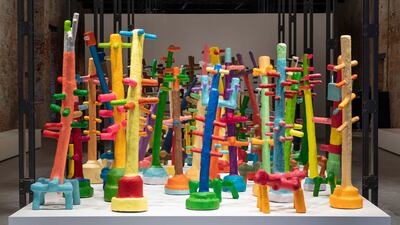
Curated by Maya Allison, executive director of NYU Abu Dhabi Art Gallery, the exhibition presents a major new work by an Emirati artist -
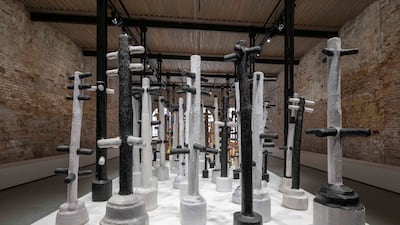
Bright colours change into a more desolate landscape of blacks and whites as you walk through the installation -
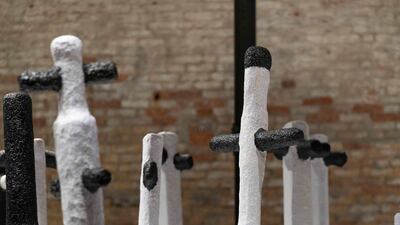
The work, and the performative walk around it, affect the transition from day to night, as seen by the eye -
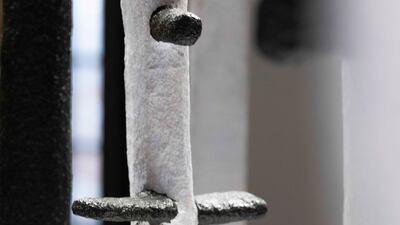
In some ways, the sculptures resemble trees and animals, but Ibrahim says they represent neither -

Mohamed Ahmed Ibrahim: Between Sunrise and Sunset is now open to the public at the Venice Biennale and runs until November 27, 2022



