

For her first institutional solo exhibition in the UAE, Pakistani artist Zara Mahmood investigates and commands stillness and heightened attention to shifting light and temporality in our day-to-day lives.
Towards Time, curated by Cima Azzam at Sharjah’s Maraya Art Centre, marks a volta in the practice of the artist who lives in Dubai. This body of work makes subtle yet pivotal departures from Mahmood’s established background in traditional printmaking, drawing and painting, gliding into the newer and more technological realms of photo transfers, video and digital prints on unconventional surfaces.
The exhibition sits a large, airy room — situated in the newly renovated second floor of the centre — filled with natural light from the windows, softening the whites of the walls and floors. It’s the ideal backdrop for Mahmood’s minimalist and sparse yet purposefully placed artworks, of which visual subtleties emerge more easily to the surface.
Upon entrance, a low-volume video of the artist plays, featuring discussions of her practice intermingled with scenes from her studio — a grounding point of entry to contextualise what’s ahead.

Many of these works were made over the past three years and their conception and process can be traced back to a trip Mahmood took to Satwa's fabric bazaar. She began experimenting with photo transfers on fabric and, after placing the printed image on fabric by a window, became entranced with the way the light coming in from behind unexpectedly affected the picture.
Intrigued by the notion of printing “moving” images that shift and change from the impact of their environment, she tried printing on other surfaces available in her studio and house, such as mylar and ceramic tiles.
We see the results in works such as A Place (2021), which shows gradations of light falling on a household surface, in the form of digital prints on mylar, as well as Dimension (2020), a series of photo transfers on tiles one would find in a kitchen or bathroom. Initially shot in the Maldives, the latter depicts muted, hazy clouds laced with sunlight, like scattered, pale fires in a grainy sky.
The tractable nature of time is a key element in this body of work. Not only inherent to the meticulous printing processes Mahmood undertakes, time is also explored in the artist’s video installations. Momentary (2018), for example, observes the ephemerality and subtle slippages of light over time through hotel blinds in Arizona. Meanwhile, the 33-minute When I Had the Sea to Myself II (2019), which appears in dimensions similar to an enlarged phone screen, portrays a choreography between light and shadow in a video of sunlight dappling the tide on the beach. It’s reminiscent of the meditative Instagram Stories or Boomerangs people post when they go to the seaside, observing the ocean and sunshine in concert, eliciting a simple aesthetic, and a spiritual and near universal pleasure.

Mahmood is also a keyboard and harmonium player for Dubai band Sail into Night, so the idea of temporality, and more specifically, tempo, is embedded in her visual practice, and highlighted in titles of works such as Frequencies (2020) and Listen (2019).
Sound is not present in the show, but rather suggested and gestured at. In Cellular (2022), a cinematic wall-width montage of digital prints, reflections of light are arranged and repeated rhythmically to mimic quietude, harmony, dissonance and recurring motifs in a musical piece. In one segment, clouds and sunlight intersperse in a manner reminiscent of a Rorschach inkblot test; other fragments of light melded into the background signify scraps of memory fading in and out of the present. The entire work is like a musical time-lapse of a moment of solitude recalled, eliciting a similarly contemplative effect as, say, looking at a large-scale Monet.
Dr Nina Heydemann, Maraya Art Centre’s director, describes much of Mahmood’s work in the show as enacting a kind of “digital Impressionism”, using technological tools and what is readily available — from household surfaces to the desktop printer and a phone camera — to achieve the same soft, poetic blurriness encapsulated by an art movement. Impressionist painters were known to spend hours outside in efforts to distill the near-imperceptible progressions of sunlight on their canvas.

Except Mahmood looks more inwards. With a lot of her works created out of and in solitude within her studio during the coronavirus lockdown, the seed of Mahmood’s conceptualisation for these artworks came from stillness and focusing on the minutiae.
Nowhere is the notion of capturing something ever-shifting and impermanent from a place of seclusion more salient than in Align (2020), a photomontage series of video stills viewed through a circular, tunnelled perspective, harking back to the “train-cinema interface associated with the early moving image”. The narrowed lens through which one views the images invokes the constraint and isolation of having to stay inside, yearning for fresh scenery.
When leaving Towards Time, Sharjah’s summer sun starts to feel more material, as does the urge to spend time observing its diaphanousness. Mahmood’s show epitomises a notable point in the artist’s own thinking and career, but it’s also an invitation to viewers to lean into their own intuitive impulses for more slowness and stillness — the same impulse gravitating us to the soft aesthetics of seashore shots and golden hour selfies; those moments that make us pause.
In essence, Towards Time pulls us towards a more focused appreciation of the ordinary, something as constant and mundane as the sun through our windows.
Embryonic Coat embodies vibrant signature style of Emirati artist Mohamed Ahmed Ibrahim — in pictures
-
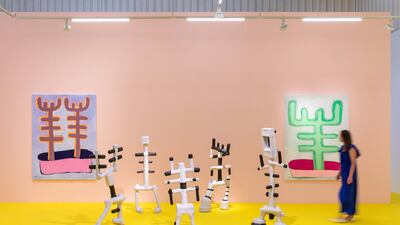
An installation view of Embryonic Coat, a solo show by Mohamed Ahmed Ibrahim running at Lawrie Shabibi gallery in Alserkal Avenue, Dubai. All photos: The artist, Lawrie Shabibi, Ismail Noor of Seeing Things -
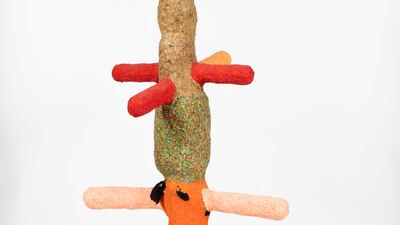
Mohamed Ahmed Ibrahim, 'Trunk', 2020, cardboard, papier mache, leaves, 164 x 58 x 45cm. -
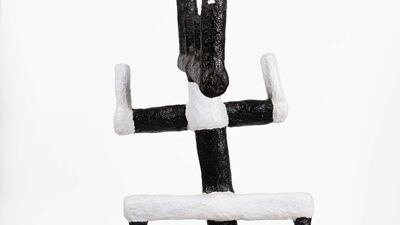
Mohamed Ahmed Ibrahim, 'Standing Body 2', 2020, cardboard, papier mache, 152 x 70 x 51cm. -
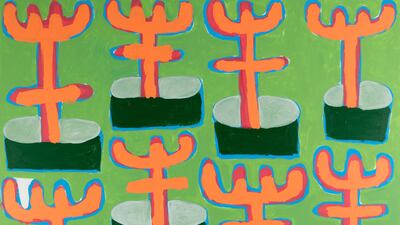
Mohamed Ahmed Ibrahim, 'My Garden's Details', 2021, acrylic on canvas, 250 x 200cm. -

Mohamed Ahmed Ibrahim, 'Assemblage Symbols', 2021, cardboard assemblage, 39 x 25cm. -
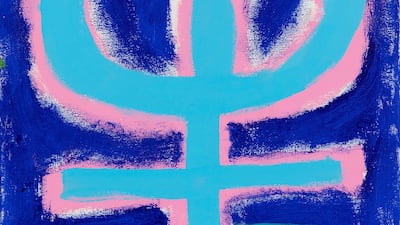
Mohamed Ahmed Ibrahim, 'My Garden's Details', 2021, acrylic on canvas, 40 x 30cm. -
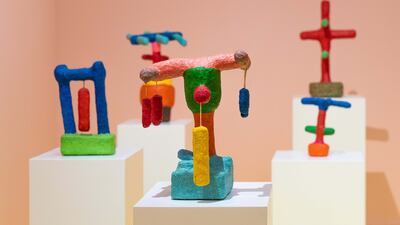
Embryonic Coat offers a vibrant artscape. -

The Khor Fakkan-born artist, 60, is one of the UAE’s pioneering art figures. -

Embryonic Coat is running concurrently with the artist's installation for the National Pavilion UAE at the 59th Venice Biennale. -
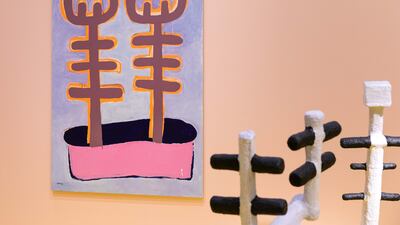
Embryonic Coat is Ibrahim’s third solo exhibition at Lawrie Shabibi. -
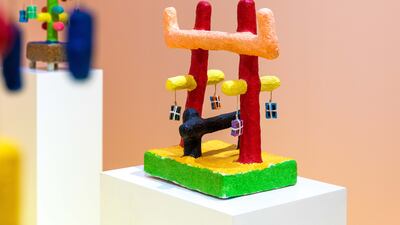
The solo show is emblematic of the signature style, mediums and artistic 'voice' he has developed over decades. -

Similar to the protective encasing or membrane formed around a seed or embryo, as outlined by the title Embryonic Coat, this show itself is a capsule of Ibrahim’s oeuvre, how it has progressed and evolved from birth to present.



