• Ukrainian artist Pavlo Makov with his piece 'The Fountain of Exhaustion' at Ukraine's pavilion at the Venice Biennale 2022. AFP
    Ukrainian artist Pavlo Makov with his piece 'The Fountain of Exhaustion' at Ukraine's pavilion at the Venice Biennale 2022. AFP
  • Makov's installation comprises 78 light blue funnels mounted on a triangle through which water flows, slowing as it travels downwards to drip slowly into the collecting basin, echoing in the otherwise silent space. AP
    Makov's installation comprises 78 light blue funnels mounted on a triangle through which water flows, slowing as it travels downwards to drip slowly into the collecting basin, echoing in the otherwise silent space. AP
  • Pavlo Makov describes his work as 'a metaphor for contemporary life'. AP
    Pavlo Makov describes his work as 'a metaphor for contemporary life'. AP
  • Visitors view 'The Fountain of Exhaustion' by artist Pavlo Makov at Ukraine's pavilion. AFP
    Visitors view 'The Fountain of Exhaustion' by artist Pavlo Makov at Ukraine's pavilion. AFP
  • Makov, 63, one of Ukraine's most important living artists, said his participation was 'an act of defiance' against the Russian invaders.
    Makov, 63, one of Ukraine's most important living artists, said his participation was 'an act of defiance' against the Russian invaders.
  • Art curator Maria Lanko loaded her car with several works of art, including Makov's installation, and drove for six days through Romania, Hungary and Austria before arriving in Italy. AFP
    Art curator Maria Lanko loaded her car with several works of art, including Makov's installation, and drove for six days through Romania, Hungary and Austria before arriving in Italy. AFP
  • 'The Fountain of Exhaustion' was inspired by the lack of vitality Makov felt as Ukraine transitioned to an independent nation in the early 1990s, and again as he travelled throughout Europe in the 2000s.
    'The Fountain of Exhaustion' was inspired by the lack of vitality Makov felt as Ukraine transitioned to an independent nation in the early 1990s, and again as he travelled throughout Europe in the 2000s.
  • A total of 58 countries, including the UAE and Saudi Arabia, are represented in national pavilions at the Venice Biennale, showcasing 213 individual artists. AFP
    A total of 58 countries, including the UAE and Saudi Arabia, are represented in national pavilions at the Venice Biennale, showcasing 213 individual artists. AFP
  • Art curator Maria Lanko and Ukrainian artist Pavlo Makov at the Venice Biennale. AFP
    Art curator Maria Lanko and Ukrainian artist Pavlo Makov at the Venice Biennale. AFP
  • Organisers of the Venice Biennale banned anyone linked to the Russian government from the entire event, joining a global cultural boycott of Moscow over the war. AP
    Organisers of the Venice Biennale banned anyone linked to the Russian government from the entire event, joining a global cultural boycott of Moscow over the war. AP

How Ukrainian artist Pavlo Makov's Venice Biennale installation was saved from war


  • English
  • Arabic

On February 24, the day Russia invaded Ukraine, curator Maria Lanko loaded her car with several works of art and drove for six days through Romania, Hungary and Austria before arriving in Italy. One of those pieces, a monumental installation by Ukrainian artist Pavlo Makov, is now on display at Ukraine's pavilion at the Venice Biennale.

Makov's installation, The Fountain of Exhaustion, comprises 78 light blue funnels mounted on a triangle through which water flows, slowing as it travels downwards to drip slowly into the collecting basin, echoing in the otherwise silent space.

He describes his work as "a metaphor for contemporary life".

"I don't think art can change the world. But art can help us to survive," he told AFP.

Scroll through the gallery above for more pictures from Pavlo Makov's Venice Biennale installation.

A visitor takes a photo of 'Fountain of Exhaustion' by artist Pavlo Makov at Ukraine's pavilion. AFP

The 59th Biennale, one of the world's prestigious art exhibitions, has however been overshadowed by the war.

Makov, 63, one of the country's most important living artists, said his participation was "an act of defiance" against the Russian invaders.

"This war in Ukraine is not an ethnic conflict," he told Associated Press.

“It is a conflict of cultures. They want to destroy, to demolish, to eliminate Ukrainian culture, so that Ukraine doesn’t exist.”

In Kyiv, Makov left behind his adult son and daughter, who were working as volunteers to help the besieged population — and his lifetime production of artworks.

“There was no question about whether to take art, because there was no room for it,” he said. “Plus, we were leaving from the bomb shelter, we were not leaving from home or the studio.”

His works have since been transferred to safer ground in western Ukraine. Some pieces have already been requested for exhibitions elsewhere.

The Fountain of Exhaustion was inspired by the lack of vitality he felt as Ukraine transformed into an independent nation in the early 1990s, and again as he travelled throughout Europe in the 2000s.

“I felt this lack of ability to protect ideas. I felt this dependence on the energy that Europe was receiving from not democratic societies was growing,’’ says Makov.

A total of 58 countries, including the UAE and Saudi Arabia, are represented in national pavilions at the Venice Biennale, showcasing 213 individual artists. But the Russian Pavilion lays empty, after the curator and artists resigned following the invasion, with artist Kirill Savchenkov saying "there is no place for art when civilians are dying".

Organisers of the Biennale praised the move and subsequently banned anyone linked to the Russian government from the entire event, joining a global cultural boycott of Moscow over the war.

In Venice, Makov is speaking more about the war than about his art.

“It is like a diplomatic mission for us," he says. “I see myself less as an artist and more as a citizen of my country.”

Scroll through the gallery below for Emirati artist Mohamed Ahmed Ibrahim's installation at the National Pavilion UAE at Venice Biennale:

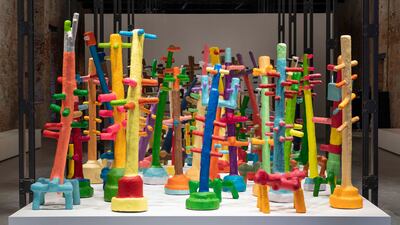
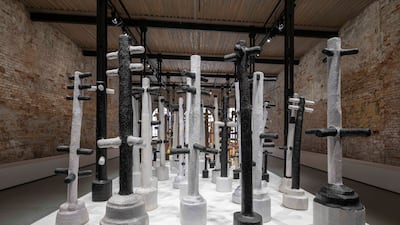
  • Emirati artist Mohamed Ahmed Ibrahim’s installation of 128 sculptures, Between Sunrise and Sunset, has opened at the Venice Biennale's National Pavilion UAE. All photos: Ismail Noor / National Pavilion UAE
    Emirati artist Mohamed Ahmed Ibrahim’s installation of 128 sculptures, Between Sunrise and Sunset, has opened at the Venice Biennale's National Pavilion UAE. All photos: Ismail Noor / National Pavilion UAE
  • Arranged in a thick column in the cavernous Arsenale room, the tree-like sculptures are inspired by Ibrahim's hometown of Khorfakkan
    Arranged in a thick column in the cavernous Arsenale room, the tree-like sculptures are inspired by Ibrahim's hometown of Khorfakkan
  • The forms remain the same but the colours change as one walks towards the back of the room, with beiges and taupes taking the place of formerly lurid shades
    The forms remain the same but the colours change as one walks towards the back of the room, with beiges and taupes taking the place of formerly lurid shades
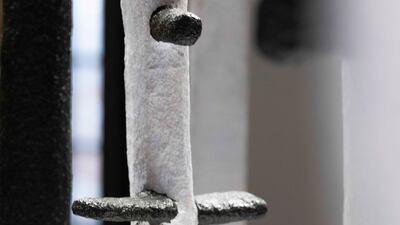
  • Made of papier-mache, the objects seem painted but actually gain their colour from the paper used to create them
    Made of papier-mache, the objects seem painted but actually gain their colour from the paper used to create them
  • Ibrahim mixed coloured sheaves of paper as a painter mixes paint, and also incorporated everyday, organic material from around him — leaves from trees in his garden in Khorfakkan, tobacco, tea, coffee, and even the cardboard packaging from toys which his grandchildren would save for him
    Ibrahim mixed coloured sheaves of paper as a painter mixes paint, and also incorporated everyday, organic material from around him — leaves from trees in his garden in Khorfakkan, tobacco, tea, coffee, and even the cardboard packaging from toys which his grandchildren would save for him
  • Curated by Maya Allison, executive director of NYU Abu Dhabi Art Gallery, the exhibition presents a major new work by an Emirati artist
    Curated by Maya Allison, executive director of NYU Abu Dhabi Art Gallery, the exhibition presents a major new work by an Emirati artist
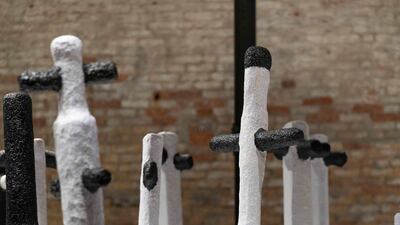
  • Bright colours change into a more desolate landscape of blacks and whites as you walk through the installation
    Bright colours change into a more desolate landscape of blacks and whites as you walk through the installation
  • The work, and the performative walk around it, affect the transition from day to night, as seen by the eye
    The work, and the performative walk around it, affect the transition from day to night, as seen by the eye
  • In some ways, the sculptures resemble trees and animals, but Ibrahim says they represent neither
    In some ways, the sculptures resemble trees and animals, but Ibrahim says they represent neither
  • Mohamed Ahmed Ibrahim: Between Sunrise and Sunset is now open to the public at the Venice Biennale and runs until November 27, 2022
    Mohamed Ahmed Ibrahim: Between Sunrise and Sunset is now open to the public at the Venice Biennale and runs until November 27, 2022

— Additional inputs by AP and AFP

Who's who in Yemen conflict

Houthis: Iran-backed rebels who occupy Sanaa and run unrecognised government

Yemeni government: Exiled government in Aden led by eight-member Presidential Leadership Council

Southern Transitional Council: Faction in Yemeni government that seeks autonomy for the south

Habrish 'rebels': Tribal-backed forces feuding with STC over control of oil in government territory

Related
Ten tax points to be aware of in 2026

1. Domestic VAT refund amendments: request your refund within five years

If a business does not apply for the refund on time, they lose their credit.

2. E-invoicing in the UAE

Businesses should continue preparing for the implementation of e-invoicing in the UAE, with 2026 a preparation and transition period ahead of phased mandatory adoption. 

3. More tax audits

Tax authorities are increasingly using data already available across multiple filings to identify audit risks. 

4. More beneficial VAT and excise tax penalty regime

Tax disputes are expected to become more frequent and more structured, with clearer administrative objection and appeal processes. The UAE has adopted a new penalty regime for VAT and excise disputes, which now mirrors the penalty regime for corporate tax.

5. Greater emphasis on statutory audit

There is a greater need for the accuracy of financial statements. The International Financial Reporting Standards standards need to be strictly adhered to and, as a result, the quality of the audits will need to increase.

6. Further transfer pricing enforcement

Transfer pricing enforcement, which refers to the practice of establishing prices for internal transactions between related entities, is expected to broaden in scope. The UAE will shortly open the possibility to negotiate advance pricing agreements, or essentially rulings for transfer pricing purposes. 

7. Limited time periods for audits

Recent amendments also introduce a default five-year limitation period for tax audits and assessments, subject to specific statutory exceptions. While the standard audit and assessment period is five years, this may be extended to up to 15 years in cases involving fraud or tax evasion. 

8. Pillar 2 implementation 

Many multinational groups will begin to feel the practical effect of the Domestic Minimum Top-Up Tax (DMTT), the UAE's implementation of the OECD’s global minimum tax under Pillar 2. While the rules apply for financial years starting on or after January 1, 2025, it is 2026 that marks the transition to an operational phase.

9. Reduced compliance obligations for imported goods and services

Businesses that apply the reverse-charge mechanism for VAT purposes in the UAE may benefit from reduced compliance obligations. 

10. Substance and CbC reporting focus

Tax authorities are expected to continue strengthening the enforcement of economic substance and Country-by-Country (CbC) reporting frameworks. In the UAE, these regimes are increasingly being used as risk-assessment tools, providing tax authorities with a comprehensive view of multinational groups’ global footprints and enabling them to assess whether profits are aligned with real economic activity. 

Contributed by Thomas Vanhee and Hend Rashwan, Aurifer

The years Ramadan fell in May

1987

1954

1921

1888

Skoda Superb Specs

Engine: 2-litre TSI petrol

Power: 190hp

Torque: 320Nm

Price: From Dh147,000

Available: Now

Lexus LX700h specs

Engine: 3.4-litre twin-turbo V6 plus supplementary electric motor

Power: 464hp at 5,200rpm

Torque: 790Nm from 2,000-3,600rpm

Transmission: 10-speed auto

Fuel consumption: 11.7L/100km

On sale: Now

Price: From Dh590,000

The President's Cake

Director: Hasan Hadi

Starring: Baneen Ahmad Nayyef, Waheed Thabet Khreibat, Sajad Mohamad Qasem 

Rating: 4/5


Rock in a Hard Place: Music and Mayhem in the Middle East
Orlando Crowcroft
Zed Books

Updated: October 12, 2022, 10:09 AM