

A view of the Moroccan village of Taddert painted by Charles, Prince of Wales, during a royal visit in 1996 is among the largest exhibition of his artwork on display in London.
The 79 watercolours, representing the first full exhibition of Charles’s paintings in the medium, are hanging in The Prince’s Foundation exhibition space at The Garrison Chapel in Chelsea for a fortnight.
Other scenes depicted include several from Tanzania, which is one of the prince’s favourite places to paint, Turkey, Greece, the Scottish mountains and Provence in the south of France.
In a display panel, Charles describes how the relaxing and therapeutic act of painting transports him “into another dimension”.
The prince goes on to reveal that his passion for the medium began because he found little joy in photography, though he “is under no illusion that the sketches represent great art or a burgeoning talent”.

“I experienced an overwhelming urge to express what I saw through the medium of watercolour and to convey that almost ‘inner’ sense of texture, which is impossible to achieve via photography,” he says.
“I very quickly discovered how incredibly difficult it is to paint well in such a spontaneous medium, and the feeling of frustration at not being able to achieve on paper the image that your eye has presented you with is intense!”
Painting, he says, enables the artist to make their own individual interpretation of the chosen view instead of simply “pointing a camera and arriving at a result probably almost identical to somebody else’s photograph”.
Though, he admits to being unimpressed by the quality of his early work.
“Looking back now at those first sketches I did, I am appalled by how bad they are,” he says.
-
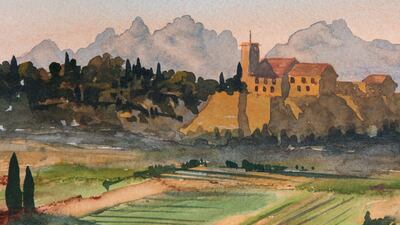
'View in South of France' by the UK's Prince Charles. The largest exhibition of work by the heir to the British throne is on display at The Garrison Chapel, at Chelsea Barracks, in Belgravia, London. Photo: Prince's Foundation -

The exhibition features 79 watercolours by Prince Charles. AFP -
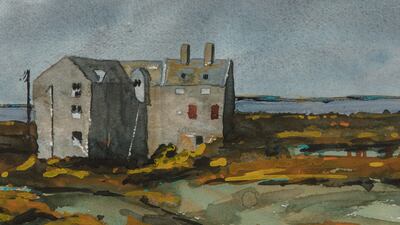
'Huna Mill, John O'Groats', by Prince Charles. Photo: Prince's Foundation -
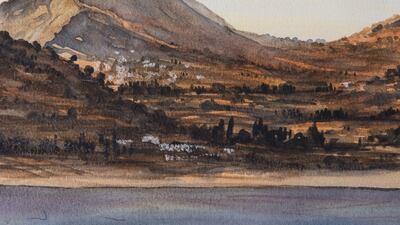
'View of Taddert, Foothills of Atlas Mountains, Morocco', by Prince Charles. Photo: Prince's Foundation -
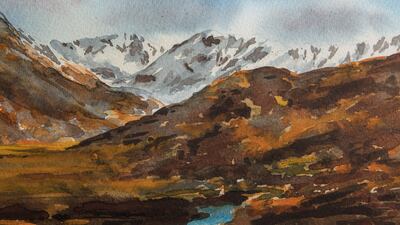
'From the Haughs, Glen Callater, towards Tolmount', by Prince Charles. Photo: Prince's Foundation -
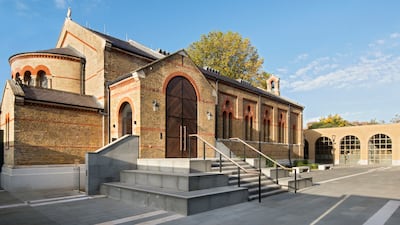
The Garrison Chapel exhibition runs until February 14. Photo: Prince's Foundation -
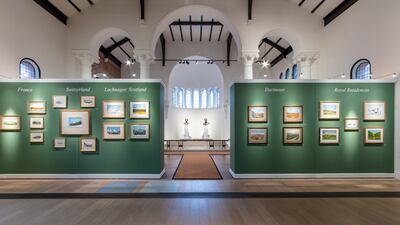
Landscapes depicted include Tanzania, East Africa, which is one of the prince’s favourite places to paint, Turkey, Greece, the Scottish mountains and Provence, in the south of France. Photo: Prince's Foundation


The obligation for him to sit down and carefully observe allowed for a richer discovery of details, such as the quality of light and shade, tone and texture, and the shape of buildings in relation to the landscape.
“It all requires the most intense concentration and, consequently, is one of the most relaxing and therapeutic exercises I know. In fact, in my case, I find it transports me into another dimension which, quite literally, refreshes parts of the soul which other activities can’t reach.
“I am under no illusion that my sketches represent great art or a burgeoning talent! They represent, more than anything else, my particular form of ‘photograph album’ and, as such, mean a great deal to me.”
The exhibition began before Christmas and reopens today for an extended run until February 14.
Rosie Alderton, who curated the show, said: “His Royal Highness has said before that he likes to sit in the actual environment and paint en plein air, and that, for him, taking a photograph doesn’t have the same feel as a painting.

“His passion for creating beautiful art is conveyed strongly in this exhibition.”
Charles indulges the passion whenever his schedule allows, and he usually takes his treasured sailcloth and leather painting bag with him on royal tours in the hope he will have time to do so.
His interest – fostered by art master Robert Waddell at Gordonstoun School in Scotland – grew in the 1970s and 1980s as he was able to meet leading artists.
He discussed watercolour technique with the late Edward Seago and received further tuition from professionals such as Derek Hill, John Ward and Bryan Organ.
An exhibition at Hampton Court Palace in 1998, held to mark the prince’s 50th birthday, displayed 50 of his watercolours, while The National Gallery of Australia’s exhibition in 2018 celebrated his 70th birthday and showed 30 pieces.

Alongside Charles’s art will be Ben Hymers’s painstakingly woven interpretation of the prince’s 2003 painting Abandoned Cottage on the Isle of Stroma.
The complex tapestry consists of hundreds of strands of coloured yarn, and the tips of the cottage chimneys are made of undyed natural wool from Welsh Lleyn sheep, a breed that the prince has on his Highgrove Estate in Gloucestershire.
“You don’t want a slavish copy of the watercolour, as that’s like translating a novel through an online tool; you don’t capture the essence," said Hymers. "Instead, I wanted to accurately show the techniques used by the prince in a tapestry, to represent the idea of the layers of colour he used and the quick strokes he applied.
“The whole point of this piece of work is to showcase tapestry as a contemporary art form and to show that it still has impact. If, by being viewed ... it sparks someone’s imagination or encourages them to weave, that’s great.”
– Additional reporting by PA

