



Over the past few years the number of African galleries circulating on the contemporary fair circuit has soared, with a growth in collectors both on the continent and internationally. Artists, who formerly left Africa for western art-world centres, are now suddenly remaining on the continent or even returning.
When Christie’s and Ghana’s Gallery 1957 held a show in Dubai last year they called it West African Renaissance – a nod to the centring of attention on the continent.
“The talent is here,” says Marwan Zakhem, who opened Gallery 1957 in 2016 after years of collecting and supporting artists. “It is the right time. Artists like Amoako Boafo are just the cherry on the cake. He is selling for $3.3 million – that’s just pouring flames on a fire that’s already burning.”
Like any “moment” – both in terms of market and the number of artists producing good work on the continent – the reasons are manifold. Before the boom, many West African countries with significant wealth had dedicated collectors, in particular Nigeria. These collectors tended to buy directly from local artists in their country, creating a number of siloed art scenes. The national distinctions were compounded by linguistic divisions, with West African anglophone countries such as Ghana and Nigeria feeling removed from francophone ones such as the Ivory Coast, Senegal, Mali and Niger – let alone from the art scenes of other regions in Africa, such as the Maghreb, East Africa or southern Africa.

But the emergence of art fairs in Africa has allowed artists and galleries to make connections outside of their local boundaries. Art Joburg in South Africa launched in 2008; Investec Cape Town Art Fair in 2012; and ART X Lagos in 2016. In addition, 1-54, the fair devoted to African and African diaspora galleries, started in 2013, with an event in London, and has since expanded to events in Paris and Marrakesh.
The shift is from a number of local scenes to the international system of galleries and fairs.
“Before there weren't galleries, but there was art,” says Touria El Glaoui, who founded 1-54. “Collectors had personal relationships with artists and had been collecting them directly for years. Suddenly, we showed them a new model, where galleries were included and you had to have a gallery that represents you at the art fairs. Many of the collectors on the continent didn’t understand why you have to pay 50 per cent more of the price, which galleries needed not only to make a profit, but also to be part of the international art market. But now they’re starting to understand the good work the galleries are doing by including artists in museum shows and in international collections.”
New collector bases
The interest by international collectors is key. The racial awakening in the West around Black Lives Matter has pushed European and American galleries and museums to try and correct their disproportionately white stables of artists. Magazines are devoting more attention to black and African artists, and collectors are following suit.

“For me what changed between before Covid and this year is the great appreciation of African art,” says El Glaoui. “There were always the usual collectors coming to 1-54 as part of the Frieze Week circuit. But this year we were very instrumental. There was a lot of complaints that we didn't have enough work – because we had so many more collectors – and there were no complaints about the prices, which makes all the difference.”
Many credit the rise in prices to one individual in particular: Amoako Boafo, the talented Ghanaian artist whose prices increased a hundredfold from 2018 to 2020, particularly after he was championed by the influential Rubell family of collectors. His story made for great copy: once working in Ghana to support his mother and sister, he is now seen alongside Paris Hilton, Joan Smalls and Karolina Kurkova at art parties held in his honour and at art fairs. A rush of collectors began flipping his works at auction, or buying them from his galleries and quickly putting them up for sale, where they fetch millions. Last December, an Asian buyer at a Christie’s Hong Kong auction set a record for a Boafo, paying $3.3 million for Hands Up (2018), a portrait of a woman in cat-eye sunglasses holding up her palms.

While Boafo has caught the attention of American collectors and those who follow the auctions, many on the continent say their collector base has also been steadily growing from buyers who are relatively new to the art market. These include African collectors who are now buying beyond their national countries, Chinese buyers, collectors from Arab countries, and, in particular, African-American buyers. The last group, many gallerists say, see African art as a way to connect with and support their roots – and, in some cases, they have been shut out of the established gallery system in the US.
“A class of collectors that has popped up is African-Americans who have made money in the past 20-30 years,” says Daudi Karungi, whose gallery Afriart is farther east, in Kampala, but who has become one of the new galleries participating at international fairs such as Art Basel Miami Beach and Abu Dhabi Art, as well as fairs across the continent. “I remember some of my collectors telling me that they were not being sold art by the white galleries in the US. I understand, because when you have a scarcity of art, how do you prioritise who to sell it to? In most cases you sell it to those you have relations with. It is understandable from a business point of view, but it is a gap that has pushed a lot of money into the acquisition of art from Africa.”

Success breeds success
The rise in prices has had a ripple effect: it has enabled galleries to expand quickly. For instance, Gallery 1957 now has three spaces in Accra and one in London's South Kensington, while Galerie Cecile Fakhoury, which began in 2012 in Abidjan, Ivory Coast, has opened a second space in Dakar and is now launching a third in Paris.
It has also shown younger artists on the continent that art could be a viable career. “African artists have realised that you can actually stay home,” Karungi continues. “Successful artists like Boafo inspire young artists. They think, that guy is my age, that guy lives in my city.”
This has helped to stop the brain drain, where talented artists only feel they can achieve success by leaving the continent for art-world centres such as London, New York or Berlin.

A number of the artists who have made it on the international market have also returned to West African countries to set up infrastructural support. Boafo, who lives in Vienna and Accra, established a studio complex in Ghana's capital. Ibrahim Mahama (now represented by contemporary London art gallery White Cube and a participant in Ghana’s acclaimed 2019 Venice Biennale exhibition) has set up three spaces – the Savannah Centre for Contemporary Art, Red Clay and Nkrumah Volini – in his home town of Tamale in northern Ghana. In Senegal, Kehinde Wiley, the black American artist who painted former president Barack Obama’s official portrait, hosts the residency space Black Rock.
Making the market sustainable
“The important thing, is it sustainable? Is it going to continue?” asks Zakhem. “How happy are we that Amoako Boafo is selling for $3.3 million? Is it helping others?” (Indeed, Boafo himself has been trying to gain control of his market, attempting to buy back many of his works from auction.)
Zakhem notes that Accra now has only one art school at a university level, down from a measly two after the Ghanatta College of Art and Design closed down a few years ago. Ghanatta is where many of Ghana’s boom artists studied, including Boafo, Kwesi Botchway, Otis Quaicoe, Serge Attukwei Clottey, Emmanuel Taku and Francis Annan Affotey.

Fears over sustainability have led galleries to prioritise non-profit activities alongside their commercial ones. Much like in the early days of Dubai’s art scene, gallerists are wearing many hats. Karungi of Afriart has set up Silhouette Projects, an artist residency programme, as well co-founding the art journal Start and most importantly the Kampala Art Biennale, in 2014. Gallery MAM, in Cameroon, has set up its foundation – Fondation MAM – housed on an organic farm that likewise hosts artists residences. Gallery 1957 has also set up a residency programme, as well as the Yaa Asantewaa Art Prize, an award dedicated to female Ghanaian artists who are still vastly under-represented.
There is also the acute sense of the vagaries of international attention – which could subside just as quickly as it arose.
“The Black Lives Matter movement impacted everybody,” says El Glaoui of the international galleries that have recently foregrounded or courted black artists. “They all pledged to do things differently. I'm just hoping that it’s not a trend and it’s going to be a constant. Real integration and inclusion will take longer.”

But these qualms, in general, are minor, faced with the enthusiasm around the interest and productivity. Most see the rise of contemporary African art as an inevitable entrance of the continent into an art world whose attention has circulated from Europe and America to India, Asia and the Arab world, but never – or at least not until recently – to Africa. The sense, repeated again and again, is that it’s Africa’s time now.
“What is happening in Africa is a journey that has just started,” says Karungi. “There is talent and exposure and empowerment and there's a lot of hidden buried feelings, whether they are racial, or of poverty, or colonial, that are being had today among the people. To me, it's like the awakening of a sleeping giant – but the giant. Because there's no other community in the world that has been suppressed as much as Africa.”
See photos of Dubai's Efie Gallery, which puts the spotlight on contemporary African artists:
-
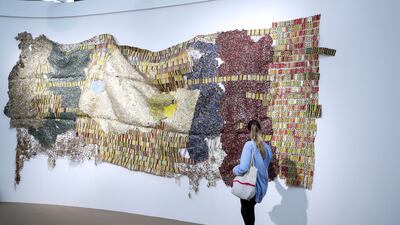
A visitor at Efie Gallery with El Anatsui's 2021 work 'TT'. Khushnum Bhandari / The National -
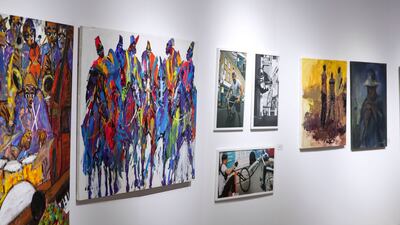
Efie Gallery, a new arrival to Dubai that aims to bring contemporary African art to the Middle East at Burj Plaza, Downtown Dubai. Khushnum Bhandari / The National -
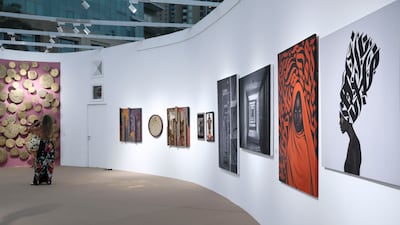
The gallery has brought in works by artists from Ghana, Nigera, Kenya, Tunisia and the African diaspora. Khushnum Bhandari / The National -
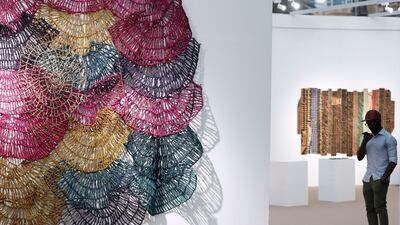
Efie Gallery's debut exhibition presents the works of established and emerging African artists. Khushnum Bhandari / The National -

Yaw Owusu, 'Treasures of the Farthest land', 2021. The artist uses pennies and coins to create these assemblages. Photo: Efie Gallery -

'Fin’s piece' (2020) by Slawn, a young artist whose work has been collected by the likes of A$AP Rocky, Frank Ocean and Virgil Abloh. Photo: Efie Gallery -
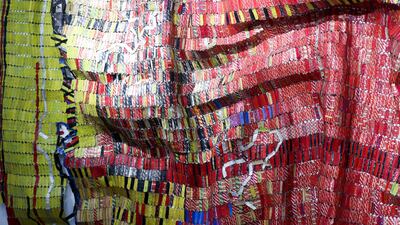
A detail of El Anatsui's ongoing work 'Detsi', which was started in 2008. Khushnum Bhandari / The National -
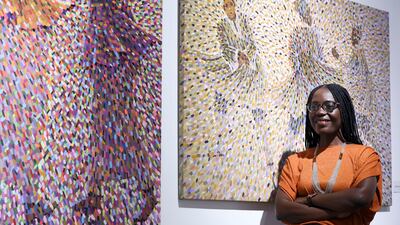
Afia Owusu-Afriyie, a curator at Efie Gallery. Khushnum Bhandari / The National -

'DNA', a wood sculpture work by El Anatsui. Khushnum Bhandari / The National -

Valentina Mintah, co-founder of Efie Gallery. Khushnum Bhandari / The National



