


A team of architects, one of whom lives in Dubai, has won The Rammed Earth Pavilion competition with their eco-friendly greenhouse, which was built in the UK.
Organised by Buildner, a leading architecture competition platform, participants were tasked with designing a temporary or permanent pavilion structure constructed of rammed earth material in a location of their choice.
Rammed earth is an ancient technique used for constructing foundations, floors and walls using natural raw materials, which has recently been revived as a sustainable method of building structures. Materials used in rammed earth can include earth, chalk, lime or gravel.
The winning idea, called Hooke Garden, was created by Farid Younesi, who lives in the UAE, Amina Yusupova from Belgium and Thanatcha Cholpradit from Thailand. The trio met while studying for their master's at the Architectural Association School of Architecture in London and chose Hooke Park, a 142-hectare woodland in Dorset, England, as the location of their project.
Hooke Garden is a pavilion made out of earth excavated from the site to form its full-length rammed earth wall. Sitting above a handmade stone-masonry base, to combat the rainy conditions of the site, the pavilion uses forest timber and lime instead of cement for more sustainable construction. The wall is supported by six dual posts to form the mould, arranged 1200mm apart that support a timber roof.
The wall acts as a thermal insulator for the greenhouse, absorbing heat during the day and releasing it at night, creating an atmosphere suitable for growing fruits and vegetables.
The Hooke Garden pavilion was praised for blending new ideas with traditional ones for greenhouses, as well as for utilising sustainable approaches.
Scroll through the gallery below for more pictures of Hooke Garden
-
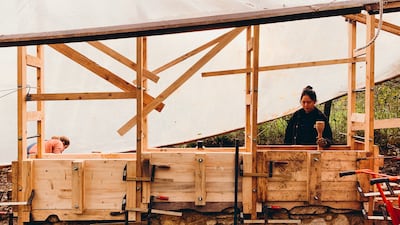
Architects Amina Yusupova and Thanatcha Cholpradit working on Hooke Garden, winner of The Rammed Earth Pavilion competition. All photos: Buildner -
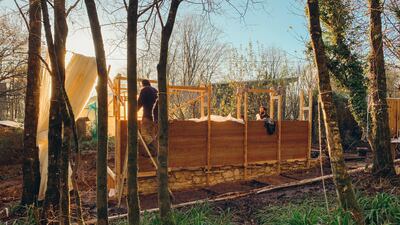
It was conceived and constructed with sustainability in mind -

The Hooke Garden pavilion blends new ideas with traditional and historically inspired ideas of a greenhouse, utilising a sustainable approach -
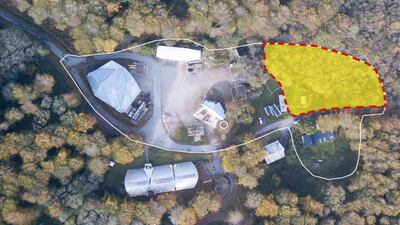
Site view of the Hooke Garden pavilion located at Hooke Park, a 142-hectare woodland in Dorset, England -
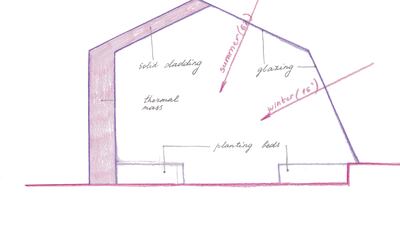
Plans outline how the greenhouse is constructed -
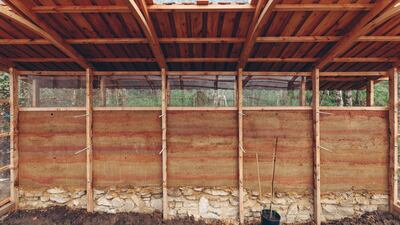
The pavilion uses forest timber and lime instead of cement for more sustainable construction -
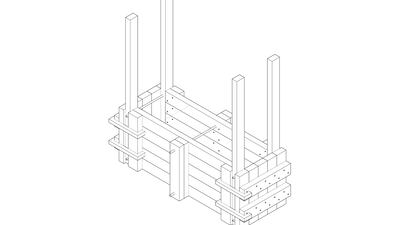
Drawing of wall construction made of six dual posts that form a mould -
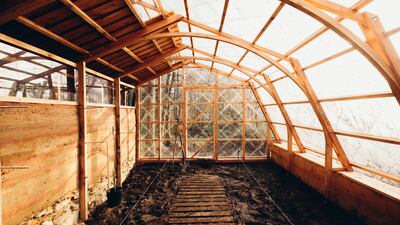
The wall performs as a thermal insulator for the greenhouse, absorbing heat during the day and releasing it at night -
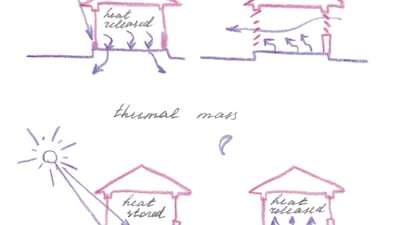
Drawings of the Hooke Garden pavilion illustrating how it acts as a thermal insulator


“Our approach was simple, to treat the project's site as a soft and rich ground for learning,” Younesi, who works as an architect at U+A Architectural Consultancy in Dubai, tells The National.
“We surrendered ourselves to the organic ecologies of the site and it, in return, allowed us insight into what the project should be and how it must be shaped. That, plus our research into the vernacular of building with earth, and our desire for a completely sustainable approach to the building process, we created a holistic design that, similar to nature itself, is simple in approach, yet complex in detail.”
Hooke Garden also won the Sustainability Prize.
“We feel honoured to have been selected as winners amongst an array of wonderful projects for this competition,” Younesi says.
“We worked hard to bring our vision to reality and we are especially proud to have also been selected to win the Sustainability Award since our approach to this project was always very considerate of the environment and the surrounding ecologies.”
The trio each work with different practices worldwide and share a passion for sustainability in architecture. For the project, all building materials were sourced from the site itself along with all the harvesting, milling, shaping and forming of the timber to avoid any emissions generated by transport.
All wood chips and offcuts were reused to generate heating for the residents living on site and the project itself will act as a communal greenhouse to encourage residents to plant, grow, and harvest their own fruits and vegetables.
“Architects have a responsibility in creating a world that exists beyond our lifetime,” adds Younesi.
“Most modern buildings last 100 plus years, and it is imperative that we take the time to study how our buildings can be energy-efficient, environmentally friendly, and socially responsible.”
Younesi and his teammates received €3,000 ($3,280) for winning the main award and an additional €500 ($537) for the Sustainability Prize.

