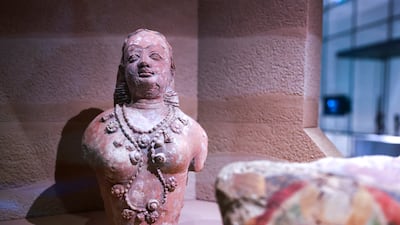

A collection of ancient glassware at Louvre Abu Dhabi bears the marks of a relatively recent tragedy. Some vessels are intact; others have been painstakingly pieced together, while fragments and shards illustrate the limits of what even skilled conservators can salvage.
The objects belong to the Archaeological Museum of the American University of Beirut, where part of the museum's ancient glass collection was shattered by the port explosion of August 4, 2020. The presentation draws attention to the objects' recent history and to the expertise involved in their recovery.
It is an approach that distinguishes Louvre Abu Dhabi's latest exhibition, Living Legacies: Protecting Heritage, Building Hope, from its previous offerings. While museums typically present the culmination of years of archaeological research, conservation and restoration, this exhibition brings those processes into public view.


“Generally, we consider this to be behind the scenes. That's what we call it, but this time it's on the stage,” Guilhem Andre, the museum's director of scientific, curatorial and collections management, tells The National.
Opening on November 25 and running until April 25, the exhibition is organised in partnership with the International Alliance for the Protection of Heritage (Aliph). It marks a decade of work by the Swiss-based foundation, established following the 2016 Abu Dhabi Conference on Safeguarding Endangered Cultural Heritage, an initiative led by the UAE and France. Aliph has since supported more than 650 projects across 65 countries.
Curated by Sandra Bialystok, Magdalena Ruiz Marmolejo and Bastien Varoutsikos, the exhibition brings together about 50 works from eight countries across seven sections, spanning ancient artefacts, manuscripts, ceremonial costumes and contemporary art.
Bringing conservation out of the laboratory
Photographs of heritage professionals at work, video testimonies and displays of conservation tools accompany the objects.
Some of the restoration took place at Louvre Abu Dhabi shortly before the exhibition opened. Manuscripts from Djenne in Mali were restored in the museum's laboratories by Maria Luisa Russo, founder of Italian organisation Amalia, an Aliph partner.
Bialystok, director of communications and partnerships at Aliph, says the Beirut glassware illustrates both the possibilities and the limitations of conservation.

The juxtaposition of restored vessels, undamaged objects and fragments, she says, shows “the immensity of the work to protect and to restore cultural heritage”.
“Sometimes it's possible, and sometimes, unfortunately, it is not.”
The exhibition also examines threats that develop more gradually. Heavy rainfall can wash away historical earthen architecture; extreme heat can accelerate the deterioration of manuscripts; and rising sea levels can introduce damaging salt into coastal structures.
Architectural examples, including the mud-brick towers of Shibam in Yemen and Al Jahili Fort in Al Ain, illustrate enduring traditions of building with earth, while a model of a fortress in Afghanistan offers insight into conservation efforts on the ground.
Andre says international organisations provide financial and technical support, but much of the initiative comes from communities themselves.
“They are committed to preserving their heritage because they know its value,” he says. “We are not there to replace them, but to give them a voice.”
Making the unseen visible

One section is dedicated to Mosul, the Iraqi city near ancient Nineveh, where centuries of exchange between religious and ethnic communities produced a rich shared culture.
Between 2014 and 2017, museums were looted, archaeological sites damaged and historic monuments deliberately destroyed. Iraqi authorities have since worked with international partners, including Unesco and Aliph, to restore the city's heritage.
Under Louvre Abu Dhabi's dome, an augmented reality experience developed by Snap in collaboration with Aliph gives visitors a sense of what was lost.

Using scans of surviving stone fragments, the team digitally reconstructed the monumental Lamassu sculptures destroyed at Mosul's museum in 2015, allowing visitors to see them at their original scale through their phones.
“You can make the unseen visible,” says Antoine Gilbert, head of AR Studio Paris at Snap.
The experience also incorporates scientific findings about the sculptures' original appearance. Traces of pigment reveal they were once painted. However, because researchers cannot establish exactly how the paint was applied, the developers have incorporated only selected elements of colour, avoiding a speculative reconstruction.
Visitors can examine the sculptures' details, photograph themselves alongside them and share the experience beyond the museum.
Preserving a living culture

Ceremonial traditions from the Grassfields of Cameroon illustrate the relationship between natural environments and intangible heritage. During certain rituals, masked dancers emerge from sacred forests believed to be inhabited by ancestral spirits.
Music, movement and communal beliefs give meaning to ceremonial objects, while materials such as wood, raffia and feathers carry symbolic significance. Protecting these traditions also entails protecting the ecosystems that sustain them.
A contemporary work by Malian artist Abdoulaye Konate explores cultural continuity from another perspective, demonstrating the influence of traditional artisanal skills on artistic creation today.
Amaryllis Maria Georges, senior curatorial assistant at Louvre Abu Dhabi, says a guide developed for children and young adults invites them to step into the roles of historians, archaeologists and conservators, introducing them to professions whose contributions are seldom visible in museum galleries.

She says cultural heritage speaks to our collective memory and identity, explaining “why we think the way we think and act the way we act and create the way we create”.
Bialystok hopes the exhibition will also encourage visitors to develop a deeper interest in cultures beyond their own, whether through understanding the traditions associated with a Cameroonian elephant costume or the cultural influences behind Konate's work.
“When we listen to other people's stories and when we can start to engage with other people's cultures and where they come from, that gives us the foundations to start real, nuanced dialogue,” she says.
“I think we go forward into the world with more empathy.”
Living Legacies: Protecting Heritage, Building Hope runs from November 25 to April 25 at Louvre Abu Dhabi