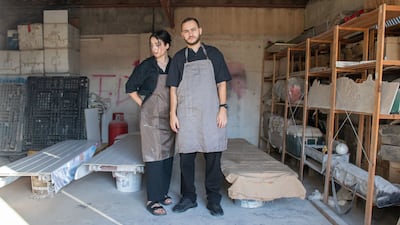

Discarded date pits are being given a new purpose by a Dubai-based design studio, whose innovative alternative to concrete has earned two international awards.
Datecrete Studio & Lab, founded by Palestinian urban planner and material researcher Sara Farha and Lebanese chemical engineer Khaled Shalkha, won the Sustainable Design category at the 2026 Dezeen Awards, as well as the public vote for Material Innovation of the Year.
The husband-and-wife team, who both grew up in the UAE, have spent about five years developing Datecrete, a patent-pending material that transforms waste from the date industry into tiles, furniture, cladding and architectural objects.

The material contains no cement, resins or petrochemicals, and its development combines the founders' backgrounds in engineering with knowledge drawn from traditional regional construction methods.
"We did some field research initially and found out that just a small percentage of it goes to cattle feed," Farha tells The National. "Besides that, not much was done with it."

Their research began by examining the composition of date pits, which contain lignocellulosic compounds also found in wood. This suggested they might have potential as a construction material, although the greater challenge was finding a suitable way to bind them together.
After years of experimentation, the pair developed a natural binder inspired by historical regional building technologies. When combined with ground date pits, the binder creates a solid material with an appearance somewhere between natural stone and concrete.
Farha says developing the binder was the most innovative part of the process. From the beginning, the founders wanted to avoid using cement, petrochemicals or synthetic resins.
Datecrete can be poured into moulds where it solidifies and takes on their shape, much like conventional concrete. Its versatility has allowed the studio to explore applications ranging from decorative surfaces to more complex architectural forms.
Finding a sustainable alternative
The founders say Datecrete offers several environmental advantages over conventional building materials, beginning with its use of an agricultural by-product that might otherwise be discarded.
Shalkha says the material also absorbs carbon dioxide over its lifetime, a process that contributes to its hardening.
Although Datecrete is still relatively heavy, it is less dense than conventional concrete, potentially making transportation and handling easier.
Its production also differs from that of materials such as ceramics and porcelain, which require energy-intensive firing in kilns.
"What's unique about ours is that it's a chemical reaction," Shalkha says. "We just put the stuff together and it just dries, basically similar to cement but not using cement."

He explains that the studio can achieve different surface appearances using coatings and finishes without firing the material at high temperatures.
The environmental benefits are central to the studio's ambitions, although its founders also recognise the importance of demonstrating what Datecrete can achieve in practical settings.
Rather than supplying the material alone, they have developed a design practice around it, producing furniture, tiles and architectural surfaces while refining their moulding techniques.
"We didn't want to stop at being material suppliers," Farha says. "We thought let's make stuff with this material, and that's also the best way to push it forward and get it validated."
The approach has helped the studio develop expertise in creating intricate forms and patterns, attracting interest from designers looking to experiment with alternatives to traditional concrete.
From Dubai to Osaka
One of Datecrete's most significant applications came at Expo 2025 Osaka, where the studio was commissioned to produce the paving in front of the UAE Pavilion.
The project represented a substantial order and offered an opportunity to test the material in a busy public environment over the exhibition's six-month duration.
Farha says the paving remained intact throughout the event and is now being reused by a Japanese architecture office.
"We've already demonstrated that it can perform in tough conditions," she says.
The project also helped introduce Datecrete to an international audience, alongside a growing number of collaborations with architects interested in experimental materials.

Farha says making the technology more widely available will require continued improvements to the studio's production operations.
Its appearance also contributes to its appeal. With a textured surface resembling natural stone, Datecrete shares characteristics with materials traditionally used in regional architecture.
Farha says materials such as clay and stone develop a natural patina, allowing them to age alongside their surroundings. She has observed similar qualities in Datecrete, which develops texture and depth over time.
Recognition beyond the UAE
The double win at the Dezeen Awards follows another international achievement.
In October, Datecrete Studio & Lab was named among 40 finalists at the 2026 Seoul Design Award, where it received one of three designboom Special Prizes.
The studio has previously received The Christo and Jeanne-Claude Award and the Art Jameel Research and Practice Platform Grant.

Shalkha says international interest has contributed to rapid growth over the past two years, both in the studio's design practice and in the development of its materials technology.
The founders now hope the recognition will encourage more architects and manufacturers to consider Datecrete for projects around the world.
Farha says the long-term ambition is to establish it as a recognised material in its own right, with applications extending beyond the experimental design projects that helped introduce it to the industry.
She acknowledges that Datecrete, like established materials, has its own characteristics and limitations, but hopes designers will increasingly consider it alongside ceramics, steel and concrete.
"We would like it to be seen more as a validated, real material category," she says.

