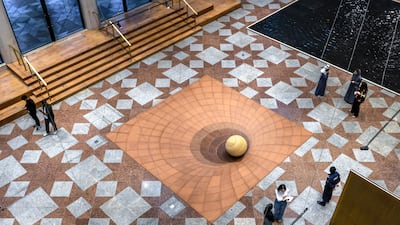

Marble ripples like water, steel folds like paper and heavy industrial materials appear almost weightless. In Shaikha Al Mazrou's sculptures, the familiar properties of everyday materials become difficult to reconcile with what the eye sees.
These contradictions are central to Two Horizons, her solo exhibition at Abu Dhabi's Cultural Foundation. Bringing together existing works and new commissions, the show explores perception, permanence and the distance between what we see and what we believe to be true.
Writing has long been part of her creative process, although it has largely remained invisible to audiences. She writes poems frequently but hesitates to define them as such, partly because of their personal nature.

The exhibition, which runs until July 18, 2027, took about a year to develop. Curated by Reem Fadda, who worked with co-curators Noor AlMehairbi and Paz Monge and assistant curator Afra Saif Almazrouei, the show unfolds across four chapters in the building's atrium and inner galleries.
Its title reflects Al Mazrou's fascination with the horizon, something she often contemplates while travelling. "I find myself constantly questioning the distance to the horizon," she tells The National. "You can name it longing. You can name it distance. You can name it curiosity."
From a plane window, she observes the changing colours of the sky and the shifting boundaries between land and sea. Although the horizon appears straight, its appearance depends on perspective.
That ambiguity takes physical form in Fragmented Horizons, a new commission of oxidised steel poles that trace an artificial horizon through the building's architecture. Another work, Water Was Never Blue, draws on the cyanometer, an 18th century instrument used to study variations in the colour of the sky.

Al Mazrou questions the assumptions people make about colour and the natural world. Water itself is clear, she says, while blue carries associations beyond its physical appearance. She says it can suggest a feeling, a mood or music.
The relationship between nature and its artistic interpretation is particularly evident in A Throw of the Dice Will Never Abolish Chance, one of the exhibition's most striking installations.
Made from black jade marble, the sculpture resembles water disturbed by gentle waves. Its fluid appearance conceals the weight and rigidity of the stone.
The piece was created for the Aichi Triennale in Japan, where Al Mazrou could choose between exhibiting in a conventional gallery or creating a site-specific installation. During a visit with Sheikha Hoor Al Qasimi, curator and president of Sharjah Art Foundation, Al Mazrou noticed an empty courtyard fountain.
"There was this empty water fountain that was sitting in the courtyard, and for some reason it spoke to me," she says.

At the time, Al Mazrou was reading poetry, including the work from which the sculpture takes its title. The encounter brought together her interest in language, chance and the contradictory qualities of water.
She describes water as both romantic and frightening, drawn to its immensity and unpredictable nature.
The marble was shaped using water jets and computer-controlled machinery before being polished by hand, creating a sculpture that appears almost liquid despite being carved from solid stone.
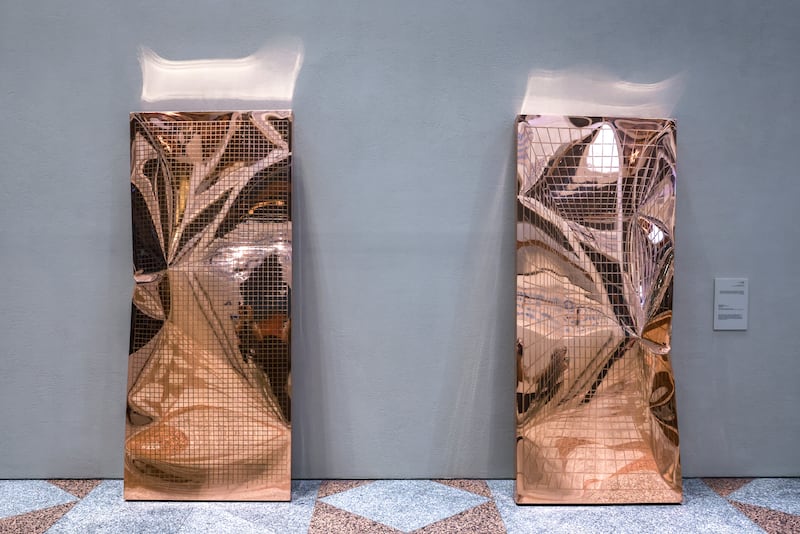
Such transformations define much of Al Mazrou's work. Her sculptures use geometric forms, steel structures and industrial surfaces while suggesting qualities associated with softer, more fragile materials.

The influence of minimalism is apparent, although she is careful not to place her practice entirely within the movement. "My practice is not minimal," she says. "It has a minimal aesthetic, but it does not come from a minimalism school."
Her training in sculpture introduced her to art history and industrial materials, but her approach has developed through research, writing and experimentation. She is particularly interested in works that deceive or conceal, using visual metaphors to challenge familiar assumptions.
The exhibition's final chapter, In Geometry of a Fold, features sculptures made from folded, coated steel. Works, including Architectonics of a Fold, resemble oversized pieces of crumpled paper or fabric, challenging the perceptions of metal's strength and permanence.
Scale has also become increasingly important through Al Mazrou's public artworks. Her sculpture Red Stack, which resembles a towering arrangement of cushions, was displayed at Frieze Sculpture in London's Regent's Park in 2022 before being shown at Tremenheere Sculpture Gardens in Cornwall. In 2025, she presented Deliberate Pauses, an installation of large red metal circles along a trail overlooking Hatta's Leem Lake.

These projects encouraged her to consider how audiences experience artworks and their surroundings. She says that moving through a sculpture's environment can become as important as observing the object itself.
That relationship is particularly significant at the Cultural Foundation, which has occupied a central place in Abu Dhabi's artistic life since opening in 1981. Unlike many of the emirate's newer cultural landmarks, the Cultural Foundation sits in the heart of the city, alongside Qasr Al Hosn. It has welcomed generations of people through exhibitions and performances, as well as its library and educational programmes.
Al Mazrou describes it as an incubator for expression, whose significance extends beyond individual exhibitions. "These walls carried a lot of memories," she says.
The building's scale allows visitors to move around and between sculptures rather than encountering them solely as objects on display.
Al Mazrou has witnessed considerable change in the UAE's cultural landscape since studying art at the University of Sharjah in the 2000s. Today, she is an assistant professor of arts practice at New York University Abu Dhabi.
She recalls a period when opportunities for art education, residencies and exhibitions were limited. The growth of museums, independent initiatives and institutions has since transformed what artists can pursue.
But she says the country's artistic history predates its recent cultural expansion. Creative opportunities existed throughout the 1980s and beyond, but artists often lacked dedicated spaces.

Now, a growing network of institutions and grassroots initiatives offers greater freedom to develop its practices and reach audiences. "We're always in transit," she says. "We're only getting better and faster."
Al Mazrou says Two Horizons is less concerned with presenting a definitive account of her career than with exploring the ideas that continue to shape it. The sculptures, poetry and surrounding architecture invite visitors to question their perceptions and the meanings they attach to what they encounter.
"This show is not defining my practice," she says. "This show is a negotiation space of what you see and what you carry."
Shaikha Al Mazrou: Two Horizons is at the Cultural Foundation, Abu Dhabi, until July 18, 2027

