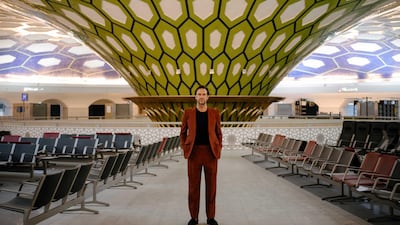

There are art fairs and design fairs, and then there is Nomad. Part exhibition, part cultural encounter and part architectural discovery, the travelling collectable design fair has made a virtue of defying simple categorisation.
Known for presenting exceptional objects in unexpected settings, Nomad returns to Abu Dhabi from November 18 to 22 for what promises to be its most ambitious edition yet, with international and regional exhibitors taking over the old Terminal 1 at Abu Dhabi’s former airport.
“I think it’s the most diverse, the richest edition we ever had,” says Nicolas Bellavance-Lecompte, Nomad's founder and co-director. “We have over 50 exhibitors, which is a record because we’re a boutique format.”
This year, the fair will expand into the former departure hall, with a dedicated space for cultural institutions, foundations and design initiatives. Participants include Abu Dhabi’s House of Artisans, presenting a project developed with the Institut du Monde Arabe in Paris, and Dubai’s Tashkeel, with a retrospective of commissions spanning 14 years. Designers and craftspeople from Uzbekistan, India and Jordan will also participate, with the latter presenting works inspired by artefacts from the Petra Museum.

The aim is to encourage dialogue between traditional craftsmanship and contemporary design. In a playful nod to the venue and the fair’s itinerant identity, a Nomad passport office will invite visitors to collect a passport and have it stamped.
In the main terminal, established international galleries will appear alongside regional exhibitors, contemporary art and an expanded jewellery offering. The latter proved particularly popular last year, attracting growing interest from jewellers. Yet Bellavance-Lecompte is determined to preserve the fair’s eclectic character.
“It’s a sort of cabinet of curiosities that you browse around,” he says. “You can see jewellery, beautiful design, and art projects.”
Lebanese designer Nada Debs will present new works from her collaboration with Studio Lel, while a collector’s lounge and a pop-up by Michelin-starred Erth restaurant will broaden the experience. Exhibitors will come from across Europe, the US, Africa, India and Korea, reflecting Bellavance-Lecompte’s commitment to giving less-represented markets an international platform.
His relationship with the Middle East predates Nomad's arrival in Abu Dhabi. In 2011, he opened what he describes as Beirut’s first collectable design gallery, connecting international designers with local craftspeople. That experience led to curatorial projects in Saudi Arabia, Qatar, Egypt, Tunisia and Algeria, as well as Rwanda and Togo, bringing together artists, designers and traditional makers.

“I'm fascinated by the idea of new destinations, new talents and changing dialogues, [and] I’ve always been very interested in the region,” he says. “For me, the Global South has always been a priority.”
These experiences shaped his conviction that design should develop beyond established European centres. From Beirut’s creative community to the craft traditions of Egypt and North Africa, his focus has been on helping local talent develop its own language and reach wider audiences, rather than simply importing international design.
Having staged editions in France, Italy and Switzerland, Nomad will hold its 19th fair globally in Abu Dhabi, almost a decade after its founding.
“Abu Dhabi was the perfect crossroads of all these ingredients,” he says of the mix of architectural heritage and scale. “We had a lot of government support without being too invasive. They’re supportive, but they’re not controlling our event. We still have our identity.”
Central to that identity is nurturing emerging talent. “All of our activations need to have cultural relevance and give back to the local community,” he says, adding that companies within the Nomad ecosystem are expected to collaborate with regional designers. “This is a real activator.”

One example was Bottega Veneta’s award-winning Destinations project at the 2025 edition, which brought together regional designers Abdalla Almulla, Amine Asselman, Nader Gammas and Zein Daouk. “We really wanted original design to be elevated, and it worked completely.”
The venue itself has been equally important to Nomad's success. Rather than a conventional exhibition hall or temporary tent, Bellavance-Lecompte wanted somewhere that reflected Abu Dhabi’s architectural heritage. After visiting more than 20 locations, he learnt that the former airport terminal had become available. His response was immediate. “Without even visiting, I said, ‘It’s a deal.’”
Designed by French architect Paul Andreu, whose work also includes Paris’s Charles de Gaulle airport, the decommissioned terminal offered everything he had been looking for. Its circular plan, intimate scale and distinctive architectural details made it an unusual exhibition space, while its history gave the experience an emotional resonance.
The connection was personal, too. Andreu is among Bellavance-Lecompte’s favourite architects, and the terminal was somewhere he knew well. “I have been here for over 30 years, within this terminal, rushing to catch the flight to Riyadh or Bombay.”
During the 2025 edition, he watched visitors return to a building they remembered from decades earlier, discovering architectural details they had overlooked while hurrying to catch flights.
“The airport becomes a destination, but not just a point of transit,” he says. “You don't know how many people came showing their arms with goosebumps.”
The inaugural edition also challenged assumptions about the region’s collecting market. Galleries reported stronger than expected sales, encouraging more exhibitors to participate this year. For Bellavance-Lecompte, it is evidence of growing confidence in both the design industry and the region.
“It's developing at light speed, and it’s what we want for the region.”


FOLLOW TN MAGAZINE