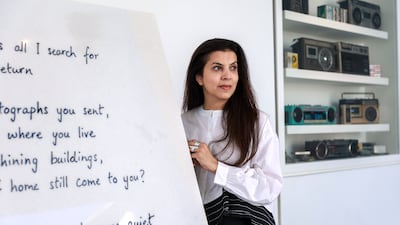

A handwritten letter from a wife in Kerala to her husband working in Abu Dhabi tells of the life he is missing. His mother is growing older, their child is getting taller and the family continues to wait for his return.
A collection of cassette players and radios recalls a time when messages travelled across the Arabian Sea, carried by returning workers and fellow travellers. Before mobile phones, these recordings helped families separated by migration stay connected.
The letter forms the centrepiece of Shorelines of Longing, an installation by Indian artist Reena Kallat at Louvre Abu Dhabi's Art Here 2026 exhibition. Set to music inspired by a traditional form of correspondence, the work explores the emotional sacrifices made by generations of families seeking better opportunities overseas.

Kallat says the response has been unexpectedly powerful.
“I'm really struck by how many people broke down as they were reading the letter, which is obviously something I didn't expect,” she tells The National.
One visitor recalled growing up apart from her father, who regularly sent gifts from abroad. What she wanted most, however, was to spend more time with him.
The installation is one of six works featured in Art Here 2026: Confluences, which opened on Wednesday and runs until February 28, 2027. Now in its sixth edition, the exhibition brings together artists from India, Saudi Arabia, the UAE and Malaysia to examine centuries of cultural exchange across the Indian Ocean.
Presented in partnership with Swiss watchmaker Richard Mille, the exhibition also serves as the platform for the annual Richard Mille Art Prize, which awards $60,000 to one of the shortlisted artists.
A conversation across centuries

Curated by Kamini Sawhney, former founding director of the Museum of Art and Photography in Bengaluru, Art Here 2026 has been conceived in dialogue with Spices and Wonders: Sailing the Indian Ocean, which opened at Louvre Abu Dhabi in October.
That exhibition brings together about 240 historical objects tracing maritime trade and cultural exchange from antiquity to the 17th century, examining the movement of goods, religions and scientific knowledge between Africa, the Arabian Peninsula and Asia.
Sawhney says she wants Art Here to extend that narrative into the present.
“It's so much more powerful when two exhibitions work together, and there's a coherent story around it,” she says.
Her research revealed the depth of historical connections between India and the Arab world, including intellectual exchanges that contributed to developments in mathematics.
She points to Indian mathematician Brahmagupta, whose writings were translated into Arabic and influenced subsequent scholarship.
“There was faith that was exchanged, there were cuisines, there was so much movement between these two regions,” she says.
“We really need to talk about confluences because so much of that has been forgotten.”
Kallat's Shorelines of Longing brings those historical connections into a more personal setting.

Drawing on Kerala's letter-song tradition, which developed alongside migration to the Gulf from the 1970s to the 1990s, the installation features marble panels bearing intimate correspondence alongside the technologies once used to maintain contact.
“The letter really here in this case embodies not just love, longing, separation, but also the emotional cost of migration,” Kallat says.
The correspondence includes details about an ageing parent, a growing child and the passage of time. There is sorrow in the separation, but also encouragement and recognition of the sacrifices being made.
Kallat chose marble to preserve these words, giving permanence to a private exchange that might otherwise be forgotten.
“Often these lives, generally of people, everyday lives, are not always recorded in official history,” she says.
The musical component was developed with the assistance of her 21-year-old son, using artificial intelligence, drawing on sounds associated with the tradition. Kallat says her Malayali mother-in-law became emotional when she heard the finished song.
Indian artist Ravikumar Kashi also explores correspondence in Meghadutam. Suspended beneath Louvre Abu Dhabi's dome, cloud-like textiles bear patterns of letters inspired by messages sent from Indian families to loved ones working in the Arabian Gulf. The forms appear almost weightless against the museum's architecture, giving a physical presence to words that once travelled across the ocean.

Giving everyday objects monumental meaning
Malaysian artist and designer Muhammad Shamin Sahrum explores personal memory through Home is What We Carry, an installation featuring colourful woven forms hanging vertically in long clusters.
The material is familiar across the region, where similar mats are used for sitting, eating, praying or gathering outdoors. However, contemporary versions are often made from plastic.
“The hardest thing for me was sourcing that initial material,” Sahrum says. “It couldn't just be any type of chatai material or any type of mat.”
He selected Korai chatai, which combines machine production with manual processes, including drying and dyeing reeds and feeding colours into the weave.
Sahrum says the material encourages audiences to reconnect with their own family histories.
“That sort of becomes the bridge between my story and theirs,” he says.

Trained as an architect, Sahrum was drawn to the opportunity to work within Jean Nouvel's Louvre Abu Dhabi, particularly its combination of water, open space and changing sunlight.
The installation is the largest he has produced in terms of height and width. Suspending mats vertically changes their familiar appearance, transforming objects usually encountered on the ground.
“The object that we sort of take for granted becomes the monument,” he says.
Sawhney says this willingness to experiment with scale and material was crucial in selecting the six artists from more than 300 applications.
“You just don't come and plant works in,” she says. “What is the understanding of scale?”
Indian artist Vivek Vilasini's Dreamings of Arabia demonstrates that approach through enormous ceramic vessels arranged across several levels of metal scaffolding.

Each bears an Arabic letter alongside its phonetic and linguistic equivalents from languages spoken in the UAE, reflecting the country's linguistic diversity and the role language plays in expressing ideas and emotions.
Sawhney recalls encouraging Vilasini to increase the size of his vessels.
“I wanted large pots. I got gigantic pots because his ambition travelled,” she says.
Between construction and collapse

Saudi artist Ahaad Alamoudi explores transformation through I Was Promised the World and the Tide Came In, an enormous curved structure positioned in a shallow pool.
Its reflective surface bears marks of weathering, while rust gradually forms as the material responds to the environment. Depending on the angle, it resembles a tent, an open book or a building facade.
“When you look at the piece itself, it's quite monumental. It's almost artificial, but in reality the piece is very sensitive,” Alamoudi says.
“It's sensitive to light. It's sensitive to dust, but also it's constantly eroding because it's placed into water.”
The Jeddah-based artist has explored transformation and the merging of different worlds for several years, although creating something on this scale has presented unfamiliar structural challenges.
She says the changing sculpture reflects tensions between development and deterioration, permanence and uncertainty.
“I wanted the piece to be in this process of movement, in this process of transformation or in this process of collapse,” she says.
Alamoudi also connects these ideas to the rapid changes taking place across the Gulf.
“What is lost and what is gained in this process of change is something that everybody experiences.”
Emirati artist Almaha Jaralla's Daria Dawlat explores movement through the wzar, a garment traditionally worn by sailors in the region.
Presented in motion without the people who would ordinarily wear them, the garments create a scene that could suggest sailors working, struggling to survive or dancing. Their positioning within a shallow pool evokes the maritime traditions that have connected communities across the Indian Ocean.
Art in conversation with architecture

The installations occupy courtyards, extend above pools of water and hang beneath the museum's vast dome, encouraging visitors to reconsider both familiar objects and their surroundings.
Sawhney says supporting the artists' ambitions was among the most rewarding aspects of the project, despite the technical challenges involved in realising works of this scale.
“The way you approach this project is an integral part of your artistic journey, not just a work,” she says.
The exhibition also offers a contemporary perspective on the historical connections explored in Spices and Wonders, drawing attention to the personal experiences behind centuries of exchange.
Sawhney thinks these relationships deserve renewed attention, particularly given the Indian diaspora's continuing presence in the Arabian Gulf.
“It's a relationship that exists even today because of this huge diaspora,” she says.
“But do we know actually what our ancestors, how much they were able to achieve just by intercultural exchange?”
Art Here 2026: Confluences runs at Louvre Abu Dhabi until February 28, 2027

