
As World Space Week celebrates humanity's achievements beyond Earth, cinema offers its own versions of where that journey might lead.
Science fiction has often looked to space and found something to fear. The genre is full of abandoned ships, hostile planets, predatory aliens and futures in which humanity has carried its worst instincts beyond Earth.
Yet some of the most enduring space films look upwards and see possibility.

In these stories, scientific progress is paramount, difficult problems can still be solved and encounters with the unknown can broaden rather than diminish our sense of ourselves. Space becomes somewhere humanity might become more curious, more co-operative and, in some cases, more humane.
Not all of these films depict utopias. Some begin with environmental collapse, extinction or profound uncertainty. What connects them is a refusal to imagine humanity's future solely in terms of decline.
To mark World Space Week, which runs from until October 10, here are eight films that suggest the future beyond Earth might be worth looking forward to.
Interstellar (2014)
The most moving thing about Interstellar's future may be that humanity almost gives up on having one.
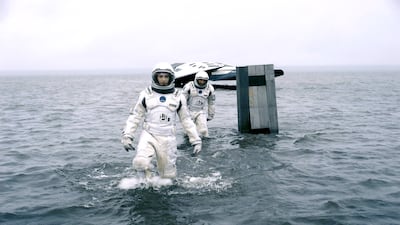
Christopher Nolan's film begins on Earth, where crops are failing, dust storms are worsening, and even the idea of space exploration has become unfashionable. Schools teach that the Apollo missions were propaganda. Former Nasa pilot Cooper has become a farmer.
The film then spends nearly three hours pushing in the opposite direction.
A mission through a wormhole becomes an attempt to recover not only humanity's future but its ambition. Cooper loses decades with his children, missions fail and the planets awaiting exploration are hardly welcoming.
Yet the ending transforms the film's opening pessimism. Humans live aboard vast rotating habitats, civilisation has survived and another world lies ahead.
Interstellar argues that exploration is not a luxury reserved for prosperous times. Sometimes it is what prevents decline from becoming permanent.
Star Trek: The Motion Picture (1979)

There is something almost radical now about how little Star Trek: The Motion Picture seems interested in turning the unknown into an enemy.
A vast entity called V'Ger is approaching Earth, and the USS Enterprise is dispatched to intercept it. Yet Robert Wise's film spends much of its running time not preparing for battle, but looking. The camera lingers on the Enterprise, on V'Ger and on the immensity of the space separating them.
That approach suits Star Trek's most enduring idea: humanity has matured.
By the 23rd century, Earth is part of a wider federation and exploration is driven by curiosity. The film's climax follows the same philosophy. What appears threatening at first is eventually revealed to be something that needs to be understood.
Its future is attractive because humanity has seemingly learnt to meet the unfamiliar with inquiry rather than destruction.
The Martian (2015)

Mark Watney's greatest weapon on Mars is not a laser, a secret technology or a convenient science-fiction miracle. It is competence.
Ridley Scott's The Martian finds enormous pleasure in watching people be good at their jobs. Watney calculates, grows food and repairs equipment. Nasa engineers test ideas. Orbital mechanics become dramatic. Even the film's jokes often come from someone finding an unexpectedly practical solution to an impossible problem.
That gives The Martian a different kind of optimism than grander space films have.
Its future is only slightly ahead of ours and feels attainable. Humanity has reached Mars, but doing so still requires huge amounts of work, money and international effort.
The eventual involvement of the China National Space Administration widens the story further. One stranded astronaut becomes a problem that people around the world decide is worth solving.
There are few visions of the future more hopeful than one in which catastrophe is met with expertise rather than panic.
Contact (1997)

What happens when humanity finally learns it is not alone?
Contact's answer is wonderfully uncinematic: scientists listen.
Robert Zemeckis's adaptation of Carl Sagan's novel centres on astronomer Ellie Arroway, whose search for extraterrestrial intelligence is rewarded when a signal arrives from Vega. Hidden within it are plans for a machine whose purpose no one initially understands.
The discovery causes political, religious and philosophical upheaval, but the film never loses sight of the wonder beneath all that noise.
Contact is less interested in extraterrestrials themselves than in what their existence might do to us. Suddenly, national rivalries and ideological divisions appear provincial. The universe has become larger overnight.
Even the machine is built through collective effort, turning contact into a scientific project on a planetary scale.
The film leaves many questions unanswered. That is part of its appeal. A better future begins with humanity becoming curious enough to admit how much it still does not know.
Mission to Mars (2000)

Mission to Mars belongs to a kind of science fiction that Hollywood rarely makes any more: completely sincere space exploration.
Brian De Palma's 2000 film has no interest in making astronauts cynical about what they do. The possibility that humanity might finally answer questions about its own origins is treated with genuine awe.
The story follows a rescue mission after the first crewed expedition to Mars encounters a mysterious structure. What initially resembles a disaster movie gradually becomes something stranger.
Its central revelation connects humanity to a far older extraterrestrial civilisation, reframing the journey to Mars as more than exploration. Humanity is, in a sense, discovering part of its own history.
There is a charming earnestness to all of this. Mission to Mars imagines scientific progress leading to one of the oldest questions imaginable: where did we come from? Its answer naturally leads to the next one: where do we go now?
2001: A Space Odyssey (1968)

Before HAL 9000 turns murderous, 2001: A Space Odyssey gives us something remarkable: space travel as routine.
A man dozes aboard a commercial flight. He makes a video call home. Scientists gather at a lunar base. Humanity has moved beyond Earth sufficiently that some of its most extraordinary achievements have become mundane.
Stanley Kubrick presents that future without constantly announcing how futuristic it is.
There is, of course, something much larger happening. The mysterious monolith connects humanity's distant past with an unknowable future. From the first tool used by early humans to the spacecraft orbiting Earth, technological progress becomes part of a continuous evolutionary process.
That process does not end with spaceships. The film's famous final passages suggest humanity may eventually become something it cannot yet comprehend.
2001's optimism is therefore unusual. It does not promise comfort. It promises that humanity is unfinished.
Project Hail Mary (2026)

Project Hail Mary begins with extinction looming, yet its real subject is the possibility that intelligence and co-operation can overcome almost anything.
Ryan Gosling plays science teacher Ryland Grace, who wakes alone aboard a spacecraft light years from Earth with no memory of why he is there. Gradually, he discovers that his mission is to find a solution to a phenomenon threatening the Sun and, with it, life on Earth.
The film, directed by Phil Lord and Christopher Miller and adapted from Andy Weir's novel, shares some DNA with The Martian. Problems are broken down, tested and solved through science rather than spectacle alone.
What pushes it further is Grace's encounter with another intelligent species facing a similar crisis.
That relationship gives the film its most hopeful idea. Humanity's future does not have to be secured alone. Somewhere beyond Earth, another civilisation might be confronting the same problems and reaching towards us for the same reason.
Ikarie XB-1 (1963)

Long before the Enterprise began exploring strange new worlds, the crew of Ikarie XB-1 were already living together on their way to Alpha Centauri.
The 1963 Czechoslovak film seems striking today because it makes interstellar travel seem ordinary. There are meals, romances, exercise sessions, celebrations and disagreements. People dance. A crew member worries about ageing relatives back on Earth. The spacecraft feels like a small travelling community.
That was an unusually sophisticated way to imagine the future in the early 1960s. Director Jindrich Polak was interested in what human life might look like once travelling between stars was possible.
The ship is devoted to scientific exploration and its multinational crew suggests that humanity has moved beyond at least some of the divisions of the 20th century.
The film's optimism lies in the everyday details: the future has not made people less human, it has simply given them much further to go.

