
Small, thoughtfully curated and easy to overlook, the Dubai Women's Museum – Bait Al Banat, or House of Girls – sits in Deira, in an older but bustling part of the city, where traditional perfume shops and hole-in-the-wall bakeries line the busy, winding roads.
It occupies a 1950s heritage building near the Gold Souq and was founded by Rafia Obaid Ghubash, a psychiatrist and former university president who spent five years developing Bait Al Banat before it opened in 2012 as the first women's museum in the Middle East.
It's not huge, but it's bigger than you might expect and very well focused. The curation is considered, and the experience feels genuinely purposeful rather than assembled for box-ticking.

Why go there?
The stories the museum tells are ones that tend to get crowded out elsewhere. It documents the contributions of women to Emirati society, culture and the arts through personal histories and objects that give the subject weight. It is moving to see specific women named and their achievements recorded in a permanent public space.

The building itself adds something. It is a restored historic structure on the older side of a largely futuristic city. The contrast between the architecture and the subject matter – forward-looking stories told in a traditional setting – works well.
What you'll see
There are three floors and the experience begins right at the entrance, at a section called Memory of the Place. This focuses on the history of the Gold Souq area and the women whose lives were woven into it – a reminder that the museum's location is deliberate.
The first gallery sets the tone with a striking installation made of niqabs and burqas. It prompts you to think about what they carry culturally before you've read any labels. Beyond that, the gallery features displays profiling individual Emirati women, past and present, alongside everyday household objects donated by local families.

On the mezzanine floor, there are sections dedicated to Muneera bint Ahmad Bin Salem Al Mazrou, a traditional healer and photographer from Sharjah, known for her work with bone and joint pain and fractures. Then there’s a display on Hajar Al Khaja, from Ajman, an avid reader and knowledge seeker.
Throughout the galleries, you’ll find artworks from Emirati artists, including Sheikha Lateefa bint Maktoum, Fatma Lootah and several by Najat Makki, including a handful dedicated to Muneera Bint Ahmad.

Star attraction
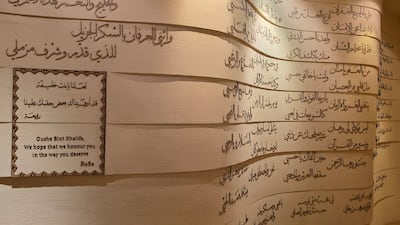
The final floor is dedicated to Ousha bint Khalifa Al Suwaidi, one of the UAE's most celebrated poets, also known as the Girl of the Arabs.
The wavy off-white walls are covered in golden Arabic calligraphy, encircling a central display of Al Suwaidi's personal objects. The effect is immersive in a way that most small museums don't manage. The design alone makes it worth the visit, even if you can’t read the words.

What to know before you go
The museum is small enough to see comfortably in an hour. If you’re driving there, rather than putting the museum into your GPS, add the nearest car park, as roadside parking is difficult to find and you might end up driving around in circles. It is only a short walk from the nearest car park.
Deira is one of the more interesting parts of Dubai to walk through. The Gold Souq, the Spice Souq and the Creek abra crossing are all within reasonable walking distance, making the Women's Museum a natural addition to a longer Deira itinerary rather than a stand-alone trip.
You’re also an eight-minute walk away from the Museum of the Poet Al Oqaili, which is worth adding to your schedule.
Ticket price and location
Admission is Dh20. The Women’s Museum is near Al Khor Street in the Gold Souq in Deira. It is open from 10am to 5.30pm every day except Sunday.

