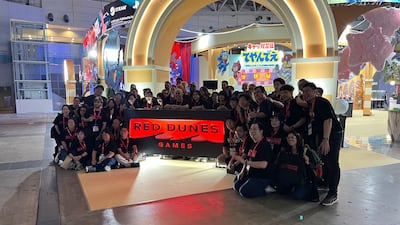

A few years ago, Red Dunes Games arrived at the Tokyo Game Show looking for introductions.
In 2023, the Abu Dhabi company did not have a stand of its own. Founders Sultan Al Darmaki and Mohamed Al Jneibi spent their time meeting developers and publishers, and trying to establish themselves in one of gaming’s most important markets.
At Tokyo Game Show 2026, it is considerably harder to miss them.

The Red Dunes booth in Hall 7 at Makuhari Messe is among the largest in its section, with banks of screens, playable games and developers from several countries gathered beneath the Emirati publisher’s banner.
Shihab Al Faheem, the UAE ambassador to Japan, says he has watched the company’s presence at the event develop over several years.

“I’ve been coming to Tokyo Game Show for the last five years,” Al Faheem tells The National. “I’ve seen Red Dunes in their first participation when they came here and participated in a single booth, or a single space, and today they are hosting a lot of companies and they have the second biggest booth in this hall.
“It’s very impressive to see the growth that Red Dunes has had in the last five years, and the growth of UAE-based games and UAE-themed games.”
Red Dunes announced nine games for this year’s show, including Port of Jumanah, Zozo and the Lost Dreams, and Nightmare Circus.
The booth is designed to make the company’s UAE roots clear.
“When we designed this booth, we always had one thing in mind,” Al Jneibi says. “It has to represent the main aspects of what it is to visit Abu Dhabi – hospitality, a sense of friendliness and a sense of wonder.”
He says the design draws inspiration from the souqs of Mina Zayed.
“When people come into our booth, they leave with something meaningful, be it tangible or intangible,” he says.

The line-up includes Blades of Mirage, developed with Indonesian studio Agate; LightSup! from Thailand’s BugBlio Studio; and Katuba’s Poacher, from South Korean solo developer Joe Yu.
There is also Samurai Pizza Cats: Blast from the Past! developed by Dutch studio Blast Zero and published by Red Dunes.
The 2D action RPG revives the 1990 Tatsunoko Production anime Kyatto Ninden Teyandee, known internationally as Samurai Pizza Cats.
The response in Japan caught Red Dunes by surprise.
“It had a following, but what we didn’t understand or expect, was that the following was going to be quite big in Japan. We saw a huge response even within the Japanese market,” Al Jneibi says. “It has actually culminated into one of our top anticipated titles under the Red Dunes banner.
“I would hesitate putting Red Dunes in a specific box,” he adds. “We are quite diverse in how we work.”

Al Darmaki says the next stage will involve larger projects.
“In the beginning we started small, but then as our capabilities and our experience have grown, and of course our network keeps growing, we are going to start creating significantly larger games in terms of scope,” he says.
He says the company has also been working behind the scenes with “a number of well-loved international IPs”, although details have yet to be revealed.
Al Faheem points to Yas Marina Circuit’s addition to Gran Turismo 7 as another example of growing ties between the UAE's and Japan's gaming industries.
The Abu Dhabi Formula One circuit was added to Polyphony Digital’s racing game in December 2025.
“I used to race in Yas Marina Circuit, and to me, racing is part of what I do,” he says. “The only way to learn a track is to go and drive it on a simulator, and Gran Turismo does this.”
Al Faheem says the effort to bring Yas Marina Circuit to the game took about two and a half years of work with Polyphony Digital, with support from Abu Dhabi Gaming and the UAE leadership.
“To me it’s not only a learning experience; it’s a game that puts our country on the map,” he says.
“We wanted to come here today to show our support for the gaming industry in the UAE and for Red Dunes’ efforts to put the UAE’s footprint in the Tokyo Game Show.”
Walking around this year’s show, Al Darmaki says he has noticed a shift in the types of games being presented by larger publishers. “A lot of companies who used to do a lot of AAA titles are now going back to their roots of creating much more manageable scope titles,” he says.
“They’re trying to take chances of reviving old IPs and at the same time having the resources to try out new IPs.”

He says the distinction between independent and blockbuster development matters less than whether the central idea works.
“At the end of the day, what you’re trying to make is an actual game, so it doesn’t matter what the size is,” he says. “It all comes down to what is the essence of your game and how it appeals to a range of audiences.”
Al Jneibi says that shift plays to Red Dunes’ strengths. “Red Dunes has always been playing with a angle of focusing on playability, game mechanics first,” he says.
Al Faheem says the scale of the company’s presence this year is also a sign of how far it has come. “We don’t see a limit in the UAE, and we think that whatever we put our minds to, we can achieve,” he says.
“I’ve seen this growth myself by coming to the Game Show and by seeing the new games being introduced every year.”

