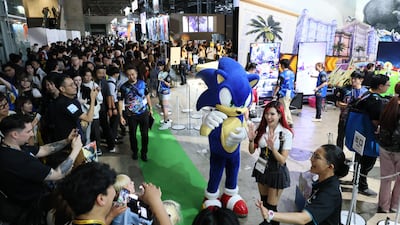

Tokyo Game Show has always been a place to look ahead.
For three decades, the event has brought together the companies making games, the people selling them and the players waiting to see what comes next. The 2026 event, which opened at Makuhari Messe in Chiba on Thursday, is its biggest yet.
The show has expanded to five days for the first time, with two business days followed by three days open to the public. Organisers announced 759 exhibitors from 51 countries and regions across almost 4,000 booths.

Some of the biggest publishers in the industry, including Sony Interactive Entertainment, Capcom, Square Enix, Sega and Atlus, Konami and Bandai Namco, have converged on Tokyo with games stretching from releases only days away to projects that will help shape 2027.
At the PlayStation booth, visitors can play some of the most anticipated games currently announced for the PS5, including Monster Hunter Wilds: Ascendance, Final Fantasy VII Revelation, Marvel's Wolverine and Ace Combat 8: Wings of Theve.
Then there is Grand Theft Auto 6. Rockstar Games' next open-world epic is not playable at Tokyo Game Show, but its pull on the industry is difficult to ignore. PlayStation has dedicated a theatre to the game, showing an extended presentation before its release later this year.

It is a striking amount of space to give to a third-party release, but also an acknowledgement of what is likely to be one of the defining launches of 2026.
Elsewhere, Sega and Atlus have one of the busiest line-ups at the event.
Persona 4 Revival is playable ahead of its release, while Sega is also presenting Stranger Than Heaven alongside the return of Crazy Taxi and a wider slate ranging from Sonic to Total War: Warhammer 40,000.
Remedy Entertainment's Control Resonant is another notable playable title. The follow-up to 2019's Control arrives digitally on September 24 for PS5, Xbox Series X/S and PC, making Tokyo one of the final opportunities for players to try it before launch.
Xbox, meanwhile, arrives during its 25th anniversary year in a position that looks considerably different from the traditional console battle of previous generations.
Microsoft is showing Minecraft Dungeons II, while Call of Duty: Modern Warfare 4's multiplayer is playable through partner Happinet ahead of its release. Its wider strategy increasingly stretches beyond Xbox hardware, with more of its games appearing across consoles, PC and other platforms.
Nintendo does not have a public exhibition booth at TGS, but its presence is still felt through games being made for the Switch 2 by other publishers.

The console has sold more than 23 million units worldwide since launching last year, while Nintendo has continued to attract stronger third-party support without being drawn too heavily into the traditional Sony-Microsoft contest.
For Sony, the picture is more complicated. PlayStation remains one of the industry's most powerful brands, and its Tokyo booth contains some formidable games. Yet 2026 has also brought higher hardware prices, questions over the strength of its first-party pipeline and the announcement that new PlayStation releases will eventually move away from physical discs.
The industry is becoming less defined by rigid platform boundaries. Games are moving more freely between hardware; console manufacturers are building wider ecosystems around their machines; and digital distribution continues to grow.
Away from the major announcements, Tokyo Game Show also has its own culture.
Across the halls, booths compete for attention with elaborate displays, playable demos and giveaways. Fans move around carrying branded bags, stickers and commemorative posters, with some items becoming sought-after souvenirs in their own right.

The show is also becoming a lot more international. The UAE is part of that shift. Abu Dhabi publisher and developer Red Dunes Games has brought nine titles to Tokyo, including Zozo and the Lost Dreams, Port of Jumanah and Nightmare Circus.
Pakistan is also making a notable appearance this year through the Tech Destination Pakistan pavilion, which brings together a group of Pakistani game companies with support from the Japan International Co-operation Agency.
The pavilion has been set up in part to connect Pakistani studios with Japanese companies, showing how TGS is becoming an important meeting point for gaming industries beyond the traditional centres of Japan, North America and Europe.
Tokyo Game Show remains deeply rooted in Japan's gaming culture, but the 2026 edition points to a broader future: more games crossing hardware, more publishers emerging from new markets, and an industry which is becoming more focused on where players are, rather than which box sits under their televisions.

