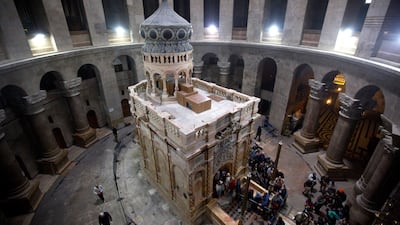

Centuries of war, fire, earthquakes and renovations have left Jerusalem’s Church of the Holy Sepulchre in a spectacular but chaotic state, a hodgepodge of styles reflecting the many communities that stake a claim to the site.
In recent years, major work has taken place to restore and excavate parts of the building. That followed a sudden Israeli assessment a decade ago that found the church’s most important structure – the chamber known as the Edicule, said to house the burial site of Jesus – was in a dangerous state.
For a few hours, the chamber was emptied. The Greek Patriarch protested against at the lack of warning.

The restoration work has, however, resulted in remarkable findings about early Christianity.
The Bible tells Christians where Jesus was buried and, they believe, resurrected. The Gospel of John says the tomb was in a "garden", an account that may have received scientific support after Italian archaeologists presented botanical and pollen evidence found during a dig. The remains of grape vines and olive trees were found in a floor section next to the Edicule.
“As archaeologists, we can say that this clear proof of agriculture near the venerated tomb and in the area of Golgotha during the time of Jesus makes the area compatible with the Gospel narrative, especially John,” Father Amedeo Ricco, one of the archaeologists who excavated the church, told The National.

More findings could now be on the way. Last week, church leaders involved in the project gathered in Jerusalem for an update on the research and restoration phase, now that the archaeological digs have concluded.
A first volume on the project, containing more than 500 pages of articles, maps and images, was shown to representatives of the churches involved. More volumes of the Hagia Polis Project are expected as researchers comb through their results and scholars review the findings.
“It’s the biggest and most invasive project that took place in the church since the end of the Ottoman period,” said Father Athanasius Macora, secretary of the Status Quo for the Custody of the Holy Land, an order of Franciscan friars that looks after Christian sites in the area.
The Status Quo is a pact dating back to 1852 that governs the often tense management of the Holy Sepulchre, where different denominations and communities have a history of quarrelling, even over seemingly minor details.
Like the church that houses it, the area that is believed to be the site of Jesus’s burial has taken many forms and seen much drama. For almost two centuries, it was covered by pagan temples, an attempt by the Roman emperor Hadrian to erase the memory of the site. Other setbacks included a fire lit by Persian troops in 614, the complete destruction of the church in 1009 by the Fatimid caliph Al Hakim, and another major fire in 1809.
The decision to go ahead with major renovations was made in 2019, after repairs were made to the Edicule two years earlier. Previous attempts at restoration were often compromised by infighting.
“The archaeology was very slow because of Covid-19 and the Gaza war. There was a lot of stopping and starting. There was an advantage at least in that there weren’t any pilgrims, so it was easy for the crew to work when they could work,” Father Athanasius added. “There were also cases where communities inside the church had to cancel their liturgies, but we tried to keep a regular prayer service going.”

In a place where fights have broken out over priests moving chairs and sweeping contested areas, it was a major achievement to agree on a project that interrupted the habits of Christian communities in such a profound way. In normal times, the church is the site of a constant stream of services and liturgies, day and night, which require continuing, and sometimes fraught, management.
The results seen today from the decision to co-operate are now being hailed as an example of what can be achieved when communities choose to work together.
Father Francesco Patton, the most senior member of the Custody of the Holy Land, said the co-operation between the three major communities in the Holy Sepulchre – Catholics, Greek Orthodox and Armenian Orthodox – “holds not merely archaeological, historical, or artistic value, but above all ecclesial and ecumenical significance”.
“It demonstrates that Jerusalem’s Christians can collaborate and that the Churches of Jerusalem – through centuries of coexistence at the Holy Sepulchre and ceaseless daily worship – are far closer and more united than the world might assume.”

