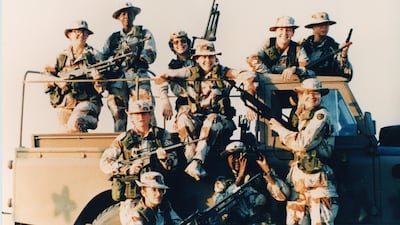

For more than six decades, since before the UAE’s founding, thousands of western veterans have served alongside Emirati forces, helping build a formidable military and producing a force regarded as one of the region’s most capable.
The UAE has a tradition of hiring residents to train and work alongside its own military personnel. Pakistan has long been a handy source of expertise but western military experts have been stationed alongside Emirati forces for just as long.
Over the decades, more than 5,000 western military expatriates have served or worked alongside the UAE Armed Forces, with an estimated 80 per cent from the UK or the US, according to a new book. Western Military Expatriates in the Armed Forces of the UAE: History and Impact, 1965–2024, shines a spotlight on these foreign personnel. Written by Dr Athol Yates, an associate professor of international and civil security at Khalifa University in Abu Dhabi, it features case studies from the early days through to the 2020s.
Different culture
Among them is Adrian Raisbeck, 53, a Malawi-born former British Royal Marine who came to the UAE in the early 2000s to analyse maritime security. He found himself operating in a very different cultural environment from the one he was used to.
As with most westerners, he was not part of the formal chain of command, so to become effective he had to develop the influence he could have on others.
“After I’d been there for about eight weeks, I wanted to leave,” Mr Raisbeck, who served as a lieutenant colonel, said. “I couldn’t see how I was going to be able to cross these cultural divides in a way that would see me taking what I’d learnt in the Royal Marines, both culturally and technically, and convey that to an Emirati leadership body that couldn’t really speak English very well and had come from a very different background to me and seemed to prioritise, I think, personal relationships.”
A former senior British military officer working with the UAE military passed him a book by TE Lawrence – Lawrence of Arabia – that emphasised the importance of allowing Arab forces to do things their way.
“That was quite a seminal moment for me and instigated a complete mindset change from my side,” Mr Raisbeck said. “I did a bit more introspecting and decided I was going to build personal relationships with my Emirati colleagues. In order to do that I was going to need language, which meant I was going to have to learn a lot of Arabic.”

Building bridges, forming friendships
He started to do just that and, for months, would step into the offices of Emirati personnel to chat, build relationships and, in turn, create influence.
Mr Raisbeck and other British personnel developed such strong bonds that Emirati officers invited them to socialise at their homes.
“I made good friends in the process and once you’ve broken through that outer exterior, you can have a laugh together,” said Mr Raisbeck, who now runs a social and agricultural enterprise in Malawi. “This meant that when we were getting down to business and advising, we were, I hope, able to be more effective.”
Early on, residents helped “accelerate the development” of the armed forces of what became the UAE, Dr Yates said, and some were commissioned into the chain of command. “Rather than organically grow them, which would’ve taken 20 years, they could do that in a couple of years.”

The roles most western expats have played, he said, are best understood through a business analogy. “The expats are not employed in management, for example, the officer corps, nor in operations, for example, the soldier, but sit outside the organisation like consultants,” he said.
While they have often brought a specific capability that they have passed on to Emirati personnel, the necessity to continuously modernise the military and bring in new capabilities means that there remains a need for residents.
“They are advisers, trainers, system commissioners, maintainers,” Dr Yates said. “They’re not in the normal chain of command, with very few exceptions.” At least five western expats are known to have died while serving, some during air accidents.
However, the “vast majority very much enjoyed” their experiences in the UAE, Dr Yates said, often because they had a degree of autonomy that they did not have before.

A former British Army officer who came to the UAE to train military helicopter pilots said it was important to allow Emirati personnel to develop their own ways of working, rather than trying to replicate the “rigid discipline” he was used to. He added that westerners who did not acknowledge this often struggled.
He said he found working with the UAE Armed Forces “a good learning experience”, in part because it made him question elements of the training he had once received.
Steep learning curve
Darren Boudreau, 56, a former British Royal Marine who came to teach boat operations and skills, said it was important not to be too much of a disciplinarian, as that wasn't effective in what was, for him, a different cultural context.
“We explained to them, ‘We’re here to teach you skills. We’re here to do a job so you can succeed in your job, and get home and feed your families,’” Mr Boudreau said. “That massively changed the landscape for us. All of a sudden they really started working with us.”

He also found that learning to speak the language made a big difference.
One of the most senior military personnel to move to the UAE in recent times was Andrew Pillar, who left the British Royal Marines as a brigadier and, during his time in the UAE from 2002 to 2011, brought over many of his former colleagues from the Marines to run training.
He said it was “a steep learning curve” for many who moved to the Emirates, not least because – echoing others – they often had to realise that what had worked in the British Armed Forces may not be appropriate in the UAE.
To give them authority, even though they were not part of the formal chain of command, gave Brig Pillar, and many others, ranks. He was promoted to major general.
He said some Emirati personnel recognised the value they brought when introducing their ways of operating. “We were involved in every area of the forces,” he said. “There were a lot of Emirati officers reluctant to see us go.”

